

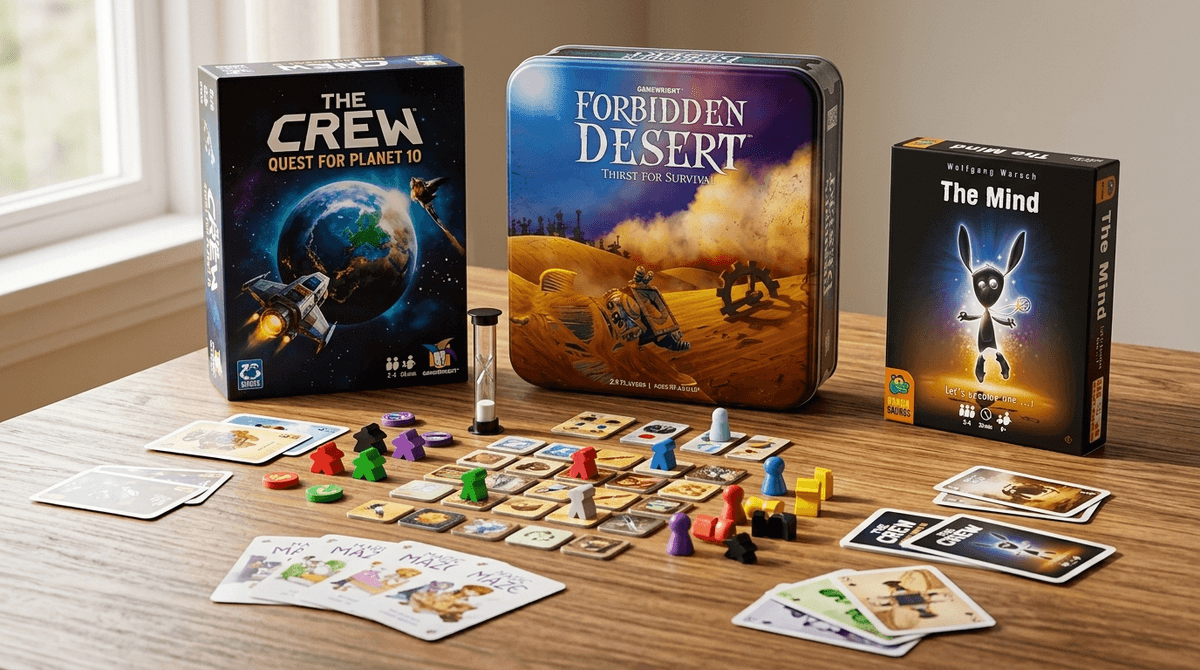
Collaborative board games are the secret weapon for surviving the middle school social minefield because they replace the "me vs. you" friction with "us vs. the board." In an era where every social interaction feels like a high-stakes performance, co-op games force kids to practice delegation, active listening, and collective failure without the "therapy talk" or the sting of a personal loss.
Middle schoolers need low-stakes ways to practice high-stakes social skills. Collaborative games like The Crew and Forbidden Desert build emotional intelligence by requiring players to communicate, manage frustration, and solve puzzles as a team. For the full breakdown of what hits for this age, check out our digital guide for middle school.
Middle school is the era of the performative eye-roll and the accidental insult. It’s also when kids start to retreat into their own silos because being "wrong" in front of peers feels fatal. Collaborative games flip that script. When the game is the antagonist, the social pressure shifts from competing with friends to supporting them.
If the team loses in Pandemic, nobody is the loser; the group just has a shared problem to dissect. That’s a massive unlock for social-emotional learning (SEL). It builds the "we’re in this together" muscle that middle schoolers desperately need but rarely get to flex.
The best co-op games for building empathy aren't the ones where you can talk freely—they’re the ones that restrict communication. These games force kids to pay attention to non-verbal cues and anticipate what their teammates are thinking.
This is a "trick-taking" game (like Hearts or Spades) where you can’t show your hand or tell people what to play. You have to complete specific missions together using very limited signals. It’s brilliant for middle schoolers because it rewards silence and observation. They have to ask: "Why did they play that card now? What are they trying to tell me?" It’s social perspective-taking disguised as a space mission.
The Mind is less of a game and more of a collective meditation. Players have to lay down cards in ascending order without speaking. The only way to win is to get in sync with the "rhythm" of the group. It sounds woo-woo, but for a 12-year-old who usually communicates in grunts, it’s a masterclass in non-verbal awareness.
Middle schoolers are famously "big" with their emotions. Co-op games provide a safe container to practice self-regulation when things go south.
Imagine a heist in a shopping mall where everyone controls a different direction (North, South, East, West), but you can’t talk. Also, there’s a timer. Magic Maze is chaotic and hilarious, but it quickly reveals who handles stress well and who starts frantically tapping the "Do Something!" pawn in everyone's face. It’s the perfect setup to talk about how we act when we’re frustrated.
Your flying machine crashed, the sun is beating down, and the sand is burying you. Forbidden Desert is a classic for a reason: it’s hard. You will probably lose the first few times. This is the "resilience" tier of gaming. It forces the group to manage resources (water) and prioritize actions under threat. It’s an exercise in collective decision-making where "I want to do this" has to take a backseat to "The team needs this."
The biggest friction point in co-op gaming is the "Alpha Player"—the kid who takes over and tells everyone else what to do on their turn. In SEL terms, this is a lack of social awareness.
If you see this happening, don't shut it down with a lecture. Instead, try these moves:
- Switch to a "Hidden Info" game: If the Alpha Player can't see everyone's cards (like in The Crew), they literally can't quarterback the whole game.
- Assign a "Consultant" role: Make it a rule that the player whose turn it is has the final say, but they must ask one other person for advice before acting.
- Go Real-Time: Games with timers (like Magic Maze or 5-Minute Dungeon) move too fast for one person to control everything. The chaos forces delegation.
The magic isn't just in the gameplay; it's in the "post-game show." After a session, ask one specific question: "What was the moment we almost lost it, and how did we pull back?"
Don't make it a "teaching moment" (cringe). Just treat it like a sports highlight reel. Analyzing the strategy naturally leads to analyzing the communication. If they’re into the strategy side of things, they might also enjoy books about game design to see how these "engines" are built to manipulate player behavior.
Q: What is the best co-op board game for a 12-year-old? The Crew: Quest for Planet 10 is the winner here. It’s portable, the missions are short (5-10 minutes), and it’s genuinely challenging for adults too, so it doesn't feel like a "kids' game."
Q: Are collaborative games better than competitive ones for social skills? They aren't "better," but they build different muscles. Competitive games build sportsmanship (how to win/lose gracefully); collaborative games build teamwork and empathy (how to solve problems together). Middle schoolers usually have plenty of the former and not enough of the latter.
Q: How do I stop one kid from bossing everyone else around during the game? This is "quarterbacking." The best fix is to play games with restricted communication or hidden information. If a kid can't see their teammate's cards, they can't tell them exactly what to do. Try The Mind or Hanabi to break the habit.
Q: Is Dungeons & Dragons considered a collaborative board game? Technically it's a tabletop RPG, but it’s the ultimate collaborative experience. If your kid has the attention span for a 3-hour session, D&D is the gold standard for SEL because it’s entirely built on communication and creative problem-solving. (Browse more tabletop and board game picks to find the right on-ramp.)
Board games aren't just for rainy days; they’re a low-stakes simulator for real-world social dynamics. By picking games that reward collective thinking over individual dominance, you’re giving your middle schooler a way to practice being a decent human being without it feeling like work.
- For more age-specific recommendations, see our digital guide for middle school.
- For more ways to fill time off the screen, browse our screen-free activities pillar.
- Get a specific game recommendation
