

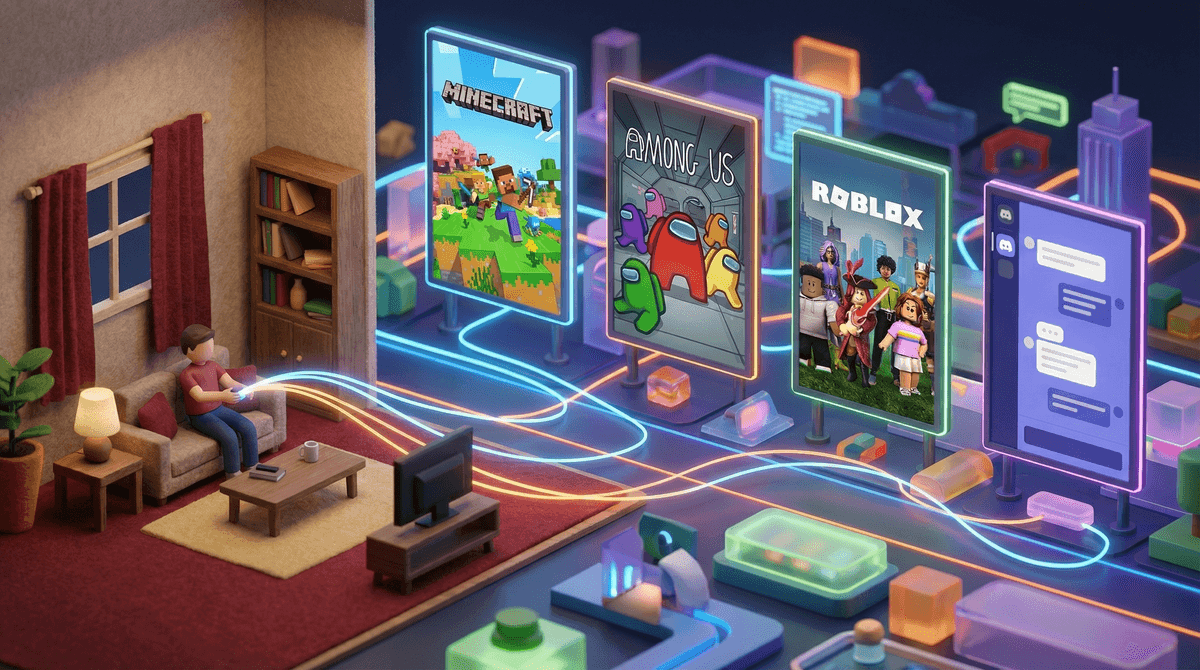
Collaboration games are exactly what they sound like: digital experiences where kids need to work together to succeed. We're talking about games like Minecraft (when played cooperatively), Among Us, Roblox experiences that require teamwork, Fortnite team modes, and apps like Discord that kids use to coordinate their gameplay.
The pitch to parents is compelling: your kid isn't just playing games, they're learning communication skills, problem-solving, and teamwork. And honestly? Sometimes that's actually true. But sometimes it's also just marketing speak for "your kid is yelling at strangers on the internet."
The real question isn't whether these games can teach collaboration—it's whether they're actually doing that for your kid, in your home, with their particular friend group.
Kids are drawn to collaboration games for reasons that have nothing to do with building their resume for future team-based careers:
They get to hang out with friends. For many kids, especially post-pandemic, these games are the digital equivalent of playing at the park. They're not logging on to practice conflict resolution—they're logging on because that's where their friends are.
They feel competent together. There's something genuinely satisfying about coordinating a raid, building something complex in Minecraft, or successfully deceiving your friends in Among Us. Kids get to experience shared achievement, which feels good.
The social stakes are real. Unlike forced group projects at school, kids actually care about these collaborations. They're motivated to figure things out, communicate clearly, and not let their squad down.
They have actual autonomy. In collaboration games, kids make real decisions with real consequences (even if those consequences are just "we lost the match"). That's powerful stuff when so much of childhood is being told what to do.
Not all collaboration is created equal. Here's what you're actually looking at:
The Good Stuff (Ages 8+)
Games like Minecraft in creative mode, where kids are genuinely planning, building, and problem-solving together. Portal 2 co-op mode is brilliant for this—it literally requires two players to think through puzzles together. Overcooked is chaotic kitchen coordination that actually teaches task delegation (and also might cause some yelling, but the fun kind).
For younger kids (6-10), Animal Crossing: New Horizons lets them visit each other's islands and trade items without much pressure. Pico Park is designed specifically for cooperative puzzle-solving.
The Middle Ground (Ages 10+)
Roblox is complicated because there are thousands of experiences, and some genuinely require teamwork while others are just... chaos with other people nearby. Fortnite team modes can teach coordination, but they can also teach your kid some colorful language from randos with headsets.
Among Us is interesting—it requires communication and deduction, but it's also built around deception, which some kids handle better than others.
The "Let's Be Honest" Category (Ages 13+)
Games like Valorant, Apex Legends, or League of Legends absolutely require teamwork. They're also incredibly competitive, have steep learning curves, and come with communities that can be... let's say "character building" in the worst way possible. Learn more about toxic gaming communities .
.
Here's what matters more than whether the game has a "collaboration" tag:
Who are they playing with? Playing with IRL friends or vetted online friends is completely different from playing with random internet strangers. If your 9-year-old is in voice chat with random people, that's not collaboration practice—that's a safety concern. Here's how to manage online gaming safety.
What's the emotional aftermath? Does your kid come away from these sessions energized and happy? Or are they frustrated, angry, or feeling bad about themselves? Collaboration should generally feel good (even when you lose).
Is there actual communication happening? Are they strategizing, planning, negotiating roles? Or is one kid barking orders while others follow? Real collaboration involves back-and-forth.
What's the time investment? Some collaboration games require 30-60 minute sessions minimum. That's fine occasionally, but if your kid is doing this daily, you're looking at significant screen time that might be crowding out other activities.
Ages 6-8: Stick with games designed for this age group where collaboration is built-in and low-stakes. Pico Park, Kirby and the Forgotten Land co-op, or LEGO games are solid. Keep it to playing with family or friends they know IRL.
Ages 8-10: This is when Minecraft and Roblox really take off. Private servers with known friends only. Voice chat should be limited and monitored. Check out Minecraft parental controls.
Ages 10-12: They can handle more complex collaboration, but you still want to know who they're playing with. This is the age where they'll push for more freedom, but random voice chat is still a hard no for most families. Among Us is huge here—just know it involves lying and deception as core mechanics.
Ages 13+: They're going to want to play the competitive team games their friends are playing. This is where you need to have real conversations about online behavior, toxicity, and when to mute/block people. The collaboration can be genuine, but so can the exposure to some really unpleasant internet culture.
Collaboration games aren't automatically teaching teamwork any more than playing Monopoly automatically teaches real estate investment. The learning comes from the context, the reflection, and the people involved.
The best-case scenario? Your kid is genuinely problem-solving with friends they care about, learning to communicate under pressure, negotiating roles, and experiencing the satisfaction of shared achievement. That's legitimately valuable.
The worst-case scenario? Your kid is spending hours in toxic environments, getting yelled at by strangers, or just passively following along while someone else calls the shots.
Most families land somewhere in the middle: some good social connection, some genuine collaboration, some questionable language learned, and a lot of time spent coordinating who's getting on when.
Try it yourself. Seriously, play a few rounds of whatever your kid is into. You'll understand the appeal (or lack thereof) immediately.
Set up a "collaboration audit." For one week, ask your kid to tell you one thing they collaborated on each gaming session. If they can't articulate it, that's useful information.
Prioritize IRL friends. If the collaboration is happening with kids they know from school or activities, that's a different equation than random internet people.
Have an exit strategy. Make sure your kid knows how to leave a toxic situation, mute people, or shut down a game that's gone south.
Consider alternatives. If you're skeptical about the screen time but want to encourage collaboration, board games like Pandemic, Forbidden Island, or Horrified offer similar skills without the screens. Ticket to Ride and Catan involve negotiation and planning, too.
The goal isn't to determine whether collaboration games are "good" or "bad"—it's to figure out whether they're working for your specific kid in your specific family. And that's going to require some actual investigation rather than just accepting the marketing promises at face value.