

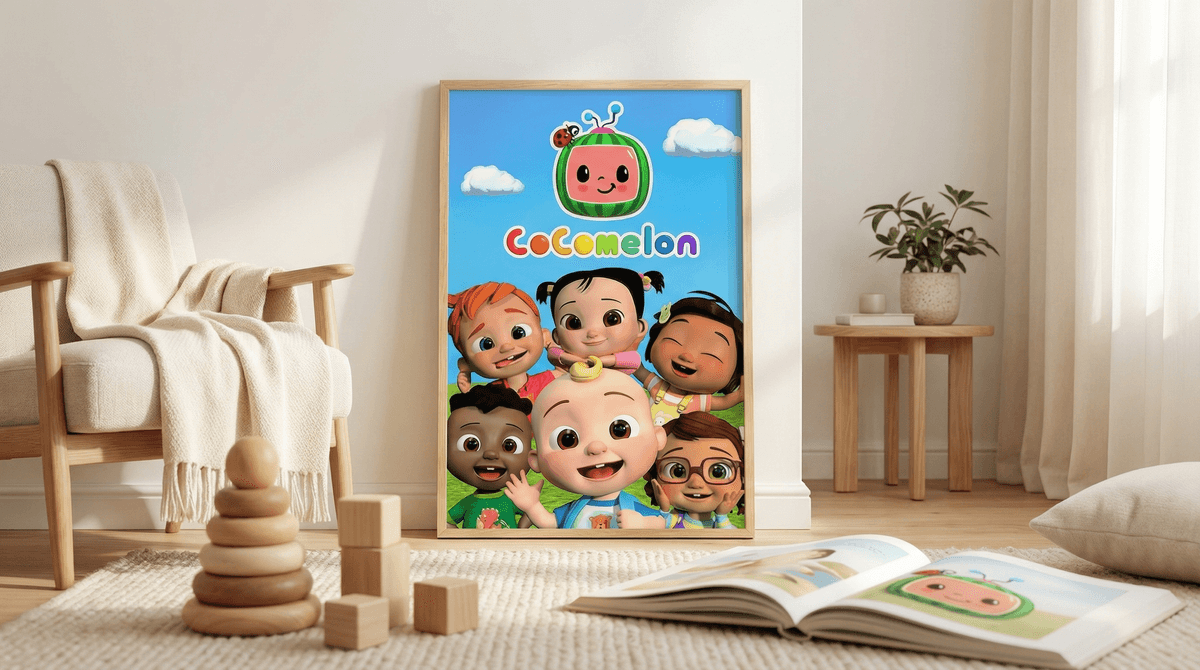
Is Cocomelon Hurting Your Baby's Attention Span?
TL;DR: The research on Cocomelon specifically is limited, but studies on fast-paced, hyperstimulating content suggest it can impact attention and self-regulation in young kids. The concern isn't that one episode will break your child's brain — it's about what happens when this becomes the default entertainment. If your toddler is already deep in the Cocomelon zone, don't panic. There are concrete steps you can take, and plenty of better alternatives that won't make you want to throw your TV out the window.
Cocomelon has become the default toddler content for millions of families. It's colorful, it's catchy, and holy hell does it buy you 10 minutes of peace. But parents have noticed something: their kids seem different after watching it. More demanding. Less able to play independently. Some describe it as their toddler being "in a trance" or "zoned out."
The show's pace is relentless. Scene changes happen every 2-4 seconds. Colors are supersaturated. Music is constant. Faces are exaggerated. It's engineered to capture and hold attention through sheer sensory overload.
Here's what we know from studies on fast-paced media and young children:
The 2011 University of Virginia study looked at 4-year-olds who watched just 9 minutes of SpongeBob (another fast-paced show with scene changes every 11 seconds). Immediately after, these kids performed significantly worse on executive function tasks compared to kids who watched a slower-paced show or drew pictures. Executive function includes things like focus, self-control, and working memory — basically the skills that help kids regulate themselves.
A 2019 study in JAMA Pediatrics found that increased screen time in babies and toddlers was associated with lower scores on developmental screening tests at ages 2 and 3, particularly in communication and problem-solving skills.
Research on "overstimulation" suggests that when young brains are constantly hit with rapid changes and intense stimuli, they can become habituated to that level of stimulation. Real life — where a block is just a block and a conversation happens at normal speed — starts to feel boring by comparison.
The American Academy of Pediatrics recommends no screen time for children under 18 months (except video chatting) and no more than one hour per day of high-quality programming for ages 2-5. They emphasize co-viewing and choosing slower-paced, educational content.
The first three years are when the brain is developing at its fastest rate. Neural connections are being formed based on what kids experience. When a huge chunk of that experience is hyperstimulating content, it can shape how their attention systems develop.
Babies and toddlers learn best through:
- Back-and-forth interaction with caregivers
- Hands-on exploration of their environment
- Unstructured play that they direct themselves
- Slower-paced experiences that let them process what's happening
Cocomelon provides none of these. It's passive, fast, and designed to hold attention through stimulation rather than engagement.
The concern isn't that your 18-month-old watching Cocomelon will definitely have attention problems. It's that when this becomes the primary form of entertainment, it crowds out the kinds of experiences that actually build attention, self-regulation, and learning skills.
Parents report:
- Kids becoming "addicted" or having meltdowns when Cocomelon is turned off
- Difficulty transitioning to other activities after watching
- Decreased interest in books, toys, or independent play
- More whining and demanding behavior
- The "zoned out" look while watching
These aren't scientific studies, but they're consistent patterns that align with what research predicts about hyperstimulating content.
Of course your kid loves it. It's designed to be loved. The rapid pace, bright colors, and constant stimulation trigger dopamine responses. This is the toddler equivalent of slot machines.
But "my kid loves it" isn't a great metric for what's good for them. Kids also love eating only goldfish crackers and never going to bed.
If you need screen time (and look, sometimes you do), here are shows that are slower-paced and actually educational:
For Babies and Young Toddlers (18 months - 2 years)
If you're going to use screens at this age despite AAP recommendations, these are the least-bad options:
-
Bluey — Slower pace, real emotional content, models great parenting and imaginative play. Ages 2+, but even younger kids can watch without the overstimulation.
-
Daniel Tiger's Neighborhood — Based on Mister Rogers, focuses on social-emotional learning with a gentle pace. Ages 2-4.
-
Sesame Street — Classic for a reason. Educational, diverse, and while it has energy, it's not hyperstimulating. Ages 2+.
For Older Toddlers and Preschoolers (3-5 years)
-
Puffin Rock — Gentle nature show about a puffin family. Narrated by Chris O'Dowd. Slow, sweet, beautiful. Ages 2-5.
-
Tumble Leaf — Amazon original about a fox exploring science concepts. Slow, thoughtful, gorgeous stop-motion animation. Ages 3-6.
-
Elinor Wonders Why — PBS show about a bunny who asks questions about nature and science. Encourages curiosity and observation. Ages 3-5.
-
Octonauts — Adventure show about underwater creatures. Has more action but isn't hyperstimulating, and it's genuinely educational about marine biology. Ages 3-6.
For more options, check out alternatives to Cocomelon.
If your kid is already in deep with Cocomelon, going cold turkey might result in epic meltdowns. Here's a more gradual approach:
1. Start mixing in other shows
Introduce one of the alternatives above alongside Cocomelon. "We're going to watch one Bluey and one Cocomelon."
2. Gradually shift the ratio
Over a week or two, increase the better content and decrease Cocomelon. Your kid might resist at first, but stick with it.
3. Reduce overall screen time
This is the hard part, but it matters. Start building in screen-free activities that are engaging:
- Sensory bins (rice, water, kinetic sand)
- Music and movement
- Simple art supplies (crayons, stickers, play-doh)
- Outdoor time
- Audio content like podcasts for kids (yes, they exist)
4. Expect an adjustment period
Your kid will probably be more whiny and bored for a few days. This is normal. Their brain is recalibrating to normal levels of stimulation. Push through it.
5. Co-view when possible
When they do watch something, try to watch with them and talk about what's happening. This makes screen time more interactive and educational.
Based on AAP recommendations and current research:
Under 18 months: No screen time except video chatting with family.
18-24 months: If you introduce screens, choose high-quality programming and watch together. Keep it minimal.
2-5 years: Maximum 1 hour per day of high-quality programming. Co-view when possible. Avoid screens during meals and before bed.
Reality check: These are guidelines, not laws. If you're using more screen time than this, you're not a bad parent. But it's worth being honest about how much is happening and whether it's serving your family.
Cocomelon bills itself as educational — it teaches colors, numbers, songs. But research shows that young children learn best from real-world interaction, not screens. A toddler will learn more from you singing "Twinkle Twinkle Little Star" together than from watching it on a screen.
When screen time does happen, educational content is better than non-educational content. But it's not a substitute for actual learning experiences.
Let's be real: parents are using Cocomelon because parenting young children is exhausting and relentless. Sometimes you need to make dinner. Sometimes you need to answer work emails. Sometimes you just need 15 minutes where no one is touching you or asking for something.
This isn't about shaming anyone for using screens. It's about making informed choices and understanding the tradeoffs.
If Cocomelon is happening occasionally because you need a break, that's different from it being on for hours every day. Context matters.
The effects aren't permanent. If your kid has been watching a lot of Cocomelon, reducing screen time and increasing other activities can help. Young brains are incredibly plastic.
You might see an improvement quickly. Many parents report that within a week of reducing hyperstimulating content, their kids are more engaged, less whiny, and better at independent play.
It's not just Cocomelon. The same concerns apply to other hyperstimulating content: Blippi (though he's gotten slightly better), Ms. Rachel (who is actually much slower-paced and better), and various YouTube Kids content that's designed to game the algorithm rather than serve kids.
Screen time is a tool, not a babysitter. When it's used intentionally and in moderation with quality content, it's fine. When it becomes the default solution for boredom, meals, car rides, and every transition, that's when problems emerge.
Cocomelon probably isn't going to cause permanent damage to your child. But it's also not doing them any favors. The research on fast-paced, hyperstimulating content suggests it can impact attention, self-regulation, and development — especially when it's a daily habit.
The good news: there are plenty of better alternatives that won't make you lose your mind, and reducing screen time in favor of other activities can make a real difference quickly.
You don't have to be perfect. You don't have to eliminate all screens. But being intentional about what your kid watches and how much matters more than most parents realize.
-
Track current usage — Be honest about how much Cocomelon is actually happening. Use Screenwise to understand your family's habits in context.
-
Pick 2-3 better alternatives from the list above and introduce them.
-
Start reducing overall screen time by 15 minutes per day and filling that time with other activities.
-
Give it two weeks and see if you notice a difference in your child's behavior and attention.
-
If you want to dig deeper into screen time research and guidelines, check out screen time recommendations by age.
The goal isn't perfection. It's being intentional about the digital diet you're feeding your kid's developing brain.