

TL;DR
AI is the new "calculator" moment for education. While the panic is mostly about kids using ChatGPT to ghostwrite essays, the real power lies in using it as a personalized tutor, a brainstorming partner, and a coding assistant.
Top Tools to Check Out:
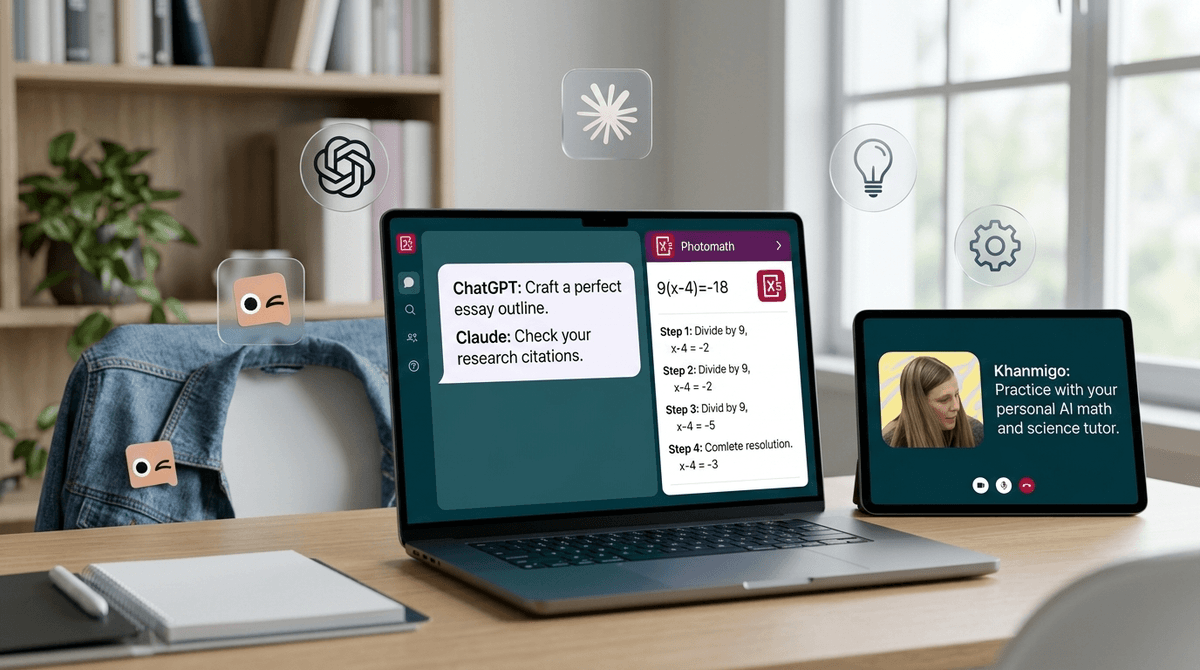
- Best for Tutoring: Khanmigo (The "gold standard" for safe, guided AI learning)
- Best for Brainstorming: Claude (Often "smarter" and more natural-sounding than ChatGPT)
- Best for Math: Photomath (But use it for the steps, not just the answer!)
- Best for Creativity: Canva Magic Studio
If you’ve been living under a rock (or just busy trying to figure out why your kid is suddenly obsessed with "Skibidi Toilet"), Generative AI is tech that can create brand-new content—text, images, code, even music—based on simple prompts.
Tools like ChatGPT aren't search engines like Google. They don't just find information; they predict the next most likely word in a sentence. This makes them incredibly "human-like" but also prone to "hallucinating" (a fancy tech term for "making stuff up with total confidence").
Let’s be real: some kids are definitely using it to bypass a 5-paragraph essay on The Great Gatsby. But for most students, the appeal is the death of the blank page.
Starting a project is the hardest part. AI lowers the barrier to entry. It’s a 24/7 "study buddy" that doesn’t get annoyed when you ask the same question five times. In our Screenwise community data, we’re seeing that while only about 15% of middle schoolers use AI regularly, that number jumps to over 50% by junior year of high school. They aren't just using it to "skip" work; they're using it to manage the crushing workload of the modern "locked in" student.
If you’re worried about AI just giving your kid the answers, this is your answer. Developed by Khan Academy, Khanmigo is designed not to give the answer. Instead, it acts like a Socratic tutor. If a student asks, "What’s the answer to this math problem?" Khanmigo says, "I can't do that, but let’s look at the first step together. What do you think we should do with this exponent?" It’s the most "intentional parent" approved AI on the market.
While everyone talks about ChatGPT, many students find Claude (by Anthropic) to be a better writer. It feels less "robotic" and is excellent at summarizing long PDFs or helping a student find a specific "voice" for a creative writing assignment.
This isn't just a spell-checker anymore. Grammarly now has "GrammarlyGO," which helps students rewrite sentences for clarity or tone. It’s a great "middle ground" tool for students who need help with the mechanics of writing without having the AI do the thinking for them.
Look, we have to talk about this one. Your kid probably already has it. You point the camera at a math problem, and it solves it. It can be a tool for "cheating," or it can be a tool for "unstucking." The "Pro" version explains the why behind every step. If your kid is using it to just copy answers, it’s "mid" at best. If they’re using it to understand a concept their teacher flew through in class, it’s a lifesaver.
For the visual learners and the "I have a presentation due tomorrow" crowd, Canva has integrated AI that can turn a text prompt into a full slide deck or a unique image. It’s teaching kids "prompt engineering" (the art of telling an AI exactly what you want) which is actually a legit 21st-century job skill.
Elementary School (Ages 5-10)
The Verdict: Keep it minimal. At this age, kids need to learn how to form their own thoughts and sentences. Using AI now is like using a calculator before you know how to add 2+2. If they are curious, let them play with Scratch to learn the logic of coding, which is the foundation of how these AIs work anyway.
Middle School (Ages 11-13)
The Verdict: Supervised Collaboration. This is where the "Ohio" memes and weird internet culture start to peak. It’s a good time to introduce AI as a brainstorming partner. If they have a science fair project, they can ask ChatGPT for "10 unique ideas for a 7th-grade project about renewable energy." The rule should be: AI generates the ideas, the human does the execution.
High School (Ages 14-18)
The Verdict: The Research Assistant. By high school, the cat is out of the bag. They should be learning how to use these tools ethically. This means using AI to outline an essay, explain a complex physics concept like they're five, or find bugs in their code for AP Computer Science.
Learn more about how to set boundaries for AI use in high school
1. The "Hallucination" Factor
AI is a confident liar. It will cite books that don't exist and historical events that never happened. Teach your kids to fact-check everything. If an AI says a fact, they need to find a secondary source (like a library database or a reputable news site) to back it up.
2. Privacy is Non-Existent
Whatever your kid types into a public AI tool is used to train that AI. They should never put in their full name, address, school name, or any deeply personal "dear diary" style content.
3. The "Cheating" Conversation
Most schools are still catching up. A "zero tolerance" policy is common, but often unenforceable. The best way to talk about it is through the lens of integrity. Ask them: "If you use AI for this, did you actually learn the material? Will you be able to pass the test when the AI isn't there to help you?"
Instead of a lecture, try a "Co-Pilot" session. Sit down with them and a tool like Claude.
- Ask: "Hey, I heard people are using this to help with homework. Show me how you'd use it to get started on that history project."
- Observe: Are they asking it to write the whole thing? Or are they asking for an outline?
- Guide: "That's a great outline. Now, let's see if we can find real sources to prove those points, because we know the AI might be making things up."
AI isn't going anywhere. It’s not a fad like the "fidget spinner" of 2017. It’s a fundamental shift in how we interact with information.
Our job as intentional parents isn't to ban it (which usually just makes them better at hiding it), but to mentor them through it. We want to raise kids who are AI-literate, not just AI-dependent. We want them to be the ones directing the tool, not the ones being replaced by it.
- Check your school's handbook. See what their specific AI policy is so your kid doesn't get blindsided by a "0" on a paper.
- Try a "Socratic" tool. Sign up for Khanmigo and see how it feels compared to a standard chatbot.
- Audit their "App Library." Check for apps like Photomath or Question.AI and have an honest talk about how they're being used.