

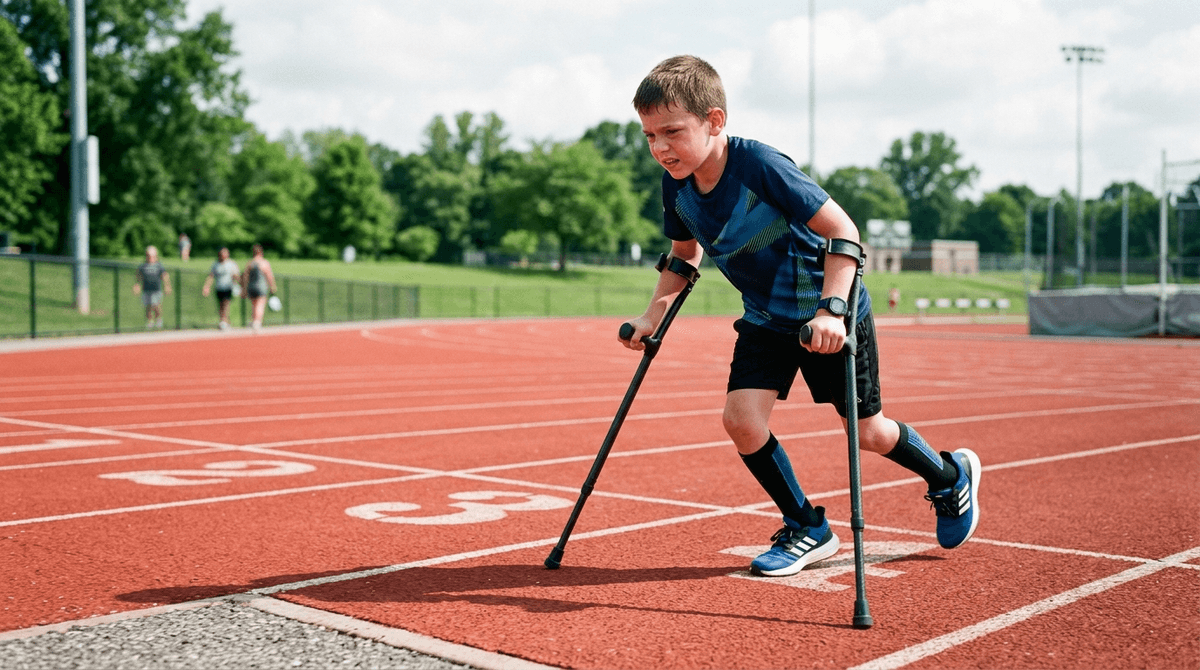

Young kids with cerebral palsy hit recommended daily activity targets at surprisingly high rates, but their movement levels drop off sharply once they hit adolescence. A child's elementary school years represent a critical window for physical endurance before teenage sedentary habits take hold.
Physical endurance and daily movement peak between ages 5 and 12 for children with cerebral palsy, after which activity drops steeply during the teenage years.
A cerebral palsy diagnosis often sparks worry that an active childhood is out of reach, but the data tells a much more encouraging story for early and middle childhood. Most young children with motor disabilities are moving enough to meet global health benchmarks.
The real challenge emerges around puberty. Knowing that stamina naturally peaks before age 12 lets you treat elementary school as a foundational training window—banking endurance and physical confidence before adolescent social changes and school demands make movement harder to sustain.
A survey of 456 Brazilian children and teens with cerebral palsy across all motor function levels revealed a clear age divide in daily activity:
- Young kids move plenty: Roughly two-thirds of children aged 5 to 12 (66%) and six in ten children under five (60%) hit World Health Organization targets for daily physical activity.
- Teens fall off a cliff: A majority of adolescents aged 13 to 18 failed to meet those same basic activity benchmarks.
- Stamina drops with age: Physical endurance scores peaked at 3.0 during middle childhood before falling to 2.5 in the teenage cohort.
- Mobility status widens the gap: Kids who could walk independently logged significantly higher activity levels and far less sedentary screen or sitting time than those using wheelchairs or mobility devices.
The steep teenage decline is not just about muscle fatigue or physical limitations—it reflects a social and systemic cliff.
Elementary schools and pediatric programs provide recess, structured physical therapy, and play-based recreation. Once kids transition to middle and high school, unstructured play disappears, competitive sports sideline athletes with disabilities, and adaptive community programs become scarce. Without an explicit replacement plan, passive sitting fills the void.
These activity levels were reported by parents and teens via questionnaires rather than tracked by objective wearable sensors. People routinely overestimate how much physical activity they actually get, meaning the real numbers may be lower across the board.
The study also evaluated children in Brazil at a single point in time. Climate, local transit, and neighborhood accessibility shape how Brazilian families move, and a cross-sectional snapshot cannot prove that aging itself causes the activity decline.
- If your child is between 5 and 12 years old… Prioritize endurance-building play and recreational sports right now, taking advantage of the developmental window when their stamina and natural motivation are at their highest.
- If your child is nonambulant or uses mobility devices… Audit their daily routine for long stretches of passive sitting, and work with physical therapists to build daily standing-frame intervals or supported movement breaks into their schedule.
- If your child is approaching the middle school transition… Scout out community adaptive sports, wheelchair basketball leagues, or adaptive swim programs early, before they age out of pediatric play routines.
Cerebral palsy does not lock your child into an inactive childhood, but keeping them active requires a deliberate strategy before the teenage drop-off begins.
Romeros ACSF, Souto DO, Magalhães EDD et al. (2026). Physical Activity and Sedentary Behavior Patterns of Brazilian Children and Adolescents With Cerebral Palsy. Pediatric physical therapy : the official publication of the Section on Pediatrics of the American Physical Therapy Association. doi:10.1097/PEP.0000000000001303 — pubmed.ncbi.nlm.nih.gov