

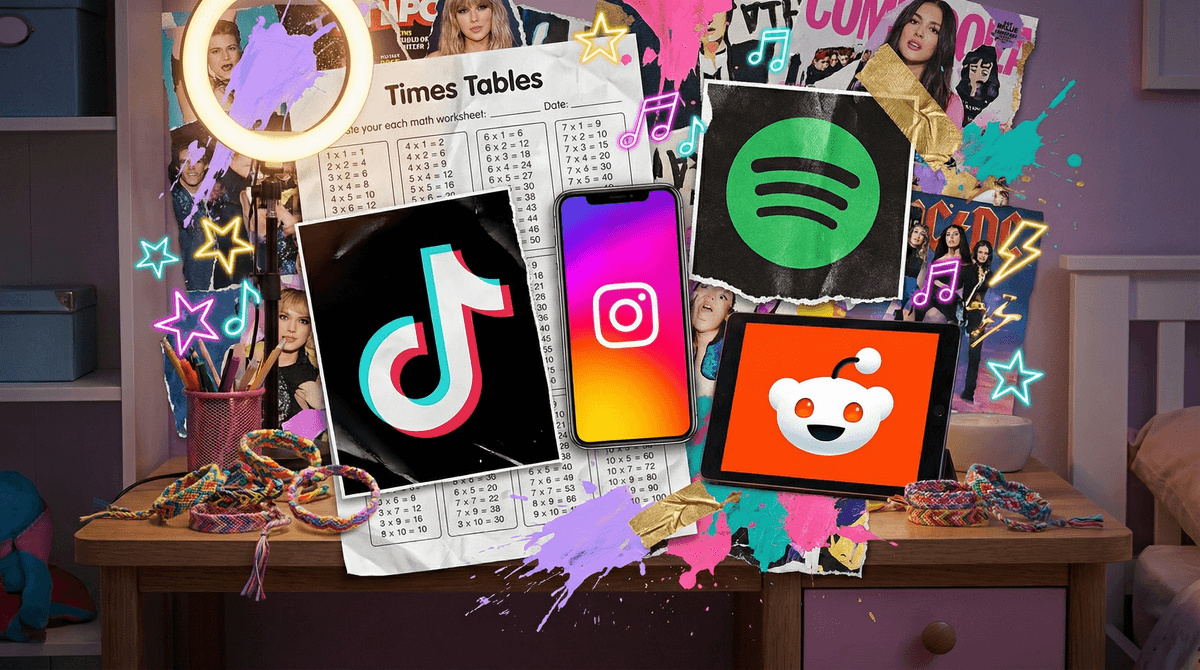
Look, every generation has had their posters on the wall. But today's celebrity obsession hits different. Your kid isn't just listening to Taylor Swift on repeat—they're watching her eat breakfast on TikTok, analyzing her outfit choices on Instagram, tracking her private jet on Reddit, and debating Easter eggs in her lyrics with 47 online strangers at 10 PM on a school night.
Celebrity obsession in kids today isn't just fandom. It's a full-time parasocial relationship, and the algorithm is the world's most enabling best friend.
The difference between "I love this celebrity" and "I'm obsessed with this celebrity" isn't always clear, but you know it when your kid can recite every member of the Sturniolo Triplets' Starbucks orders but can't remember their own locker combination.
Here's the thing: celebrity obsession isn't actually about the celebrity. It's about identity formation, belonging, and control in a world that feels increasingly chaotic to kids.
When your 10-year-old declares themselves a "Swiftie" or your 13-year-old has their entire personality wrapped up in K-pop stan culture, they're not just being fans. They're:
- Finding their tribe - Fandom communities offer instant belonging and shared language
- Practicing identity - "I'm the kind of person who likes THIS" is a safe way to figure out who you are
- Feeling connected - Parasocial relationships feel real because the access feels real (even though it's completely manufactured)
- Exercising agency - Kids can't control much, but they can control their Spotify playlist and their bedroom walls
The algorithm understands this better than we do. Every click, every like, every "OMG DID YOU SEE" comment trains the feed to serve up more. And more. And more.
Not all celebrity obsession is unhealthy. Lots of kids go through intense fandom phases and come out the other side with great memories, concert t-shirts, and maybe some questionable fan fiction they'll laugh about later.
But here are the red flags that it's crossed a line:
It's affecting real life: They're skipping homework to scroll fan accounts. They're losing sleep to watch livestreams. They're melting down when they can't watch the latest video immediately.
It's replacing real relationships: They'd rather talk to online fans than actual friends. Family dinners are interrupted by celebrity news alerts. They're more invested in a stranger's life than their own.
It's financial: They're begging for merch constantly, spending (or stealing) money on fan club memberships, or getting into fights about concert tickets that cost more than a mortgage payment.
It's affecting self-esteem: They're comparing themselves to the celebrity or their lifestyle. They're adopting unhealthy behaviors they see modeled. They're devastated by parasocial "breakups" when celebrities disappoint them.
The content isn't age-appropriate: Your 8-year-old is deep into beauty influencer drama. Your 11-year-old is consuming celebrity gossip that's basically tabloid trash. Your 13-year-old is in stan Twitter wars that would make a lawyer blush.
Here's what makes modern celebrity obsession trickier than the teen magazine era: it feels mutual.
When a celebrity responds to comments, does Q&As, shares "relatable" content about their morning coffee, posts "get ready with me" videos, or creates content that feels like a FaceTime with a friend—kids' brains process this as a real relationship.
But it's not. It's a business model.
Your kid's favorite YouTuber isn't their friend. That influencer doesn't actually care about them personally. The celebrity who posts "I love you guys!" to 10 million followers isn't talking to YOUR kid specifically.
This isn't cynical—it's just reality. And kids need help understanding the difference between actual relationships (mutual, reciprocal, with real people who know them) and parasocial ones (one-sided, curated, with people who are performing a version of themselves for profit).
Ages 5-8: Celebrity interest at this age is usually pretty surface-level—they like a character from a show or a singer from a movie. The bigger risk is YouTube rabbit holes where they're watching endless toy unboxing or Cocomelon compilations. Set clear screen time limits and co-watch when possible. Talk about how the people on screen don't know them personally.
Ages 9-12: This is peak fandom formation age. They're old enough to engage with content deeply but not old enough to fully understand the business behind it. This is when you want to:
- Talk about parasocial relationships explicitly
- Set boundaries around screen time and fan content consumption
- Monitor what communities they're joining (some fan spaces are toxic)
- Help them balance fandom with other interests and relationships
- Discuss how social media accounts are curated, not real life
Ages 13+: Teens are going to have celebrity interests, full stop. The goal isn't to eliminate it but to build critical thinking. They need to understand:
- How algorithms feed obsession
- The difference between admiration and unhealthy attachment
- How celebrity culture can promote unrealistic standards
- The financial incentives behind influencer content
- How to engage with fandom without it becoming their entire identity
The algorithm is not neutral: If your kid watches one video about a celebrity, they'll get 50 more. The platforms WANT obsession because it drives engagement. You're not fighting your kid's willpower—you're fighting a billion-dollar recommendation engine.
Some celebrities are better role models than others: Not all celebrity obsessions are created equal. There's a difference between your kid loving Simone Biles (incredible athlete, mental health advocate) and being obsessed with influencers who promote diet culture, consumerism, or drama for clicks. Learn more about evaluating influencer content .
.
Stan culture can be toxic: Online fan communities can be wonderful, but they can also be brutal. Cyberbullying, harassment campaigns, and parasocial competition are real issues in many fan spaces. If your kid is active in online fandom, you need to know what platform they're on and what the norms are.
It's often a phase: Many kids move through intense celebrity obsessions and come out fine. The key is making sure it doesn't crowd out everything else during that phase.
Your kid might be filling a need: Sometimes intense celebrity obsession is covering for something else—loneliness, anxiety, lack of control in other areas. If the obsession feels extreme, it's worth asking what need it's meeting.
Don't mock or dismiss: "That's so stupid" or "Why do you care about someone who doesn't know you exist?" will just make them defensive and secretive. Their feelings are real even if the relationship isn't.
Get curious: Ask them what they love about this person. What draws them in? What do they get from the fan community? You'll learn a lot about what your kid values and needs.
Set boundaries collaboratively: "I've noticed you're spending 3 hours a day on TikTok watching videos about [celebrity]. I'm worried it's taking over time for homework and friends. Let's figure out a limit together that feels fair."
Teach media literacy: Watch a "day in the life" video together and talk about what's real vs. curated. Discuss how influencers make money. Point out when content is sponsored or when someone is selling something.
Model healthy relationships with media: If you're doom-scrolling celebrity gossip or obsessively following influencers yourself, your kid is watching.
Offer alternatives: Make sure they have other ways to connect, create, and find identity. Sports, arts, clubs, real-life friendships. Fandom is fine as ONE interest, not the ONLY interest.
Celebrity obsession isn't inherently bad. Fandom can teach kids about community, creativity, and passion. Some of the best fan fiction writers, artists, and critical thinkers started in online fan communities.
But when it's taking over their life, affecting their mental health, or replacing real relationships, it's time to step in.
The goal isn't to eliminate celebrity interest—it's to help kids engage with it in a balanced, critical, healthy way. They can love Taylor Swift without making her their entire personality. They can enjoy YouTube creators without believing those creators are their actual friends.
You're not trying to kill their joy. You're trying to teach them that real life—messy, imperfect, non-curated real life—is where actual connection and identity happen.
-
Have the parasocial relationship talk: Explain what it means and why it matters. Make it a conversation, not a lecture.
-
Audit their screen time: Use built-in phone tools or apps to see how much time they're actually spending on celebrity content. The number might surprise both of you.
-
Set boundaries together: Work with your kid to establish limits that protect time for homework, sleep, family, and friends.
-
Check their communities: If they're active in fan spaces online, know which platforms and what the culture is like. Some are great. Some are toxic.
-
Encourage balance: Make sure they have other interests, hobbies, and relationships outside of fandom.
-
Keep talking: This isn't a one-and-done conversation. Check in regularly about what they're watching, who they're following, and how it makes them feel.
And if you need help navigating specific platforms, content, or situations, that's exactly what Screenwise is here for. Because parenting in the age of algorithmic celebrity obsession is hard enough without having to figure it all out alone.