

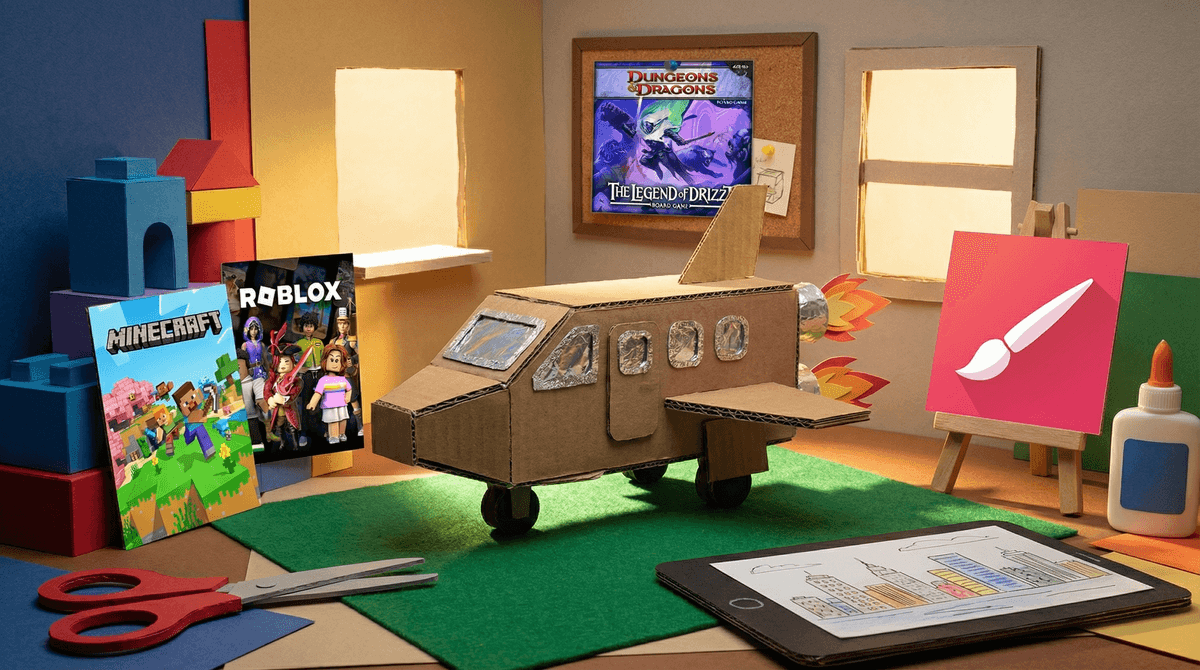
Here's the thing that keeps me up at night: my 7-year-old can build an entire functioning amusement park in Roblox, but when I suggested we build a fort out of couch cushions last weekend, she looked at me like I'd suggested we churn our own butter.
When we talk about "imagination" in childhood, we're usually picturing kids lost in pretend play—building blanket forts, creating elaborate storylines with action figures, or turning a cardboard box into a spaceship. But here's what's tricky: our kids ARE using their imagination constantly. They're just doing it in Minecraft worlds, through digital art apps, and in collaborative storytelling on platforms we didn't grow up with.
The real question isn't whether screens are killing imagination (spoiler: the research says they're not, automatically). It's about understanding how imagination develops differently when a huge chunk of childhood happens through a glowing rectangle, and what we need to do to make sure our kids' creative muscles grow strong in all directions.
I was talking to another parent at soccer practice who said something that stuck with me: "My kid can spend three hours building in Minecraft, but can't spend ten minutes playing independently without a screen."
This is the heart of it. Research from the American Academy of Pediatrics shows that open-ended, unstructured play is crucial for developing executive function, problem-solving, and creative thinking. But here's what makes the digital age different: screens often provide the structure, the rules, the immediate feedback, and the dopamine hits that make unstructured play feel... boring by comparison.
A 2023 study found that children ages 8-12 spend an average of 5-6 hours daily on screens, but less than an hour in unstructured, imaginative play. And while some of that screen time absolutely involves creativity and imagination, it's a fundamentally different experience than the kind of play that happens without a predetermined framework.
The stakes? Kids who don't develop strong imaginative play skills often struggle with:
- Problem-solving when there isn't a clear "right answer"
- Boredom tolerance (which, ironically, is where the best ideas come from)
- Internal motivation versus needing external rewards
- Flexible thinking when plans change
Here's where it gets complicated, and why I push back on the "screens bad, outside good" oversimplification:
Digital tools CAN build imagination. Kids creating worlds in Stardew Valley, making stop-motion videos, coding their own games, or collaborating on creative writing in shared docs—this is legitimate creative expression. My 10-year-old learned about narrative structure from watching Minecraft storytelling videos, then applied it to the fantasy novel he's writing (in Google Docs, naturally).
But digital play has guardrails. Even in the most open-ended games, someone else built the physics engine, created the possible interactions, set the rules. You can build anything in Minecraft... as long as it's made of blocks and follows the game's logic. This isn't bad, but it's different from the completely unconstrained imagination of a kid who decides a stick is a magic wand, then a sword, then a fishing pole, then a conductor's baton.
Ages 3-5: The Foundation Years
This is when imaginative play is naturally at its peak—and honestly, the easiest time to keep it screen-free or screen-light. The AAP recommends no more than 1 hour of high-quality programming daily for this age group.
What actually works:
- Keep screens completely out of independent play time
- When they do watch, co-view and extend the play offline ("Want to build a Daniel Tiger neighborhood with blocks?")
- Resist the urge to fill every moment—boredom is where imagination lives
- Simple is better: boxes, blankets, dress-up clothes trump elaborate toys
Ages 6-9: The Hybrid Years
This is when most kids start mixing digital and analog play naturally. They're also hitting the age where "everyone has a tablet" arguments begin.
The balance:
- Aim for a 2:1 ratio—for every hour of screen time, two hours of non-screen play (including outdoor, creative, and social play)
- Choose digital tools that have analog extensions: kids learning to draw through YouTube tutorials
 , then drawing on paper
 - Introduce "creation time" versus "consumption time" as categories
- Set up a "maker space" that's as appealing as the iPad
Ages 10-13: The Independence Years
Tweens are developing their identities, and digital creation often becomes central to that. This is also when the pressure to be on social platforms intensifies.
What to prioritize:
- Support digital creation: video editing, digital art, coding, music production
- Encourage "portfolio thinking"—creating things they're proud to share
- Maintain at least one non-digital hobby or skill they're developing
- Talk about the difference between passive consumption and active creation
The "bored breakthrough" is real. Every parent knows this moment: your kid is complaining they're bored, you resist suggesting a screen, they huff around for 20 minutes, and then suddenly they're building an elaborate marble run or putting on a puppet show. Research shows that this transition—from boredom to creative play—is where some of the most important cognitive development happens. But it takes time. Usually 20-30 minutes of genuine boredom before kids' brains shift into creative mode.
Not all screen time is created equal. Watching YouTube shorts for an hour? Pure consumption. Building a world in Minecraft with friends? Creative collaboration. Using Procreate to design characters? Artistic expression. The question isn't just "how much screen time" but "what kind of engagement?"
The comparison trap is real. Kids see impossibly polished creations online—professional-level Minecraft builds, perfect TikTok dances, amazing digital art—and it can actually inhibit their willingness to try. They're comparing their rough drafts to everyone else's highlight reel.
Building imagination in a digital age isn't about choosing between screens and "real" play. It's about being intentional about the balance and understanding what different types of play develop.
Your kid needs:
- Unstructured time where they have to generate their own entertainment
- Physical play that isn't gamified or tracked
- Boredom (I know, I know, but it's true)
- Creative tools both digital and analog
- Models of adult creativity (they need to see you reading, making things, being bored sometimes too)
The goal isn't to raise kids who never touch screens. It's to raise kids who can be creative, imaginative, and resourceful in any context—with or without a device.
-
Do a play audit this week. Track what types of play your kid engages in—structured vs. unstructured, digital vs. analog, creation vs. consumption. Just notice patterns without judgment.
-
Create a "boredom kit" with open-ended materials: cardboard, tape, markers, fabric scraps, old electronics to take apart, craft supplies. Make it as accessible as the iPad.
-
Institute one "analog day" per week where the family does a screen-free activity together. Not as punishment, but as an experiment in a different kind of fun.
-
Balance digital creation with analog creation. If your kid loves making videos, get them a cheap camera or teach them stop-motion with toys. If they love gaming, introduce tabletop games or D&D.
-
Explore Screenwise's guides on creative platforms to understand which digital tools actually support imagination versus just consuming content.
The kids are going to be fine. But they need us to be intentional about creating space for the kind of play that doesn't come with a tutorial or achievement badges. That's where the magic happens.