

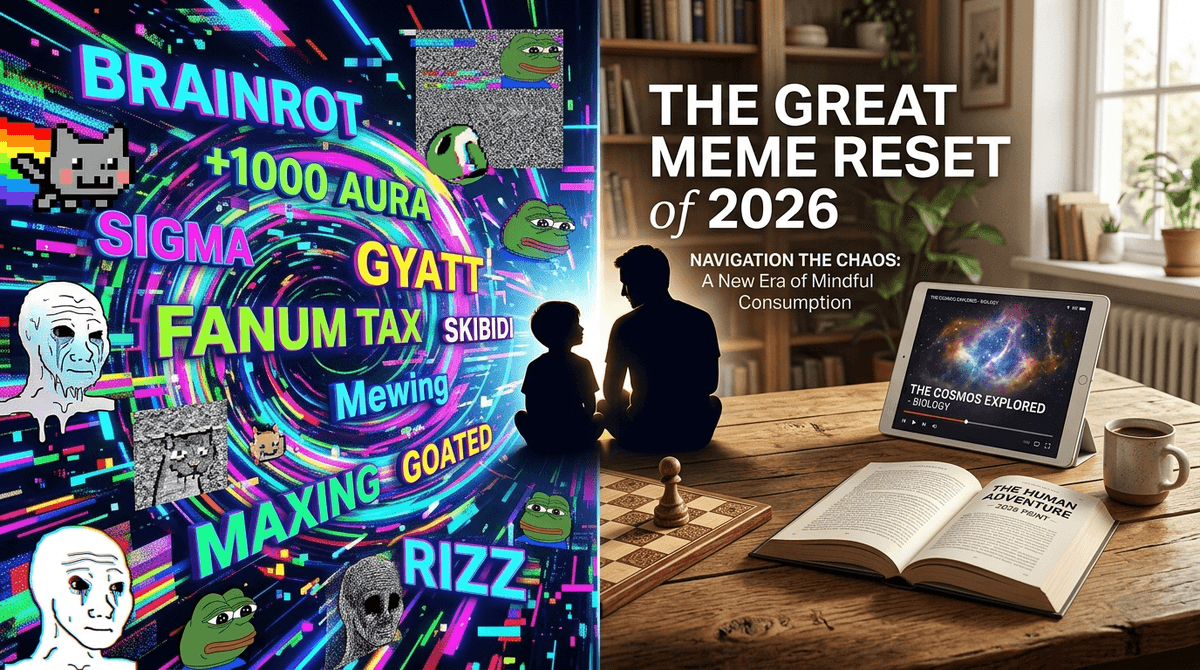
TL;DR: "Brainrot" is the current umbrella term for the hyper-stimulating, nonsensical, and often AI-generated content flooding YouTube Shorts and TikTok. While mostly harmless nonsense, it becomes concerning when it replaces high-quality storytelling or affects a child’s attention span.
Quick "Brainrot Detox" Recommendations:
- For Curiosity: Mark Rober – High energy, but high value.
- For Storytelling: The Wild Robot by Peter Brown – A perfect antidote to short-form chaos.
- For Humor: Bluey – Still the gold standard for all ages (even if they won't admit it).
- For Strategy: Catan – Get them off the screen and into a trade war.
If you’ve heard your ten-year-old mention "Skibidi," "Aura," or "Ohio" in the same sentence and felt like your brain was melting, you aren't alone. We’ve officially hit what I call the Great Meme Reset.
In the past, memes had a shelf life. They were based on a movie scene or a funny cat. Today, thanks to the sheer speed of TikTok and the rise of generative AI, memes are evolving every 48 hours. "Brainrot" refers to content that is intentionally absurd, loud, and fast-paced. It’s designed to exploit the "loop" mechanics of social media, keeping kids in a dopamine-drenched trance.
It’s called brainrot not necessarily because it’s "evil," but because it’s the digital equivalent of eating a bowl of pure frosting for dinner. It’s sweet, it’s addictive, and it has zero nutritional value for a developing mind.
If you haven't seen it, Skibidi Toilet is a YouTube series about heads popping out of toilets and fighting people with cameras for heads. It sounds like a fever dream because it basically is.
The Reality Check: While it looks like "brainrot," Skibidi Toilet actually has a complex (albeit weird) lore that kids follow like a soap opera. The concern isn't the toilets; it's the 5,000 "copycat" channels that use the characters to create low-effort, violent, or weirdly suggestive content to farm views from toddlers.
Learn more about the history of Skibidi Toilet and its impact on kids
To talk to your kids, you have to speak the language. Here is the current "Brainrot Dictionary":
- Aura: Think of this as social "coolness" points. If you do something cool, you have "+1,000 aura." If you trip in the hallway, that’s "negative aura." It’s basically a gamified version of reputation.
- Ohio: At this point, "Ohio" just means "weird" or "cringe." It has nothing to do with the actual state anymore.
- Italian Brainrot: A newer trend involving hyper-stylized, AI-generated videos of people eating pasta or acting out Italian stereotypes in increasingly surreal ways. It’s the peak of "slop"—content made by AI for the sole purpose of being weird enough to stop a scroll.
- Sigma: Originally meant to be a "lone wolf," but now it's mostly used ironically to mean someone is being a "boss" or, occasionally, just being a jerk.
Kids love these memes because they are a private language. When a child says, "That’s so Ohio," and you look confused, they feel a sense of belonging to their peer group. It’s the same reason we had "Valley Girl" talk or "Wassup" commercials—it’s just faster and weirder now.
However, the reason we feel that visceral "ugh" reaction is the pacing. Content on YouTube Shorts is often edited to have a cut every 1.5 seconds. There is no silence, no reflection, and no "boring" parts. This is where the concern lies: we are training kids' brains to expect constant stimulation.
Check out our guide on the impact of short-form video on attention spans
The real danger in 2026 isn't a head in a toilet; it's AI Slop. This is content generated entirely by algorithms—think weirdly distorted faces, nonsensical stories, and "life hacks" that are actually dangerous—uploaded by the millions to Facebook and Instagram.
Red Flags to Watch For:
- The "Zoned Out" Look: If your kid is scrolling and you can’t get their attention without shouting, they are in a "flow state" that is purely passive.
- Increased Irritability: When the "high" of the brainrot ends (i.e., you take the phone away), the "crash" can lead to meltdowns because the real world feels too slow.
- Mimicry of Mean Spirits: Some brainrot, specifically around "Sigma" culture, can lean into misogyny or bullying. If they start using these terms to put others down, it’s time to intervene.
A lot of parents ask me if Roblox is brainrot. The answer is: it depends on the game.
Roblox can actually be a great place for kids to learn basic entrepreneurship—as long as they aren't just "aura farming" or begging for Robux.
Ages 5-8: The "No-Shorts" Zone
At this age, the brain is too plastic for the 2-second-cut style of YouTube Shorts. Stick to long-form content.
- Recommendation: Bluey or Storyline Online. These have actual narrative arcs.
- The Goal: Build the "attention muscle."
Ages 9-12: The "Meme Explainer" Phase
This is when they will start repeating the nonsense. Don't ban it—it'll just make it cooler. Instead, ask them to explain it to you.
- Recommendation: Kurzgesagt. It’s visually stunning and fast-paced, but it’s teaching them about black holes and biology.
- The Goal: Critical thinking. Ask, "Why do you think an AI made this video?"
Ages 13+: The "Aura" Era
Teens use these memes for social currency. It’s mostly harmless unless it’s replacing sleep or schoolwork.
- Recommendation: MrBeast. While high-octane, his videos usually have a clear objective and a beginning, middle, and end.
- The Goal: Balance. Ensure they have "analog" hobbies like board games or sports.
If you want to have a real conversation, don’t start with "That video is stupid." Start with curiosity.
Try these prompts:
- "I saw a video about 'Italian Brainrot' today. What is the deal with the flying pasta?"
- "I feel like my attention span is getting shorter when I scroll Instagram. Do you ever feel like that after watching Shorts?"
- "Who is your favorite creator who actually makes stuff, rather than just reacting to other people's videos?"
Get a script for talking to your kids about digital wellness
Memes have always been weird, but the speed of 2026 content is unprecedented. "Brainrot" isn't a permanent condition, but it is a sign that the algorithm is in the driver's seat.
Our job as parents isn't to police every single "Skibidi" that comes out of their mouths. It’s to ensure they still know how to enjoy a slow-moving book, a long movie, or a 30-minute board game. We want them to be able to handle a world that doesn't have a "Skip Ad" button or a subway-surfer video playing in the corner of their vision.
- Check the Settings: Disable "Autoplay" on YouTube to break the loop.
- Audit the Feed: Spend 10 minutes watching what your kid is actually scrolling through. If it’s all screaming and flashing lights, it’s time to introduce some "high-fiber" content.
- Swap the Slop: For every 30 minutes of "brainrot," encourage 30 minutes of a "high-WISE score" game like Minecraft or Zelda.