

Books with Muslim Characters: Building Empathy Through Diverse Stories
Here's the thing: representation in books matters. Like, really matters. When kids see characters who look like them, practice their faith, or share their cultural background in stories, it validates their existence. And when kids read about characters who are different from them? That's where empathy gets built, one page at a time.
Muslim characters in children's literature have historically been either invisible or reduced to stereotypes. But in the last decade, we've seen an explosion of incredible books featuring Muslim kids just being kids—dealing with friendship drama, navigating school, falling in love, going on adventures, and yes, also exploring what their faith means to them. These aren't "issue books" (though some tackle important topics). They're just... good stories.
Whether your family is Muslim and looking for mirrors, or you're seeking windows into experiences different from your own, these books deserve a spot on your shelf.
For Muslim kids: Seeing yourself in books isn't a luxury—it's essential. When every protagonist celebrates Christmas, eats pepperoni pizza without a second thought, and has a name that teachers never mispronounce, Muslim kids get a subtle message that they're not the "default" audience. Books with Muslim characters say: your life, your traditions, your family's way of doing things—it all counts as a real, valid, interesting story worth telling.
For non-Muslim kids: Reading about Muslim characters builds cultural competency in a way that feels natural, not like a lecture. Kids learn that Muslim families are diverse (shocker: not everyone's experience is identical), that hijab is a choice some Muslim girls make and others don't, that Ramadan is actually pretty cool, and that Muslim kids worry about the same stuff they do—will their crush like them back, will they make the team, is their younger sibling the most annoying human alive.
In a world where Islamophobia is real and Muslim kids face bullying and microaggressions, these books are doing important work. They're normalizing Muslim existence in a landscape where "normal" has historically meant white and Christian.
Picture Books (Ages 3-7)
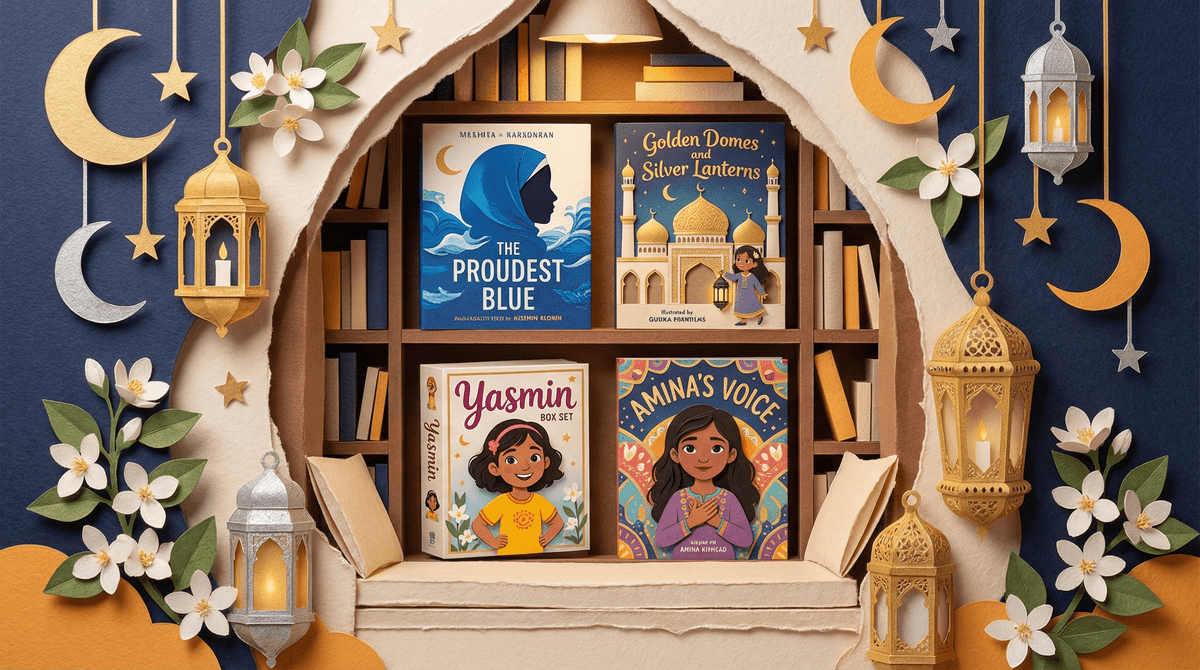
Golden Domes and Silver Lanterns by Hena Khan is gorgeous—a color-themed introduction to Islamic culture that's perfect for little ones.
The Proudest Blue by Ibtihaj Muhammad (yes, the Olympic fencer) is about a girl's first day wearing hijab and her sister's fierce support. It's sweet, it's empowering, and it handles the reality of mean comments without being heavy-handed.
**Yasmin** series by Saadia Faruqi features a Pakistani American second-grader who's creative, confident, and constantly coming up with solutions to everyday problems. These are early readers that Muslim kids can see themselves in without the story being about being Muslim, if that makes sense.
Middle Grade (Ages 8-12)
Amina's Voice by Hena Khan is the gold standard here. Amina is navigating middle school, a changing friendship, and what it means to be Pakistani American and Muslim. It's thoughtful and real without being After School Special-y.
The Night Diary by Veera Hiranandani is set during the 1947 Partition of India. The protagonist is half-Muslim, half-Hindu, and the book handles religious identity and conflict in a way that's accessible to kids.
Amal Unbound by Aisha Saeed is about a Pakistani girl sold into indentured servitude who finds her voice. It's heavy subject matter handled beautifully, and Amal's determination is infectious.
Other Words for Home by Jasmine Warga is a novel in verse about a Syrian girl who comes to America as a refugee. It's nuanced about the immigrant experience and what "home" means.
Young Adult (Ages 13+)
Love from A to Z by S.K. Ali is a romance featuring a hijabi protagonist with multiple sclerosis who falls for a guy dealing with his own family stuff. It's swoony and smart.
The Henna Wars by Adiba Jaigirdar features a Bangladeshi Irish lesbian protagonist navigating a business competition and a complicated crush. Yes, Muslim and queer—both identities exist in the same person, imagine that.
A Very Large Expanse of Sea by Tahereh Mafi is set in 2002, post-9/11, and follows a hijabi breakdancer falling for a white guy while dealing with intense Islamophobia. It doesn't sugarcoat how hard that moment was.
Saints and Misfits by S.K. Ali tackles sexual assault in the Muslim community—specifically, what happens when the perpetrator is a "good Muslim boy" that everyone loves. It's important and well-done.
These books aren't monolithic. Muslim characters come from different countries, practice their faith differently, and have wildly different life experiences. Some wear hijab, some don't. Some pray five times a day, some struggle with their relationship to faith. That diversity is the point.
You don't need to be Muslim to read these. Seriously. The whole point of diverse literature is that everyone benefits from reading outside their own experience. Your kid doesn't need to be Muslim to love Amina or root for Amal.
Some books tackle hard topics. Islamophobia, discrimination, identity struggles—these are real things Muslim kids face. Some books address them head-on. That's not being "too political," that's reflecting reality. Preview books if you're concerned about age-appropriateness, but don't shy away from difficult conversations.
Faith is often present but not preachy. Most of these books feature characters who are Muslim the way characters in other books are Christian—it's part of their life, but not a conversion narrative. They might fast during Ramadan, pray, or reference Allah, but it's woven into the story naturally.
Check the author. Own Voices matters here. Muslim authors writing Muslim characters tend to get the nuance right in a way that outsiders often don't. Most of the books listed here are by Muslim authors.
Building a diverse home library isn't about checking boxes or performing wokeness for your Instagram feed. It's about making sure your kids understand that the world is big, that different doesn't mean scary, and that every kid deserves to see themselves as the hero of a story.
Books with Muslim characters are just... good books. They're funny, heartbreaking, adventurous, romantic, and real. They belong on your shelf next to Percy Jackson and Harry Potter and Diary of a Wimpy Kid—not in some separate "diversity" section that signals these are educational vegetables instead of actual stories.
Start with one. See what resonates. And then keep going.
Talk about what you read. Ask your kids what they noticed, what surprised them, what they related to. These conversations are where the real learning happens.
Visit your library. Librarians are incredible resources and can recommend books based on your kid's interests and reading level. Most libraries now have diverse book displays.
Follow Muslim authors and reviewers. Social media is full of people sharing great recommendations. Look for hashtags like #OwnVoices and #MuslimKidLit.
Don't make it weird. Just... put these books in the rotation. You don't need to announce "Now we're reading a book about a Muslim character to learn about diversity!" Just hand your kid a good story and let them discover it.
And if you want to explore more diverse books across different backgrounds and experiences, check out our guide on building an inclusive home library.