

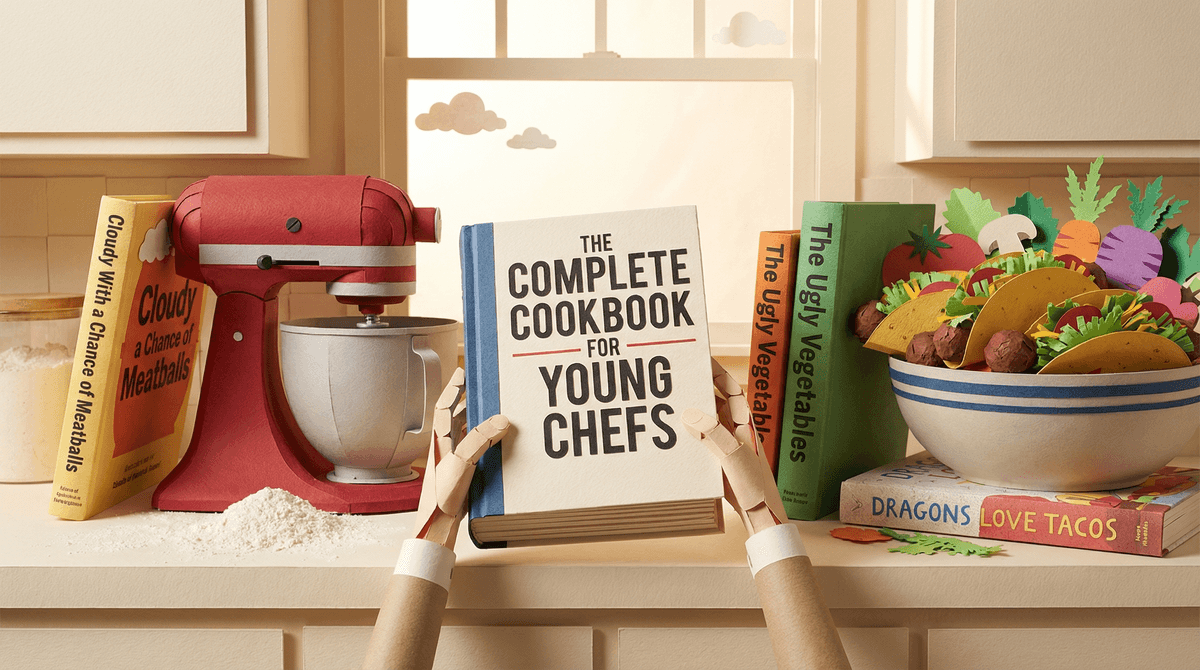
We're talking about everything from picture books where anthropomorphic vegetables go on adventures, to middle-grade novels where the plot revolves around a baking competition, to actual kid-friendly cookbooks that teach real culinary skills. Think Cloudy with a Chance of Meatballs, The Vanderbeekers Make a Wish (where baking brings a community together), or The Complete Cookbook for Young Chefs from America's Test Kitchen.
These books use food as a lens to explore culture, science, math, creativity, family traditions, and yes—actual cooking techniques. And honestly? In an age where kids can watch 47 TikTok recipe videos in the time it takes to butter toast, there's something beautifully analog about a kid flipping through a cookbook with flour-dusted fingers.
Food books aren't just about teaching kids to make mac and cheese—though that's a solid life skill. They're doing some surprisingly heavy lifting:
Building food literacy. Kids who read about food and cooking develop a more curious, less anxious relationship with what's on their plate. They learn that tomatoes don't just appear in sauce form, that bread requires chemistry, and that "yucky" foods might have interesting stories worth exploring.
Creating low-stakes family connection. Cooking together from a book gives you a shared project with a clear beginning, middle, and end. Unlike Fortnite or Roblox, where you're mostly watching your kid play, cooking is genuinely collaborative. Plus, you get to eat the results, which beats another participation trophy.
Teaching actual executive function skills. Following a recipe requires reading comprehension, sequencing, time management, measurement, and the ability to recover when you accidentally use salt instead of sugar. These are the same skills that help kids manage homework, friendships, and eventually, their own lives.
Introducing cultural empathy through the stomach. Books like Yum! ¡MmMm! ¡Qué Rico! or The United States of Cookies show kids that different cultures have different food traditions—and that's fascinating, not scary.
Ages 2-5: Picture Books That Make Food Fun
- Eating the Alphabet by Lois Ehlert—gorgeous illustrations, simple concept
- Dragons Love Tacos—silly, memorable, and yes, kids will want to make tacos
- The Ugly Vegetables by Grace Lin—about a Chinese-American girl learning to appreciate her family's garden
Ages 6-9: Stories Where Food Drives the Plot
- Ivy and Bean Make the Rules—includes a pancake restaurant scheme
- Pie by Sarah Weeks—a mystery centered around a secret pie recipe
- A Taste of Magic by J. Elle—a girl discovers her baking has actual magic
Ages 10-14: Cooking Gets Real
- The Miscalculations of Lightning Girl—features a cupcake baking subplot that's genuinely sweet
- Measuring Up by Lily LaMotte—a graphic novel about a Taiwanese-American girl competing in a cooking competition
- Actual cookbooks: America's Test Kitchen's kid series, or Molly on the Range for teens who want Instagram-worthy results
Not all food books are created equal. Some are just vehicles for cute illustrations with zero actual cooking knowledge. Others assume your 8-year-old has the knife skills of a sous chef. Skim before you commit.
Cookbooks for kids often require adult supervision. I know, I know—you wanted them to make dinner while you doomscroll. But most kid cookbooks are designed for cooking together, not solo. The upside? Built-in quality time. The downside? You still have to be there.
Food books can accidentally trigger diet culture stuff. Be wary of books that moralize about "good" and "bad" foods, or that focus heavily on nutrition in a way that makes kids anxious. The goal is curiosity and competence, not guilt. Books that celebrate food as culture, creativity, and connection > books that treat food as fuel or moral test.
The mess is the point. If you can't handle flour on the floor and egg on the counter, maybe start with books about food rather than cookbooks. No shame—different seasons of life call for different approaches.
Food books are one of those rare wins where kids think they're just reading a fun story or making cookies, but they're actually building literacy, math skills, cultural awareness, and a healthier relationship with what they eat. Plus, they offer a legitimate alternative to screen time that doesn't feel like you're forcing them to "go outside and play" for the 47th time this week.
Start with picture books if your kids are young, move to food-centered novels for middle-graders, and introduce actual cookbooks when they're ready to crack eggs without having an existential crisis. And if they want to watch cooking videos on YouTube? Cool—pair it with a book. Here's how to navigate YouTube Kids vs. regular YouTube if you need a refresher.
The goal isn't to raise the next Top Chef Junior contestant. It's to raise a kid who knows that food is interesting, that cooking is a learnable skill, and that the kitchen is a place where good things happen—both on the plate and around it.