

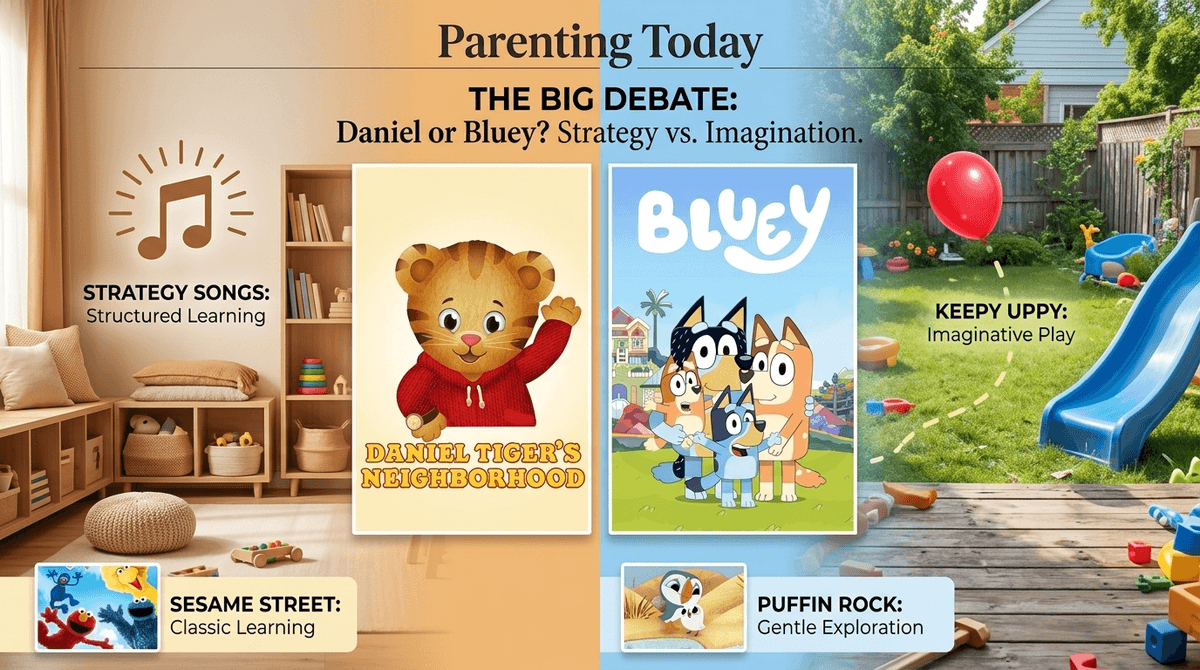
TL;DR: Daniel Tiger's Neighborhood is your child’s first instruction manual for big emotions, using "strategy songs" to build a literal script for life. Bluey is a masterclass in imaginative play that teaches children (and parents) how to process the world through creativity and resilience. While Daniel tells kids what to do, Bluey shows them how to be.
If you’ve spent more than five minutes in a room with a toddler lately, you’ve likely had a four-inch-tall cartoon tiger or a six-year-old Blue Heeler living rent-free in your head.
At school pickup, we usually talk about the "big" stuff—Roblox scams or whether "Skibidi Toilet" is actually rotting their brains—but the foundation of a kid's digital life starts much earlier with these two titans of preschool media.
Choosing between Daniel Tiger's Neighborhood and Bluey isn't just about which theme song is less likely to drive you to the brink of madness. These shows represent two fundamentally different philosophies of childhood development. One is a toolkit; the other is a mirror.
Daniel Tiger's Neighborhood: The Script for Life
Let’s be real: Daniel Tiger's Neighborhood is basically "Management Training for Four-Year-Olds."
Produced by Fred Rogers Productions, it carries the DNA of Mister Rogers’ Neighborhood but updates it for a generation of kids who need immediate, actionable strategies. The show is built on a specific pedagogical framework: Social-Emotional Learning (SEL).
What it teaches:
- Emotional Regulation: Every episode features a "strategy song"—a short, repetitive earworm designed to be recalled in moments of crisis. "When you feel so mad that you want to roar, take a deep breath and count to four." It’s simple, it’s effective, and it works.
- Predictability: The world of the Land of Make-Believe is incredibly stable. This helps younger toddlers (ages 2-4) feel safe. They know exactly what to expect, which is why they can watch the same episode about going to the potty eighteen times in a row.
- Functional Skills: From visiting the doctor to trying new foods, Daniel walks kids through the "how-to" of being a person.
The Screenwise Take: Daniel Tiger is a utility. It’s the show you put on when your kid is struggling with a specific milestone. However, it can feel a bit "clinical." The parents are perfectly patient (which can be a bit grating for us real-life, exhausted humans), and the conflicts are always resolved with a neat little song. It’s a great show for building a vocabulary of feelings, but it doesn't always capture the beautiful, chaotic mess of actual childhood.
Learn more about the best educational shows for toddlers
Bluey: The Art of the Game
Then there’s Bluey. If Daniel Tiger is a textbook, Bluey is a poem.
While Daniel is busy teaching your kid how to share a toy, Bluey is busy showing them how to turn a cardboard box into a multidimensional portal or a hospital for "unwell" stuffed animals.
What it teaches:
- Executive Function through Play: In episodes like "Keepy Uppy" or "The Creek," the show demonstrates how kids use play to test boundaries, solve problems, and negotiate social hierarchies.
- Resilience and Failure: Bluey and her sister Bingo lose games. They get their feelings hurt. They deal with death (the "Copycat" episode is a masterpiece) and aging. The show doesn't give them a song to fix it; it shows them sitting in the discomfort and moving through it.
- Parental Modeling: Let’s be honest, half of Bluey is for us. Bandit and Chilli Heeler are the parents we want to be on our best days—playful, present, and willing to be embarrassed—but they also show frustration and exhaustion.
The Screenwise Take: Bluey is arguably the best-written show on television right now, period. It’s "co-viewing" at its finest. It teaches kids that life isn't a series of scripted interactions, but a series of improvisational games. It encourages divergent thinking—the ability to see multiple solutions to a single problem.
Check out our guide on why Bluey is a "parenting show" disguised as a kids show
| Feature | Daniel Tiger | Bluey |
|---|---|---|
| Primary Goal | Direct instruction of social skills | Exploration of world through play |
| Learning Style | Auditory/Repetitive (Songs) | Visual/Narrative (Improvisation) |
| Parental Role | Teachers/Guides | Active Play Participants |
| Best Age Range | 2–4 years old | 3–7+ years old (and parents) |
| Conflict Resolution | A specific "Strategy" | Emotional processing and compromise |
Why This Matters for Your Family’s Digital Diet
We often talk about "screen time" as a monolithic block of "bad" or "neutral" time. But the difference between these two shows illustrates why content quality matters more than the clock.
If your child is currently in a "hitting" phase or struggling with potty training, 20 minutes of Daniel Tiger's Neighborhood is essentially a therapy session. It’s high-value, high-intent media.
If your child is becoming a "screen zombie" and losing their ability to play independently, Bluey can actually act as a catalyst for "off-screen" play. Many parents report that after an episode of Bluey, their kids are more likely to grab a balloon or a "magic xylophone" and start an imaginative game of their own.
While Daniel and Bluey dominate the conversation, there are a few other shows that bridge the gap between these two philosophies:
This is the "zen" option. It’s beautiful, Irish, and narrated by Chris O'Dowd. It teaches nature facts and gentle social lessons without the high-octane energy of some other shows. It’s perfect for "winding down" before bed.
Similar to Bluey, this show focuses on the friendship between a boy and a literal trash truck. It’s sweet, slow-paced, and emphasizes the wonder of the everyday world.
The OG. While it has become more segment-heavy over the years, it remains the gold standard for diversity, inclusion, and academic readiness (letters/numbers) mixed with emotional intelligence.
- Ages 18 Months – 3 Years: Stick with the slow-paced, high-repetition content. Daniel Tiger's Neighborhood and Sesame Street are your best bets. Avoid high-sensory "brain rot" like Cocomelon, which can be overstimulating for developing brains.
- Ages 3 – 5 Years: This is the sweet spot for Bluey. They are starting to understand social nuances, sarcasm (mildly), and complex play. You can also introduce Trash Truck.
- Ages 5 – 7 Years: Kids might start to feel "too old" for Daniel Tiger, but they will likely stay with Bluey for years. This is also a good time to transition into more narrative-driven shows like The Octonauts for science or Molly of Denali for informational text skills.
There is one "warning" I have to give about Bluey. It’s what I call the Bandit Problem.
Bandit (the dad) is a professional archaeologist who apparently has infinite time and energy to play elaborate games of "Hospital" or "Bus" at a moment's notice. For many of us working 9-to-5s or just trying to get the dishes done, Bluey can sometimes make us feel like "bad" parents because we aren't turning every mundane task into a 15-minute improv sketch.
The Fix: Use the show to talk to your kids about why we play. You can say, "I love how Bandit plays, but right now Mommy needs to finish the laundry so we have clean clothes. Let’s play 'Keepy Uppy' for five minutes when I'm done."
How to set boundaries around screen time without the meltdown
If you want your child to learn the rules of the world, turn on Daniel Tiger's Neighborhood. It’s a fantastic, safe, and effective tool for early childhood development.
If you want your child to learn how to navigate the world with heart, humor, and a sense of adventure, turn on Bluey.
Both are "Screenwise Approved," but they serve different purposes in your parenting toolkit. Just remember: it’s okay to skip the strategy song if you’re too tired to count to four. We’ve all been there.
- Observe your kid: Next time they watch, are they singing along with Daniel or trying to mimic a game from Bluey? This tells you what their brain is currently craving.
- Try a "Strategy Song" in the wild: Use a Daniel Tiger song during a real-life meltdown and see if the "script" helps.
- Play one "Bluey" game: Pick one simple game (like "Magic Asparagus" or "Statues") and play it for 10 minutes. See if it changes the energy in your house.
- Check the Screenwise App: Take our survey to see how your family's media consumption compares to other intentional parents in your community.