

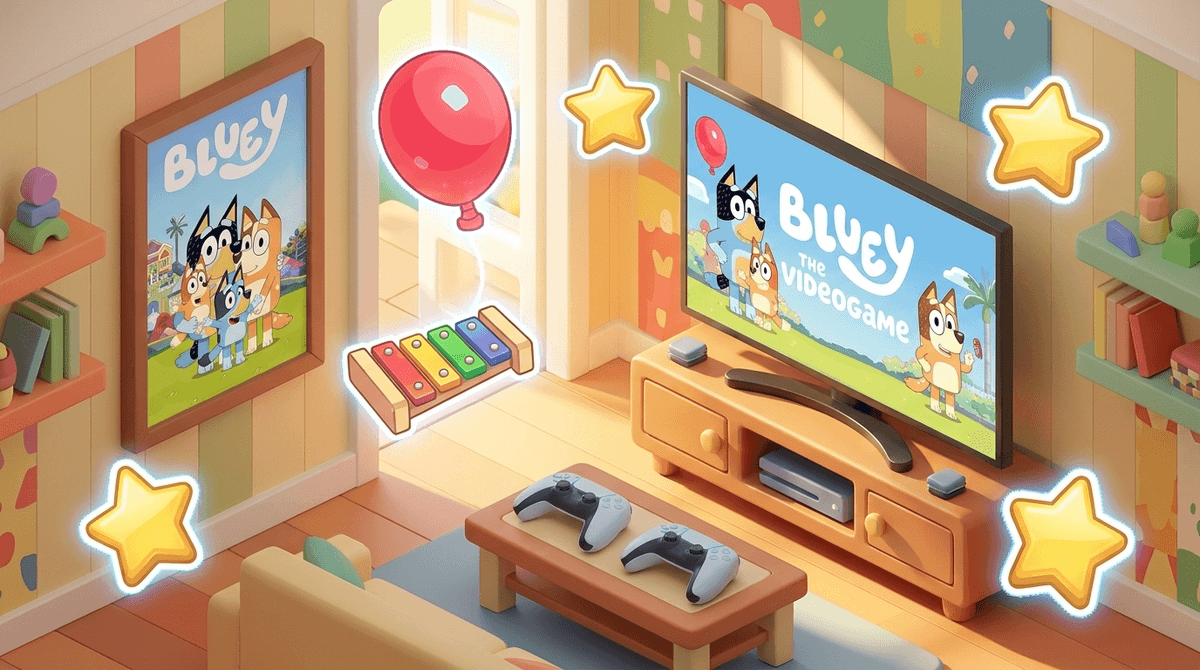
TL;DR: Bluey: The Videogame is a "low-stakes, high-vibes" sandbox game that lets kids explore the Heeler house and play mini-games like Keepy Uppy. It’s the ultimate "starter" game for the 4-7 age bracket. It’s short (you can beat it in under two hours), a bit glitchy, and arguably overpriced at $40, but it’s 100% safe, has zero microtransactions, and supports 4-player local co-op.
Quick Links:
If your living room has been colonized by Bluey merch, you already know the vibe. This game is essentially an interactive, four-part episode of the show. You can play as Bluey, Bingo, Bandit, or Chilli.
Unlike Minecraft where you might get blown up by a Creeper, or Roblox where a stranger might try to trade your kid a "legendary" pet for actual lunch money, Bluey: The Videogame has zero combat, zero "game over" screens, and zero online interactions.
It’s a sandbox. You wander around the Heeler house, the playground, the creek, and the beach. You pick up items, you dress up the characters in silly hats, and you trigger mini-games that fans of the show will recognize instantly, like Magic Xylophone and The Floor is Lava.
Compare Bluey: The Videogame to Peppa Pig and PAW Patrol games
For a five-year-old, the appeal isn't the "gameplay mechanics"—it’s the wish fulfillment. They get to be Bluey. They get to see what’s inside the cabinets in the Heeler kitchen.
For parents, the win is the co-op. You can jump in and out at any time. If your kid is struggling to jump onto a floating couch in "The Floor is Lava," you can just pick up a second controller, help them finish the level, and then go back to scrolling your phone or finishing your lukewarm coffee.
Screenwise data shows that about 45% of parents with kids in the K-2 age range are looking for "co-play" opportunities rather than just "handing off the iPad." This game is built specifically for that bridge.
Let’s be real: if this weren't a Bluey product, critics would probably tear it apart.
- It’s short. We’re talking "finish the whole story in 90 minutes" short. For $40, that’s a tough pill to swallow for some families.
- It’s buggy. The physics are a little "floaty." Characters sometimes get stuck in walls or the camera angle goes wonky.
- The controls. While it’s designed for kids, some of the platforming (jumping from thing to thing) can actually be frustrating for a toddler who hasn't mastered the thumbstick yet.
However, compared to the absolute "brain rot" found in some corners of the App Store, this is high-quality art. The voice actors from the show are all there. The music is the actual score from the show. It feels authentic, which matters because kids can sniff out a cheap knock-off from a mile away.
Check out our guide on whether expensive kids' games are worth the investment
If you’re looking for a first gaming experience, you’ve probably looked at a few other titles. Here’s how they stack up:
This is even simpler than Bluey. It’s basically a 2D point-and-click adventure. If your child is 3 or 4 and has never touched a controller, Peppa Pig is actually a better starting point because it requires almost zero "skill."
This is a 3D open-world game similar to Bluey but with more "missions." It’s a bit more "gamey," requiring kids to follow directions and complete specific tasks to progress. It’s great for building those "gamer" muscles but lacks the emotional heart of the Heeler family.
Many parents start here because of the "Auto-Steering" feature. It’s a classic for a reason, but it’s high-energy and competitive. Bluey: The Videogame is the "chill" alternative for when you don't want your kids screaming because they got hit by a blue shell.
A lot of people recommend this for kids, but honestly? There is way too much reading for a non-reader. Bluey is fully voiced, so your kid doesn't need to be able to read "Let's go to the creek!" to know what's happening.
- Ages 3-4: They will mostly just enjoy walking the characters into walls and watching the animations. You will need to do 90% of the actual "playing."
- Ages 5-7: This is the sweet spot. They can navigate the world, understand the mini-games, and will enjoy the "sticker book" collect-a-thon elements.
- Ages 8+: They will likely find it too easy and "babyish" unless they are absolute Bluey superfans. At this age, they’re usually moving toward Minecraft or Pokemon Scarlet/Violet.
This is the shortest section of the guide because, frankly, there’s nothing to worry about.
- No Microtransactions: You cannot buy "Bluey Coins" or skins. You pay once and you own the whole thing.
- No Online Play: There is no "chat" feature. No "Ohio" memes from strangers. No risk of exposure to inappropriate content.
- Low Frustration: There is no way to "die" or lose progress.
If you are worried about "gaming addiction," this game is actually a great training tool. Because the story is so short, it’s easy to say, "We’re going to finish this one chapter and then turn it off," and actually have a natural stopping point.
Learn more about setting healthy gaming boundaries for preschoolers
We often talk about whether Roblox is teaching kids about the economy (it’s mostly teaching them about gambling, let’s be real), but Bluey: The Videogame teaches something else: Cooperative Play.
In the game, just like in the show, the characters have to work together to solve "problems" (like getting a toy down from a shelf). When you play with your kid, you’re modeling how to share a screen, how to wait for your partner to catch up, and how to handle a "glitch" without a meltdown. It’s digital emotional intelligence.
If you want to turn this into a "learning moment" (without being that annoying parent who ruins the fun), try these prompts:
- "Which character are you playing as? Why did you pick Chilli instead of Bluey?"
- "The Floor is Lava is hard! How do we stay calm when we keep falling off the cushions?"
- "If we were going to make up a 'For Real Life' game in our actual house right now, what would it be?"
Bluey: The Videogame is not a masterpiece of software engineering. It’s a bit clunky and it’s definitely a "brand play."
But in a world where so much of "kids' tech" is designed to keep them clicking, keep them buying, and keep them scrolling, there is something deeply refreshing about a game that just wants them to play Keepy Uppy for twenty minutes and then go outside.
It’s a safe, gentle, and genuinely joyful introduction to the world of gaming. If you can catch it on sale for $25 or $30, it’s a no-brainer. At $40, you’re paying a "Bluey Tax," but for many of us, the peace of mind is worth the extra ten bucks.
- Check your platform: It’s available on Switch, PlayStation, Xbox, and PC. The Switch version is great for portability, but the PlayStation/Xbox versions run a bit smoother.
- Set a timer: Even though it’s "safe" content, the "just one more sticker" pull is real.
- Play together: Don't just hand them the controller. Be the Bandit to their Bluey. It’s worth it for the laughs alone.