

TL;DR: If you’re looking for the perfect "bridge" between picture books and chapter books that won't make you want to claw your eyes out during read-aloud time, Bink and Gollie is the gold standard. It’s high-vocabulary, high-humor, and features a friendship that feels refreshingly real.
Quick Links:
- Bink and Gollie (Book 1)
- Bink and Gollie: Two for One
- Bink and Gollie: Best Friends Forever
- Mercy Watson (Another DiCamillo win for this age group)
Finding books for a first or second grader is a weirdly specific challenge. They’ve moved past the "The Cat Sat on a Mat" phase, but they aren't quite ready to tackle Harry Potter solo.
In the digital world, this is the age where they start begging for Roblox and watching weirdly hypnotic YouTube Kids shorts that have the nutritional value of a gas station slushie. If you're trying to build some "narrative stamina" and digital wellness, you need content that can actually compete with a tablet.
Enter Bink and Gollie.
Created by the powerhouse duo of Kate DiCamillo (who basically owns the "intentional parent" bookshelf) and Alison McGhee, with illustrations by Tony Fucile (who worked on The Incredibles), these books are the antidote to "brain rot" early readers.
Think of them as the modern, roller-skating version of Frog and Toad.
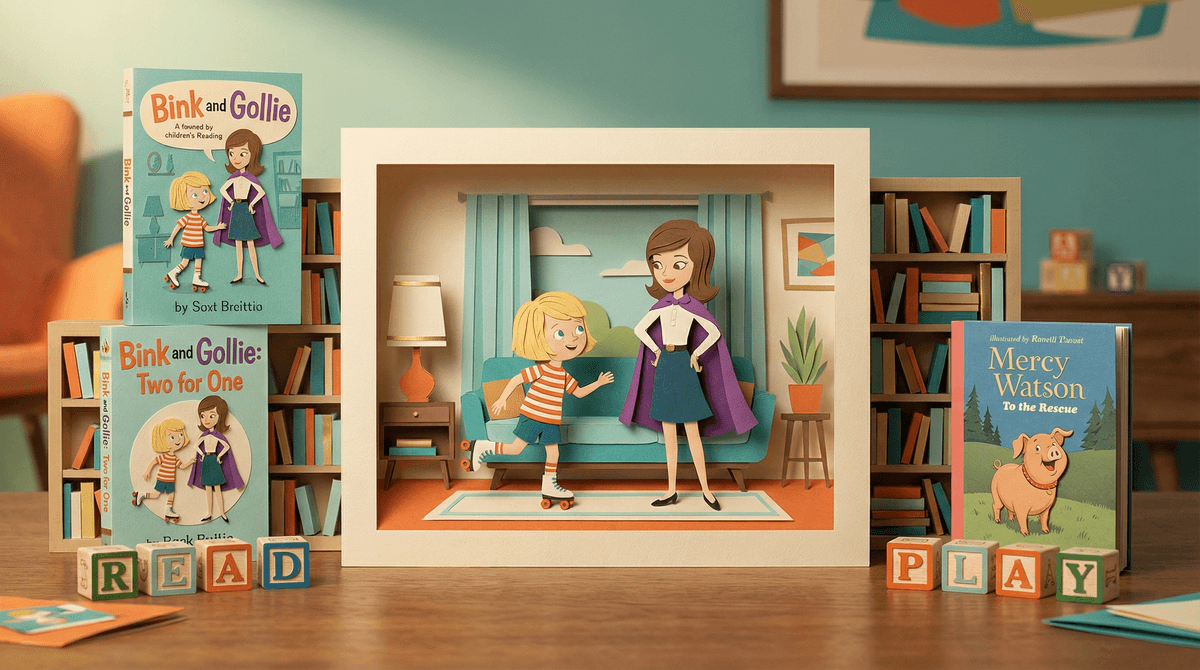
Bink is short, impulsive, and obsessed with peanut butter and bright socks. Gollie is tall, logical, slightly pretentious, and makes a mean pancake. They live in a world that looks like a mid-century modern dream, and they spend their days navigating the complexities of being best friends when you have absolutely nothing in common.
The books are structured as three short stories per volume. This is a massive win for kids who get overwhelmed by long chapters. It gives them three distinct "wins" in one sitting, which is great for building confidence.
Most early readers use "controlled vocabulary"—meaning they only use words that a 6-year-old already knows. It’s functional, but it’s boring.
Bink and Gollie takes the opposite approach. Gollie, in particular, uses words like "implore," "extraordinary," and "compromise."
When Bink wants to buy a pair of "outrageous" bright socks that Gollie hates, they don't just argue; they have a sophisticated negotiation. It teaches kids that:
- Big words are fun to say.
- You don't have to agree with your friends to be friends with them.
- Compromise is an actual skill, not just something parents nag you about.
In an era where digital communication is often reduced to emojis or "Ohio" memes, seeing characters actually articulate their feelings is a breath of fresh air.
This is the starter pack. It establishes their dynamic perfectly. The first story about the "outrageous" socks is a masterclass in sibling-style bickering and eventual resolution. If your kid is used to the fast-paced visual humor of SpongeBob SquarePants, they will appreciate Tony Fucile's expressive illustrations. He captures the "eye roll" better than any artist working today.
The duo heads to the state fair. This one is great for talking about talents and jealousy. Bink tries to win a giant duck; Gollie enters a talent show. It’s relatable for any kid who has ever felt like their friend was "better" at something than they were.
This volume deals with things like collecting "treasures" (Bink) and the realization that you might not actually be royalty (Gollie). It’s slightly more introspective but still hilarious.
Recommended Ages: 5-8
- Ages 5-6 (The Read-Aloud Phase): Even if they can't read the word "extraordinary" yet, they will love hearing you say it. The physical comedy in the art keeps them engaged while you handle the heavy lifting of the text.
- Ages 7-8 (The Independent Phase): This is the sweet spot. The font is large, the white space is generous, and the vocabulary is challenging enough to make them feel like a "grown-up" reader.
1. The Art is Half the Story
Because Tony Fucile comes from an animation background, a lot of the plot happens in the characters' expressions. This is great for "visual literacy." Ask your kid, "How do you think Gollie feels right now?" based on her face. It’s a low-key way to build empathy and social-emotional skills.
2. It's Not "Gendered"
Despite having two female leads, these books aren't "girl books." They’re "friendship books." Boys find Bink’s chaotic energy just as hilarious as girls do. In a media landscape that often tries to silo kids into "pink" and "blue" categories, Bink and Gollie just exists in a cool, neutral space.
3. The "Anti-Brain Rot" Factor
We talk a lot at Screenwise about "slow media." When your kid is used to the 2-second cuts of a MrBeast video, their brain is being trained for constant dopamine hits. Books like these require a different kind of focus. They aren't boring, but they aren't frantic. They’re a great way to "reset" the nervous system after school or before bed.
Check out our guide on moving from picture books to chapter books
If you want to use these books to spark some actual conversation (beyond "did you like it?"), try these:
- On Compromise: "Bink wanted the socks, and Gollie hated them. How did they fix that? Have you ever had to do that with [Friend's Name]?"
- On Differences: "Gollie loves her pancakes and her quiet time. Bink is a bit more... loud. Do you think you're more of a Bink or a Gollie?"
- On Big Words: "Gollie used the word 'implore' today. What do you think that means? Let's try to use it at dinner tonight." (Pro tip: "I implore you to eat your broccoli" usually gets a laugh).
Bink and Gollie is a rare find. It’s sophisticated enough for parents to enjoy, funny enough for kids to choose over a screen, and educational without being a "teaching book."
If you're trying to be intentional about the media entering your home, these three books belong on your permanent shelf. They teach kids that being a good friend doesn't mean being the same—it means being willing to put on your roller skates and meet the other person halfway.
- Grab the first book: Start with the original Bink and Gollie.
- Explore the author: If they love the vibe, move on to the Mercy Watson series for more Kate DiCamillo brilliance.
- Check the stats: Use Screenwise to see what other books parents in your community are recommending for the 6-8 age gap.