

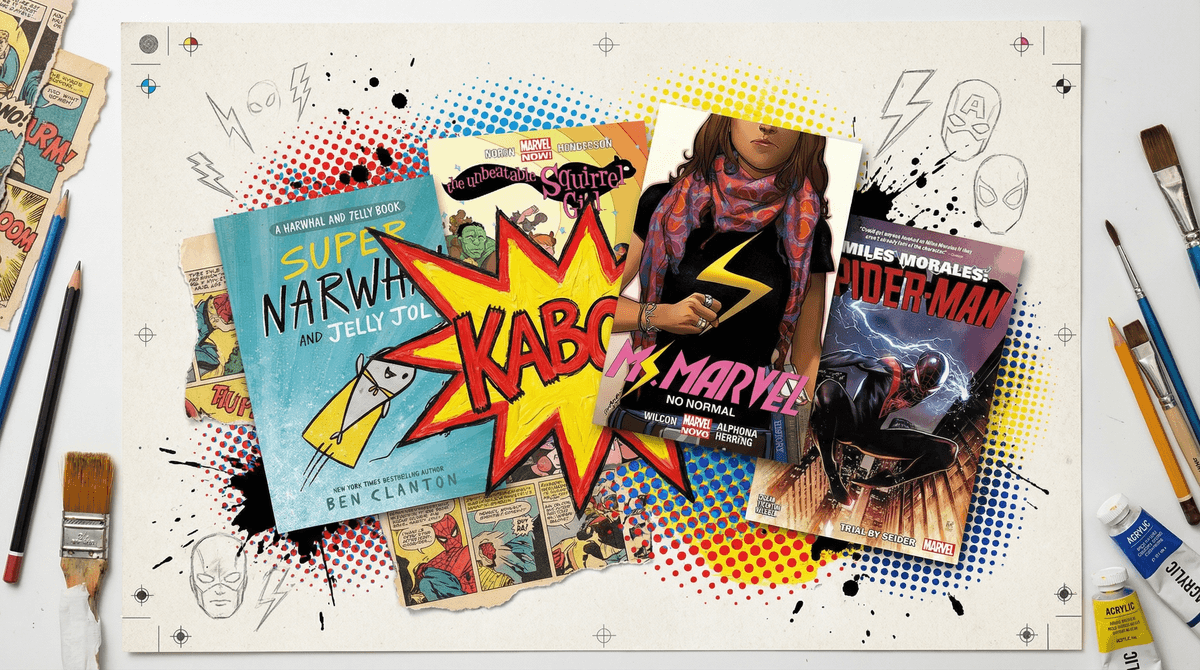
Look, we need to talk about superhero content for kids. Because here's the thing: while your kid is begging to watch another Marvel movie or rewatch The Incredibles for the 47th time, there's this whole universe of superhero reading that's just sitting there, waiting to hook them on actual books.
And I'm not talking about those movie tie-in readers with three sentences per page. I'm talking about real graphic novels and comics that are legitimately good literature — stories that teach empathy, explore what it means to be brave when you're scared, and yes, have cool people punching bad guys.
The best part? Comic books and graphic novels are a gateway drug to reading for so many kids who think they "don't like books." The visual format makes complex stories accessible, the serialized nature keeps them coming back, and suddenly your "reluctant reader" is devouring 300-page graphic novels in one sitting.
Superhero stories hit different for kids because they're fundamentally about power and powerlessness — which is basically the central tension of childhood. Kids have almost no control over their lives, and superheroes are the ultimate fantasy of agency and impact.
But the good superhero stories (and there are plenty of bad ones, let's be real) go deeper than just "strong person fights evil." They explore:
- Responsibility and choice — What do you do when you CAN help?
- Identity and belonging — Who are you when you're different from everyone else?
- Courage vs. fearlessness — Being brave means acting despite being scared
- Using your specific gifts — Everyone has something unique to contribute
Plus, let's not discount the pure fun of it. Kids love powers, costumes, secret identities, and epic battles. And if that's what gets them reading? We take that win.
Ages 4-7: Starting Young
Dog Man series by Dav Pilkey — This is the gateway. Part dog, part man, all ridiculous. The humor is very much aimed at the elementary school crowd (lots of butt jokes), but the stories actually have heart. Kids who loved Captain Underpants will devour these.
Super Narwhal and Jelly Jolt by Ben Clanton — For younger readers who aren't quite ready for Dog Man's chaos. It's sweet, funny, and teaches friendship alongside superhero adventures.
Supergirl: Daughter of Krypton — DC's younger reader line has some solid options, and this one gives kids a powerful female hero without dumbing down the storytelling.
Ages 8-11: The Sweet Spot
This is where superhero reading really takes off. Kids this age can handle more complex plots, moral ambiguity, and serialized storytelling.
Mighty Jack series by Ben Hatke — Not traditional superheroes, but has all the elements: ordinary kids discover extraordinary abilities, face real danger, and have to be brave. Gorgeous art, genuinely suspenseful storytelling. This one hooks reluctant readers HARD.
New Kid by Jerry Craft — Okay, hear me out. This isn't a superhero book in the traditional sense, but it's about a kid navigating being one of the few Black students at a prestigious private school — and the courage that requires is absolutely heroic. It won the Newbery Medal for a reason.
Ms. Marvel Vol. 1: No Normal — Kamala Khan is probably the best new superhero character of the last decade. She's a Pakistani-American teenager from Jersey City who gets powers and has to figure out how to be a hero while also dealing with her family, school, and identity. The storytelling is smart, funny, and genuinely moving. Start with Volume 1 and watch your kid tear through the rest.
Hilo series by Judd Winick — A robot boy falls to Earth and befriends two kids. It's got the action and humor kids want, but also real emotional depth about friendship and belonging. The art style is dynamic and accessible.
The Unbeatable Squirrel Girl — This Marvel series is pure joy. Doreen Green can talk to squirrels and has "the proportional strength and speed of a squirrel" (which is actually pretty impressive). But what makes it special is that she often solves problems through empathy and talking rather than just fighting. It's genuinely funny and clever.
Ages 12+: Getting Sophisticated
Nimona by ND Stevenson — This one's a masterpiece. It's about a shapeshifter who becomes the sidekick to a supervillain, but nothing is what it seems. It explores heroism, villainy, and how those labels are often more about perspective than reality. There's some violence and complex themes, so definitely 12+, but it's stunning.
Miles Morales: Spider-Man graphic novels — Miles is everything a modern superhero should be: dealing with real issues (gentrification in Brooklyn, code-switching, family expectations) while also fighting bad guys. The storytelling respects teen readers' intelligence.
Watchmen — Okay, this is for your mature 14-15+, and you should probably read it yourself first. It's dark, it's complex, it completely deconstructs the superhero genre. But for the right teen reader who's ready for sophisticated storytelling about power, morality, and humanity? It's incredible. Just know what you're getting into — this is NOT for younger kids.
Saga — Again, this is firmly in the mature teen category (16+), and it's technically more sci-fi than superhero, but it's one of the best graphic novel series ever made. It's about family, war, love, and sacrifice. There's violence and adult content, so definitely preview this one, but for older teens ready for complex storytelling, it's extraordinary.
Comics and graphic novels are real reading. Let's just get this out of the way: there's sometimes this weird stigma that graphic novels "don't count" as much as prose books. That's nonsense. Reading comprehension for graphic novels actually requires MORE cognitive work in some ways — kids have to integrate visual and textual information simultaneously. If your kid is reading graphic novels, they're reading. Period.
The format is especially powerful for reluctant readers. Kids who struggle with traditional books often thrive with graphic novels because the visual storytelling provides context clues and breaks up the text in manageable chunks. This isn't "easier" reading — it's different reading that works better for many kids' brains.
Check the content rating, especially for older kids. Comic books and graphic novels have gotten much more sophisticated in the last decade, which is great, but it also means some series that LOOK like they're for kids (because they're illustrated) are actually pretty mature. Most publishers now include age recommendations. Use them.
The library is your friend here. Graphic novels are expensive (usually $12-15 each), and kids can blow through them fast. Most libraries have fantastic graphic novel sections now. Check out how to maximize your library's digital resources too — many have digital graphic novel lending through apps like Hoopla or Libby.
Let them reread favorites obsessively. Kids will often reread the same graphic novel 5-10 times, and that's actually great for reading development. They're picking up new details, deepening comprehension, and building fluency. Don't push them to "move on" if they want to reread.
The best superhero reading list for your kid is the one they'll actually read. Start with what interests them — if they're obsessed with Spider-Man, start with Miles Morales. If they love funny stuff, try Dog Man or Squirrel Girl. If they want something with more depth, go for Ms. Marvel or Nimona.
The goal isn't to create some perfectly curated reading list. It's to find the books that make your kid say "just one more chapter" at bedtime, that they talk about at dinner, that make them excited to read.
Superhero stories at their best teach kids that being a hero isn't about being the strongest or the most powerful — it's about showing up, making hard choices, and using what you have to help others. And if they learn that while developing a genuine love of reading? That's pretty super.
Start with one book. Don't buy a whole series yet. Get one book that matches your kid's age and interests, see if it hooks them.
Visit your library. Seriously, their graphic novel section has probably gotten amazing in the last few years and you didn't even know it.
Read together if they want. Some kids love sharing what they're reading, others want it to be their own thing. Follow their lead, but be available to talk about the stories if they want to.
Don't overthink it. The best book is the one they'll read. If that's Dog Man and it seems "too silly" to you? Who cares. They're reading.
And if you want to dig deeper into specific titles or need help finding the right fit for your particular kid, Find age-appropriate superhero content — we can get specific about your family's needs and preferences.