

Look, we all know the guilt spiral. Your kid asks for "just one more episode" and you're mentally calculating whether this counts as educational screen time or if you're just buying yourself 22 minutes of peace to answer work emails.
The good news? There are actually science shows out there that deliver on the promise of making screen time feel less like a parental compromise and more like a genuine learning opportunity. From the OG science educators to modern streaming favorites, these shows can turn passive watching into active curiosity about how the world works.
The key difference between science shows that actually teach and the ones that just dress up entertainment in a lab coat? Genuine curiosity, respect for kids' intelligence, and content that sticks around after the credits roll. You want shows that spark questions at dinner, inspire backyard experiments, or make your kid suddenly interested in why the sky is blue.
Here's the thing about science TV for kids: when it's done well, it doesn't just teach facts. It teaches how to think. How to ask questions, test ideas, be wrong, and try again. That's the stuff that actually matters long-term.
Plus, in an era where your kid's YouTube recommendations can spiral from legitimate science content to conspiracy theories about flat earth in about three clicks, curated science programming gives you a safer sandbox. These shows have actual educators and researchers behind them, not just whatever algorithm thinks will keep eyeballs glued to screens.
Bill Nye the Science Guy (Ages 7-12)
Yes, it's from the '90s. Yes, the video quality looks like it was filmed on a potato. And yes, it's still excellent. The format holds up because Bill Nye actually explains why things work, not just that they work. The theme song alone is worth it. Available on various streaming platforms, though you might need to hunt a bit.
The Magic School Bus (Ages 5-9)
Ms. Frizzle is the chaotic science teacher we all deserved. The original series from the '90s remains gold standard for making complex topics (the human body, weather systems, space) accessible to younger kids. The newer Magic School Bus Rides Again on Netflix is fine—cleaner animation, more diverse cast—but something about the original just hits different.
Emily's Wonder Lab (Ages 6-10)
Netflix actually got this one right. Emily Calandrelli (an actual engineer and science communicator) does experiments that kids can mostly replicate at home without requiring a Home Depot run and a second mortgage. The experiments are genuinely cool—making elephant toothpaste, building catapults, exploring momentum—and Emily's enthusiasm feels real, not performed.
Brainchild (Ages 8-13)
Also Netflix. Each episode tackles one big concept (creativity, social media, emotions) and actually treats kids like they can handle nuance. The production value is high, it's fast-paced enough to hold attention, and it doesn't dumb things down. Fair warning: your kid might come away with opinions about neuroplasticity.
Octonauts (Ages 3-7)
For the younger crowd, this is the sweet spot of entertainment and education. It's about underwater rescue missions, but every episode features real marine biology facts. The creatures are actual species, the science is sound, and it's engaging enough that you won't lose your mind if you have to watch it 47 times. The newer Octonauts: Above & Beyond expands to terrestrial animals too.
Crash Course Kids (Ages 8-12)
If you're okay with YouTube (and honestly, with supervision and the right channels, it's not inherently evil), Crash Course Kids breaks down science concepts in 5-minute videos. Perfect for kids with shorter attention spans or when you want something quick and focused.
SciShow Kids (Ages 5-10)
Another solid YouTube option. Jessi and her robot rat Squeaks answer questions like "Why do we have to sleep?" and "How do flowers grow?" It's genuinely educational without being tedious.
The YouTube caveat: autoplay is your enemy. Watch together or have a plan for what happens when the episode ends, because the algorithm will absolutely serve up something random and potentially terrible next.
Age ratings are suggestions, not rules. A curious 6-year-old might love Bill Nye while a 10-year-old might find it babyish. You know your kid.
"Educational" doesn't mean "unlimited." These shows are better than random YouTube rabbit holes, but screen time is still screen time. The American Academy of Pediatrics still recommends limits, even for quality content.
The best science shows spark offline activity. If your kid watches Emily's Wonder Lab and wants to try the experiments, that's the win. If they watch and immediately ask for another episode, maybe redirect to actually doing something with what they just learned.
Some shows age better than others. The Magic School Bus occasionally has outdated science (it's from the '90s). Bill Nye's episode on gender from back in the day didn't include current understanding of gender identity. These can be teaching moments too—science evolves, which is kind of the whole point.
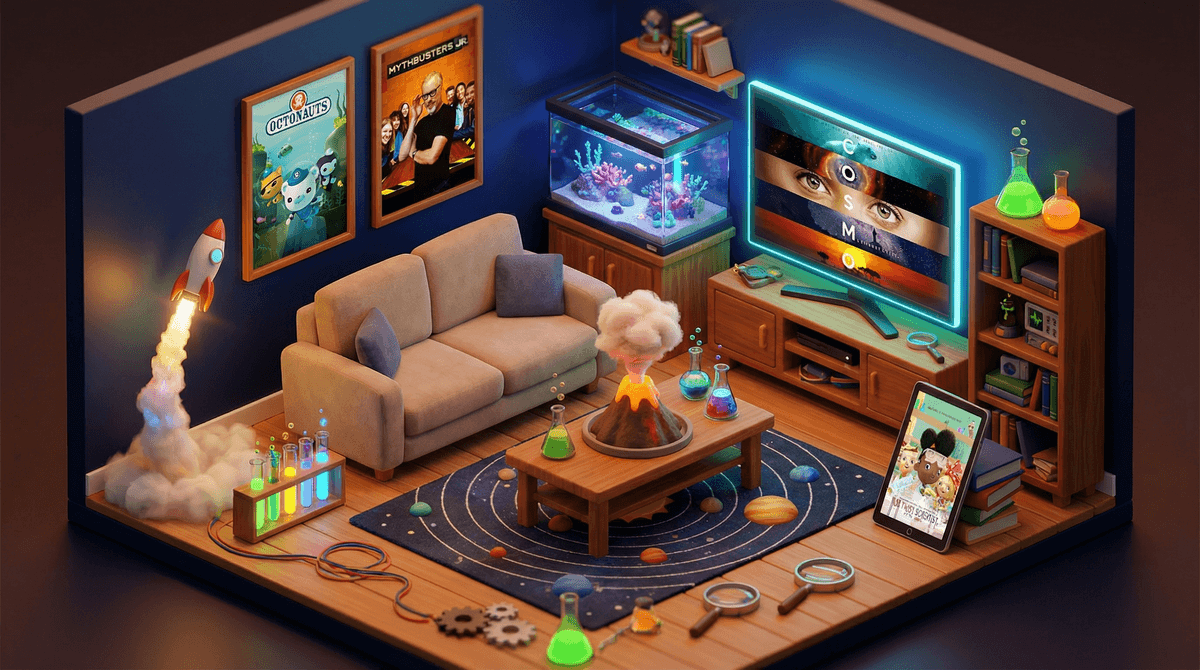
Ages 3-5: Octonauts, Sid the Science Kid, Peep and the Big Wide World
Ages 6-8: The Magic School Bus, Emily's Wonder Lab, Ada Twist, Scientist
Ages 9-12: Bill Nye the Science Guy, Brainchild, Mythbusters Jr.
Ages 13+: Cosmos, Our Planet, original Mythbusters
Not all screen time is created equal, and science shows that actually teach something can absolutely be part of a healthy media diet. The goal isn't to eliminate screens—that ship has sailed, and also, it's 2025. The goal is to be intentional about what's on those screens.
Choose shows with real educators, accurate information, and content that encourages curiosity beyond the episode. Watch together when you can. Ask follow-up questions. Maybe even try some experiments yourselves.
And when your kid inevitably wants to watch the same episode of Octonauts for the 47th time? At least they're learning about marine biology while they're at it.
Want to explore more educational content options? Check out the best educational podcasts for kids or screen time alternatives that actually work.
And if you're trying to figure out how much science content is too much, or how to balance educational shows with pure entertainment, find out how much educational screen time is appropriate about your specific situation.