

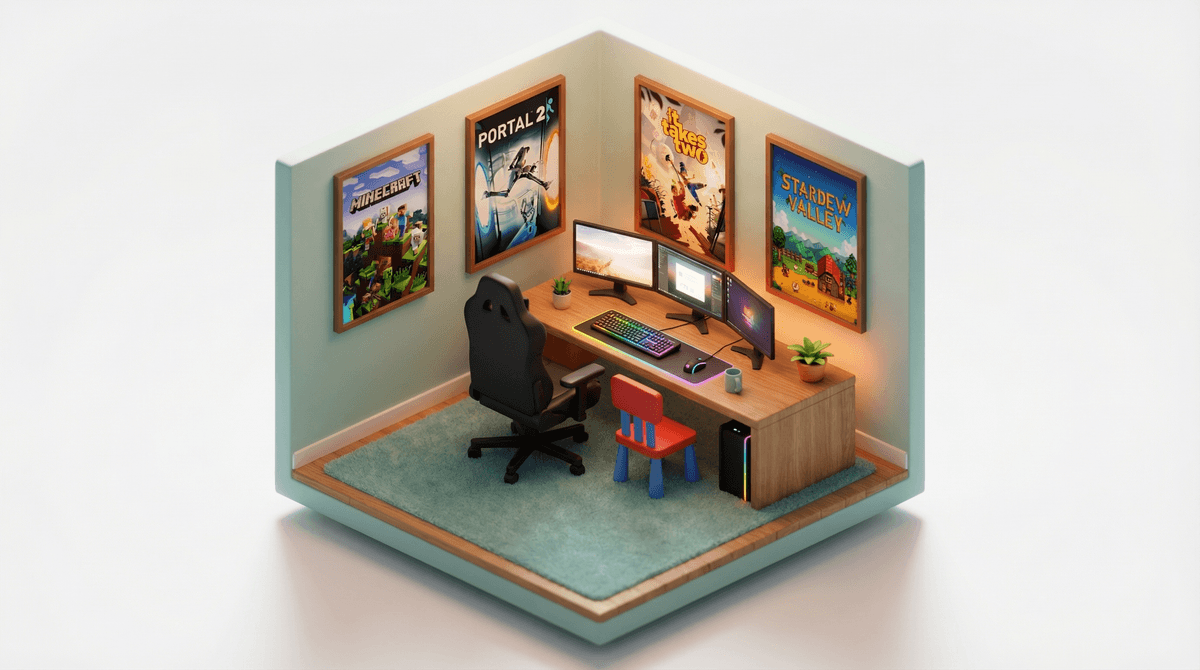
Look, I get it. When someone says "family PC gaming," you might picture everyone awkwardly crowding around a single monitor, taking turns clicking while three people stand behind going "my turn, my turn, MY TURN."
But here's the thing: PC gaming has quietly become one of the best ways for families to actually play together. We're talking true co-op experiences where you're working as a team, creative sandbox games where everyone contributes to the same world, and puzzle adventures where different ages bring different strengths to the table.
Unlike console gaming (where you need multiple controllers and the right setup), or mobile gaming (where everyone's isolated on their own device), PC co-op gaming hits this sweet spot. One computer, multiple players working together, and games that actually require communication and collaboration. Plus, PC games tend to be less about twitch reflexes and more about strategy, creativity, and problem-solving—which means age gaps matter less.
It's naturally collaborative. The best family PC games aren't competitive—they're cooperative. You're literally on the same team, working toward the same goal. This changes the entire energy compared to games where someone wins and someone loses (and then someone cries and someone gloats and suddenly it's bedtime for everyone).
It levels the playing field. A 7-year-old and a 12-year-old and a parent can all contribute meaningfully. The younger kid might spot visual patterns faster, the older one might handle strategy, and the parent might... well, the parent might be frantically Googling the controls, but everyone's useful.
It teaches actual skills. We're talking communication, resource management, spatial reasoning, reading comprehension, and that underrated skill of "not losing your mind when your sister makes a suboptimal move in a cooperative game."
It's screen time that doesn't feel isolating. Instead of everyone on separate devices in separate rooms, you're together. Talking. Laughing. Occasionally arguing about whether we should build the base here or over there, but still—together.
It Takes Two
Ages 10+ | 2 players | Requires 2 controllers or keyboard + controller
This is the gold standard for co-op gaming, and yes, I know it requires two input devices, but hear me out. It Takes Two is specifically designed so that both players are equally essential—you literally cannot progress without working together.
The story follows two parents going through a divorce who get turned into dolls (stay with me), and every level introduces completely new mechanics. One level you're navigating a cuckoo clock, the next you're in a snow globe. It's creative, it's gorgeous, and it's genuinely funny.
Parent note: There's some mild language and the divorce storyline might hit close to home for some families, but it's handled thoughtfully. The game is really about communication and partnership—which, let's be real, is a pretty good metaphor for parenting.
Overcooked! 2
Ages 7+ | 2-4 players | Keyboard or controllers
Overcooked is absolute chaos in the best possible way. You're running a kitchen together, chopping ingredients, cooking dishes, washing plates, and trying not to set everything on fire. Literally.
The genius here is that everyone has a clear role, but those roles shift constantly. Younger kids can handle simple tasks (washing dishes, delivering orders) while older players manage the cooking. And when the kitchen starts splitting apart or moving through space (yes, really), everyone's equally panicked.
Fair warning: this game will test your family's ability to communicate under pressure. If you can get through the later levels without someone yelling "WHO DIDN'T WASH THE PLATES?!", you're basically ready for any parenting challenge.
Minecraft
Ages 6+ | Unlimited players | One purchase, multiple accounts
Yeah, yeah, everyone knows about Minecraft. But have you actually played it with your kids, not just supervised them playing it?
Setting up a family server (or just a LAN world) transforms Minecraft from a solo building game into a genuine collaborative experience. You can work together on massive building projects, go on mining expeditions, or create elaborate redstone contraptions that definitely won't explode (they will explode).
Pro tip: Start in Creative mode for younger kids so nobody's getting frustrated by dying. Switch to Survival when everyone's comfortable with the controls and wants more challenge.
Stardew Valley
Ages 8+ | Up to 4 players | Requires separate copies for multiplayer
Stardew Valley is the cozy farming sim that somehow became a cultural phenomenon. You inherit a run-down farm and work together to build it into something beautiful—planting crops, raising animals, fishing, mining, and befriending the townspeople.
This game is perfect for families who want something lower-stakes and more chill. There's no time pressure (beyond the in-game day/night cycle), no combat (okay, there's optional combat in the mines), and no way to "lose." It's just you and your family building something together.
Bonus: The game teaches some surprisingly sophisticated concepts about resource management, planning, and delayed gratification. Your 9-year-old will learn about crop rotation and you won't even have to make it educational.
LEGO Games (Any of them)
Ages 6+ | 2 players | Drop-in/drop-out co-op
The LEGO games (LEGO Star Wars, LEGO Harry Potter, LEGO Marvel, etc.) are the reliable minivan of family gaming. They're not flashy, they're not innovative, but they absolutely get the job done.
These games nail the fundamentals: simple controls, forgiving difficulty, drop-in/drop-out co-op (so someone can join or leave without disrupting the game), and humor that works for multiple ages. Plus, if your family is into the source material (Star Wars, Harry Potter, Marvel), the nostalgia factor is real.
Portal 2
Ages 10+ | 2 players | Separate co-op campaign
Portal 2 might be the smartest puzzle game ever made, and its co-op mode is specifically designed for two players working together. You're both robots with portal guns, solving increasingly complex spatial puzzles that require genuine coordination.
This is ideal for slightly older kids (10+) who can handle more abstract thinking. The puzzles get legitimately challenging, but the satisfaction of solving them together is unmatched. Plus, the writing is hilarious—the game is genuinely funny in a way that both kids and adults appreciate.
Note: The main single-player campaign is also fantastic and totally family-appropriate, despite being rated E10+. There's no violence, just physics puzzles and dark humor.
Unrailed!
Ages 8+ | 2-4 players | Frantic railroad building
Unrailed is like Overcooked but with trains. You're working together to build a railroad track in front of a constantly moving train, gathering resources, managing your tools, and trying not to let the train derail (hence the name).
It starts simple but gets wonderfully chaotic as you add more cars to your train, navigate more complex terrain, and deal with obstacles. The key is communication and role division—someone's chopping trees, someone's mining, someone's laying track, and someone's putting out the fires that keep starting because someone (always the parent) accidentally left dynamite too close to the campfire.
Technical requirements matter. Not all PCs can run modern games smoothly. Check the system requirements before buying. Games like Minecraft and Stardew Valley run on basically anything; games like It Takes Two need more horsepower.
Controller vs. keyboard is a real consideration. Some games require controllers, some work better with keyboard and mouse. If you're serious about family PC gaming, investing in a couple of Xbox or PlayStation controllers that connect to your PC is worth it.
Multiplayer isn't always free. Some games require each player to own a copy (like Stardew Valley), while others let multiple people play on one purchase (like Overcooked). Check before you buy.
Save files and user profiles. PC games often tie progress to specific user accounts. Make sure you understand how saving works so you don't accidentally overwrite 20 hours of someone's Minecraft world (ask me how I know this is a problem).
Ages 6-8: Start with LEGO games, Minecraft in Creative mode, or Overcooked on easier levels. These kids need simple controls, forgiving gameplay, and lots of visual feedback.
Ages 9-11: Add Stardew Valley, Unrailed, and It Takes Two (with parent co-pilot). They can handle more complex mechanics and longer play sessions.
Ages 12+: Everything's fair game. Portal 2 becomes genuinely fun rather than frustrating, and you can explore more challenging co-op games together.
PC gaming for families isn't about everyone taking turns on Fortnite. It's about finding games that are designed for collaboration, where different ages and skill levels can all contribute, and where the goal is working together rather than competing.
The best family PC games create these moments where your 8-year-old spots something you missed, or your 12-year-old figures out the puzzle solution, or everyone's laughing because the kitchen in Overcooked is literally on fire and nobody knows where the fire extinguisher went.
Is it screen time? Yes. But it's screen time where you're together, communicating, problem-solving, and building something (even if that something is a digital farm or a chaotic restaurant).
And honestly? In a world where screens often mean isolation, that feels like a win.
Start simple. Don't jump straight into the most complex game. Begin with something forgiving like a LEGO game or Minecraft in Creative mode.
Set up properly. Make sure you have the right controllers, everyone can see the screen comfortably, and you've tested the game before family game night.
Establish ground rules. Decide upfront how long you'll play, how you'll handle disagreements (pause and talk it out), and what happens if someone gets frustrated.
Rotate who's "in charge." If there are leadership decisions to make, let different family members lead different sessions.
Know when to stop. If everyone's getting cranky or frustrated, it's okay to save and come back later. The game will still be there.
Want more specific recommendations based on your kids' ages and interests? Find games for your family setup or check out our guide to alternatives to Fortnite if you're looking for less intense options.