

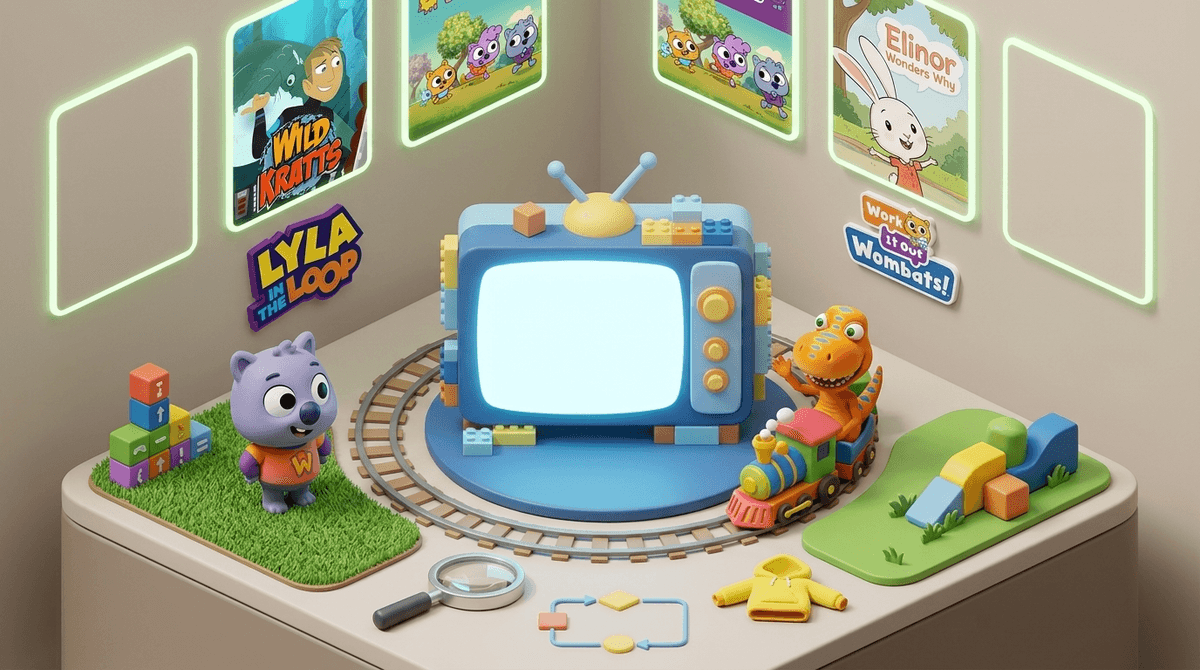
TL;DR: The STEM Starter Pack
If you’ve only got 30 seconds before a toddler starts climbing you like a jungle gym, here are the heavy hitters for preschool STEM on PBS Kids. These shows move beyond "counting to ten" and actually teach kids how to think like engineers and scientists.
- Best for Coding Logic: Lyla in the Loop
- Best for Computational Thinking: Work It Out Wombats!
- Best for the Scientific Method: Sid the Science Kid
- Best for Early Math & Logic: Peg + Cat
- Best for Nature & Observation: Elinor Wonders Why
Get a STEM media plan for your child
We’ve all been there: it’s 5:00 PM, you’re trying to get dinner on the table, and the "brain rot" fear starts kicking in. You know the one. It’s that nagging feeling that if they watch one more mindless unboxing video or a neon-colored fever dream, their ability to focus will evaporate before they even hit kindergarten.
But here’s the reality: screen time isn’t the enemy; passive screen time is.
If we’re going to park them in front of a screen so we can boil pasta in peace, we might as well make it a "learning lab." PBS Kids has spent decades perfecting the art of the "stealth education" show. They aren't just teaching kids what to think; they’re teaching them how to think.
In 2026, STEM isn't just about chemistry sets and calculators. It’s about "computational thinking"—the ability to break down a big problem into small, manageable steps. It’s the foundation for coding, engineering, and honestly, just surviving a trip to the grocery store without a meltdown.
You might think coding or engineering sounds a bit heavy for a four-year-old who still puts their shoes on the wrong feet. But preschool is actually the peak age for "inquiry." This is the "Why? Why? Why?" phase.
STEM shows at this age leverage that natural curiosity. Instead of giving them a tablet to play Roblox (which has its own merits for older kids, but can be a predatory "bank account drainer" for the uninitiated), these shows build the mental scaffolding they’ll need later for Scratch or Minecraft.
Learn more about when your kid is ready for Roblox
This is the new gold standard for "pre-coding." Lyla doesn’t sit at a computer; she solves everyday problems in her neighborhood using "computational thinking." Whether she's trying to build a more efficient way to deliver sandwiches or figuring out a "loop" (a repeating pattern) for a dance routine, she’s teaching the logic behind programming. It’s brilliant because it shows kids that "coding" is just a way of organizing your thoughts to get a result.
- Age Recommendation: 4-7
- Key Concept: Debugging, loops, and sequencing.
If Lyla is the "how-to," the Wombats are the "let’s try it." Set in a massive treehouse apartment complex called the Treeborhood, three wombat siblings use computational thinking to solve community problems. What I love about this show is that it explicitly uses terms like "algorithms" and "decomposition" (breaking a big job into small parts) in a way that doesn't feel like a lecture. It’s colorful, fast-paced, and genuinely funny.
- Age Recommendation: 3-6
- Key Concept: Algorithms and step-by-step processing.
Sid is an oldie but a goodie. Produced by the Jim Henson Company, it uses "digital puppetry" to make the characters feel incredibly lifelike. Every episode follows the scientific method: Sid has a question (Why do bananas get mushy?), he makes a hypothesis, he tests it at school with his friends, and he journals the results. It’s the perfect blueprint for how to handle your kid's "Why?" questions at home.
- Age Recommendation: 3-5
- Key Concept: The Scientific Method and observation.
This show is much calmer than the others—perfect for kids who get overstimulated by high-energy cartoons. Elinor is a bunny who is obsessed with nature. The show focuses on "biomimicry"—how humans can learn from nature to solve problems (like how velcro was inspired by burrs that stick to fur). It encourages kids to slow down, look at a leaf or a bug, and ask how it works.
- Age Recommendation: 3-5
- Key Concept: Biology and environmental science.
Math can be intimidating for parents to teach, but Peg + Cat makes it a musical comedy. They tackle "The Really Big Problem" in every episode using logic, basic geometry, and arithmetic. It’s great for showing that math isn't just about numbers on a page; it’s a tool for fixing things when they go wrong. Plus, the soundtrack is actually tolerable for adults.
- Age Recommendation: 3-6
- Key Concept: Logic, shapes, and ordinal numbers.
If your kid is in a "dino phase," this is the one. It’s produced by the Henson folks again, and it’s surprisingly rigorous. They don't just talk about T-Rex; they get into classification, paleontology, and evolution. They use the "Train" to travel through the Triassic, Jurassic, and Cretaceous periods, making the distinction between different eras of Earth's history very clear.
- Age Recommendation: 3-7
- Key Concept: Paleontology and natural history.
This is the gateway drug to harder science. The Kratt brothers combine animal facts with "Creature Power Suits" (basically superhero suits based on animal abilities). It’s a bit more high-octane, but the sheer volume of zoological information they pack into 22 minutes is impressive. Your kid will start telling you about the "force of a mantis shrimp's punch," and you'll realize they're actually learning physics through biology.
- Age Recommendation: 4-8
- Key Concept: Zoology and habitat ecosystems.
Check out our full guide on the best science podcasts for kids
The biggest mistake we make with educational TV is treating it like a babysitter. I know, I know—sometimes you just need to shower. That’s fine.
But the "Screenwise" way to do this is co-viewing. Research shows that kids learn significantly more from educational media when a parent or caregiver watches with them—or at least talks about it afterward.
You don't have to sit there for the whole 30 minutes. Just catch the last five minutes and ask:
- "What was Lyla's 'Really Big Problem' today?"
- "How did they fix it?"
- "Can we try that 'loop' dance in the kitchen?"
This moves the information from their short-term "entertainment" memory into their long-term "application" memory.
Since we’re in 2026, it’s worth noting that PBS Kids is excellent about representation and scientific accuracy. Shows like Dinosaur Train and Wild Kratts treat evolution and climate change as the settled scientific facts they are. Additionally, Lyla in the Loop and Molly of Denali (which is great for informational literacy) feature diverse leads and authentic cultural contexts without being "performative." It’s just good storytelling that reflects the real world.
If your kid is starting to show a real interest in these shows, you can bridge the gap to "active" tech.
- If they love Lyla: Try the PBS Kids Games app or the PBS Kids website. They have specific coding games that mirror the shows.
- If they love Sid: Get a cheap magnifying glass and a notebook. Go on a "Scientific Investigation" in the backyard.
- If they love Peg + Cat: Use snack time to talk about "greater than" or "less than" with crackers.
Find hands-on STEM activities based on these shows
Preschoolers are tiny scientists by default. They are constantly testing the "physics" of their world (usually by seeing how far milk splashes when they drop a cup).
PBS Kids shows like Lyla in the Loop and Work It Out Wombats! take that chaotic energy and give it a framework. It’s not "brain rot"—it’s a head start.
So next time you need that 20-minute break to regain your sanity, don't feel guilty. Just make sure they're hanging out with the Wombats or Sid. You're not just "parking them in front of the TV"; you're enrolling them in a mini-engineering seminar.
- Download the PBS Kids Video app – It’s free and doesn't have the weird algorithm issues of YouTube.
- Pick one show – Start with Work It Out Wombats! if you want to focus on logic, or Elinor Wonders Why for nature.
- Ask one question – After the show, ask your kid to explain one "new thing" they learned. Even if they say "Ohio" (because for some reason, that's what they say now), keep the conversation going.