

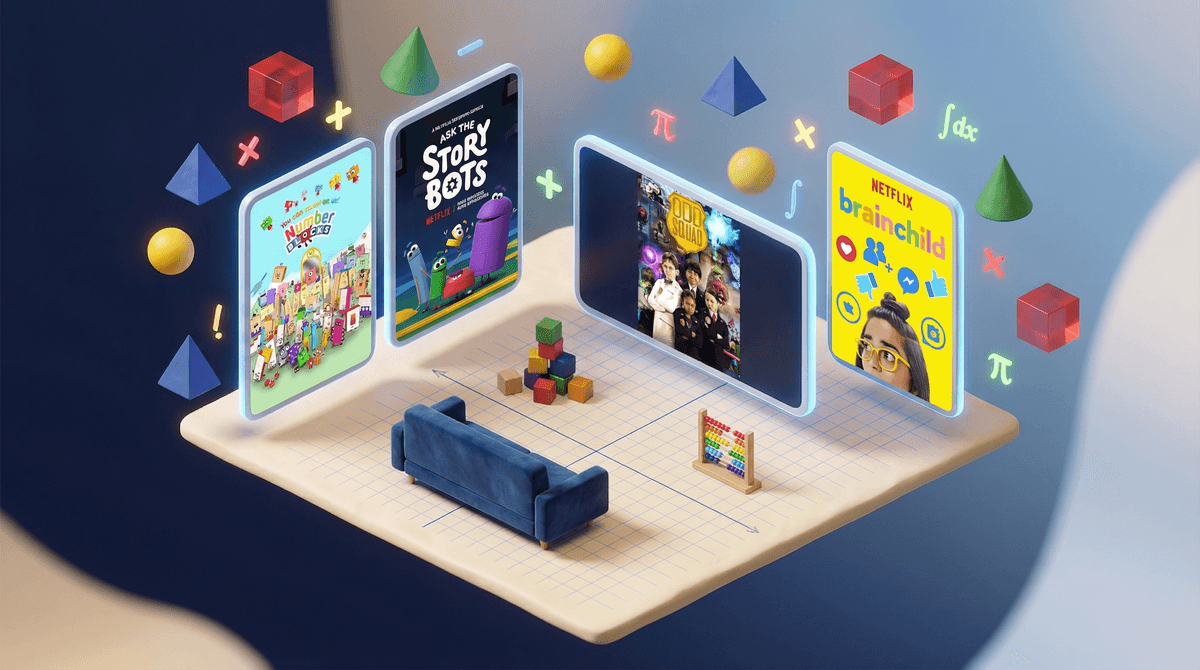
Look, we all know the guilt spiral: another hour of screen time, another episode of something that's probably turning their brains into mush. But here's the thing—not all shows are created equal. Math-integrated entertainment is exactly what it sounds like: shows that weave mathematical concepts into their storytelling so naturally that kids don't even realize they're learning.
And before you picture some dusty educational video from 1987, I'm talking about actual quality programming. Shows with real plots, characters kids care about, and math that feels like part of the adventure, not a lecture.
According to our community data, about 40% of families use Netflix regularly, and the average kid is clocking around 4.2 hours of screen time daily. If some of that time is going to happen anyway (and let's be real, it is), we might as well make it count.
Math anxiety is real, and it often starts early. Kids develop their relationship with numbers long before they hit algebra, and media plays a bigger role in that than most of us realize. When a beloved character solves problems using math, or when patterns and sequences are part of an exciting story, it normalizes mathematical thinking as something cool and useful—not just something that happens during the boring parts of school.
Plus, these shows can be genuine conversation starters. "How did they figure that out?" "What pattern did you notice?" These aren't forced teaching moments; they're natural extensions of what your kid just watched.
For Preschool & Early Elementary (Ages 3-7)
Numberblocks is legitimately brilliant. Each episode features animated number blocks that physically represent mathematical concepts—when Numberblock 3 meets Numberblock 2, they literally combine to become Numberblock 5. It makes addition, multiplication, and even early division completely visual and intuitive. My only complaint? The songs will absolutely get stuck in your head.
Octonauts sneaks in measurement, counting, and basic problem-solving through underwater rescue missions. The math isn't front and center, but it's consistently there—estimating distances, counting creatures, comparing sizes. Plus, it's genuinely entertaining enough that you won't want to gouge your eyes out during the inevitable rewatch requests.
StoryBots has specific episodes dedicated to numbers and shapes, with their signature irreverent humor that actually works for adults too. The "How Many Stars Are in the Sky?" episode is a surprisingly solid introduction to really big numbers.
For Elementary (Ages 6-10)
Odd Squad is where things get interesting. This PBS show (available on Netflix in many regions) features kid agents solving weird problems using math. We're talking pattern recognition, logical reasoning, and basic algebra concepts—all wrapped in a spy-agency aesthetic that feels like a kid-friendly Men in Black. The humor is clever, the math is integrated naturally, and kids genuinely want to figure out the solutions.
The Who Was? Show isn't strictly math-focused, but several episodes feature mathematicians and scientists, making STEM fields feel accessible and cool. The sketch comedy format keeps it moving fast enough for short attention spans.
Brainchild (produced by Pharrell Williams, if that matters to you) has an episode specifically about numbers and patterns that's genuinely engaging. It's more science-show-meets-variety-show than traditional educational content, which is exactly why it works.
For Tweens & Teens (Ages 10+)
Nailed It! might seem like just a baking competition, but there's actually a ton of applied math happening: ratios, measurements, time management, spatial reasoning. Watching contestants fail spectacularly at calculating proportions is both hilarious and secretly educational.
The Great British Baking Show (or "Bake Off" if you're fancy) is similar but more sophisticated. The technical challenges especially require precise mathematical thinking. Bonus: it's wholesome content that the whole family can actually watch together without anyone being bored or traumatized.
Abstract: The Art of Design features multiple episodes where designers discuss mathematical concepts like the golden ratio, geometric patterns, and spatial relationships. It's gorgeous, it's inspiring, and it shows how math applies to real creative work.
Not every episode needs to be educational. Seriously. If your kid watches Numberblocks one day and mindless content the next, that's fine. The goal isn't to turn every screen moment into school.
These shows work best with light engagement. You don't need to pause every three minutes to quiz your kid on what they learned. Sometimes just watching together and making occasional observations ("Wow, how did they figure that out?") is enough.
Math integration varies wildly. Some shows, like Numberblocks, are explicitly mathematical. Others, like Nailed It!, just happen to involve math as part of the activity. Both are valuable, just in different ways.
Age ratings matter less than interest level. A math-obsessed 5-year-old might love Odd Squad, while a math-phobic 8-year-old might need to start with Octonauts. Follow your kid's lead.
Perfect screen time doesn't exist, but intentional screen time does. If your kid is going to watch something anyway—and with 4.2 hours of average daily screen time in our community, they probably are—these shows offer actual value beyond just keeping them quiet for 22 minutes.
The real win isn't that these shows "teach math." It's that they normalize mathematical thinking as something interesting, useful, and even fun. That's a foundation that pays off long after the episode ends.
Not sure if your current screen time balance makes sense? Check how your family's habits compare to your community . Or if you're looking for more educational content beyond math, explore other learning-focused shows and apps.
And hey, if you try Numberblocks and can't get the songs out of your head, just know you're not alone. We're all suffering together.