

TL;DR: The 2025 "No-Skip" List
If you only have thirty seconds before your teen disappears into their room with a bag of Takis, here are the top picks that bridge the gap between "parent-approved" and "actually cool":
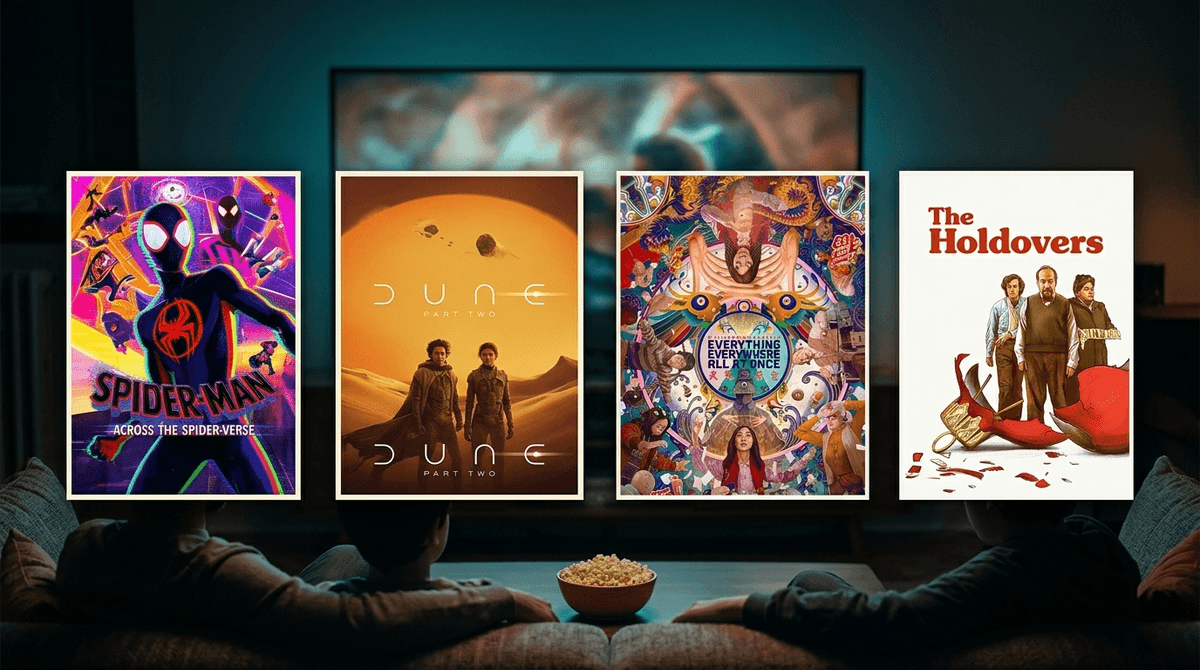
- For the Visual Learner: Spider-Man: Across the Spider-Verse — Even if they’ve seen it, the artistry holds up.
- For the Future Entrepreneur: Blackberry — It’s like The Social Network but more chaotic and funny.
- For the Deep Thinker: Everything Everywhere All At Once — Existentialism, but with googly eyes and kung-fu.
- For the Comedy Fan: Bottoms — Satirical, weird, and definitely for the older teen (16+).
- For the Music Lover: Sing Street — A 1980s Dublin vibe that somehow feels perfectly 2025.
Get movie recommendations based on your teen's favorite games
We’ve all been there. You suggest a "family movie night," and your teen looks at you like you just asked them to explain why "Ohio" is funny (spoiler: it’s not anymore, we’re onto something else now). The reality is that by the time kids hit 14 or 15, their media diet is almost exclusively algorithm-driven. They are watching 15-second clips of people "cooking" or "clutching" on TikTok or YouTube.
Sitting down for a two-hour narrative is a big ask. To get them to put the phone face-down, the movie can't feel like a lecture. It can't be "brain rot," but it also can't be a sanitized Disney+ original where everyone learns a lesson about friendship in the final act. They want authenticity, high stakes, and characters who actually speak like humans.
Movies are one of the last "shared canvases" we have. When your teen is playing Fortnite, you’re usually not in the squad. When they’re scrolling Instagram, you’re seeing a completely different feed. A movie is a controlled environment where you can witness a difficult theme—grief, consent, failure, or ambition—together. It gives you a "third party" to talk about so you don't have to grill them about their own lives.
If your teen spends any time on the internet, they already know the aesthetic of this movie. It’s fast-paced, absurd, and visually stunning. But at its core, it’s a story about a mother and daughter trying to understand each other across a generational (and literal) divide. The Conversation: It’s a perfect opening to talk about the "nothing matters" nihilism that a lot of Gen Z and Gen Alpha feel, and how to find meaning anyway. Ages: 14+ (Mild language and some very "out there" humor).
Don't let the 1970s setting fool them; this is one of the most relatable "lonely kid" movies in years. It’s about a grumpy teacher, a grieving cook, and a troubled student stuck at a boarding school over Christmas. It’s funny, it’s biting, and it treats the teenage protagonist with actual respect rather than as a caricature. The Conversation: Talk about the "masks" people wear and what it means to actually be seen by someone. Ages: 13+ (Language).
If you want to compete with Roblox or Minecraft for visual stimulation, this is it. It’s a massive, sweeping epic that demands a big screen (or at least a very good TV). It’s basically Star Wars but for people who want to think about politics, religion, and environmentalism. The Conversation: The idea of "The Chosen One" and the dangers of following charismatic leaders. Ages: 12+ (Intensity and stylized violence).
Fair warning: this one is irreverent. It’s a satirical high school comedy about two unpopular girls who start a fight club to, well, get girls. It’s a parody of every teen movie you grew up watching. If your teen has a dry, ironic sense of humor, they will love this. If you are sensitive to "raunchy" humor, maybe skip it. The Conversation: Satire—how do we poke fun at stereotypes without becoming them? Ages: 16+ (Sexual references, language, and comedic violence).
This is a survival movie (based on a true story) about a plane crash in the Andes. It is intense, harrowing, and deeply moving. Teens are often drawn to "extreme" scenarios because they’re starting to grapple with the reality of the world. This handles the "can we survive?" question with incredible dignity. The Conversation: Ethics in impossible situations. What do we owe each other when things go wrong? Ages: 14+ (Graphic depictions of a crash and its aftermath).
When we talk about "age-appropriate," we usually mean "is there a nipple or a swear word?" But for teens, "age-appropriate" often means "does this feel like it was written by a 50-year-old trying to sound 15?"
Here is how to navigate the ratings in 2026:
- PG-13 is the Sweet Spot: Most "prestige" blockbusters live here. They have enough "edge" to feel real but won't make you want to crawl under the sofa during an unexpected sex scene.
- The "Sex Scene" Anxiety: Let’s be real—nothing kills a movie night faster than an awkward, prolonged sex scene. Use Common Sense Media or check our detailed guide on movie ratings to see if a film is "safe" for your specific comfort level.
- Language: Most teens hear more profanity in one Discord call than they will in an entire R-rated movie. Focus less on the "F-bombs" and more on the context of the behavior being modeled.
Check out our guide on navigating "mature themes" with your teen
Teens are increasingly watching movies with subtitles on. It’s not because they’re hard of hearing; it’s a byproduct of consuming short-form content with captions. If they ask to turn them on, don't fight it—it actually helps with focus and retention.
Also, be prepared for the "Second Screen" struggle. Your teen will likely try to check their phone during the slow parts. Instead of making it a "no phones allowed" rule (which feels like a punishment), try to pick movies with high visual engagement or "mystery" elements that keep them guessing.
How to Talk About It (Without Ruining It)
The fastest way to make a teen hate a movie is to pause it halfway through to ask, "So, what do you think the director was trying to say about the industrial-military complex?"
Try these instead:
- The "Rating" Game: After the movie, ask them to rate it on a scale of 1-10. Then ask, "What would have made it a 10?"
- The "Character Swap": "If you were [Character X], would you have actually done that, or was that just a dumb movie move?"
- The "Soundtrack Check": "Was the music fire or mid?" (Yes, you can use "mid" if you use it correctly—meaning mediocre/average).
Finding the "best" movie for your teen isn't about finding the most "educational" film. It’s about finding a story that doesn't talk down to them. Whether it’s the multiversal chaos of Spider-Man: Across the Spider-Verse or the quiet emotional resonance of The Holdovers, the goal is shared experience.
If the movie is a dud? Own it. Say, "Wow, that was actually terrible, I'm sorry I made us watch that." Sometimes bonding over a "trash" movie is just as effective as bonding over a masterpiece.
- Audit your streaming queues: Check out our guide to the best hidden gems on Netflix.
- Set the Vibe: Dim the lights, get the good snacks, and let them pick the start time.
- Survey the Fam: Use the Screenwise Digital Habits Survey to see how your family's media consumption stacks up against your community.