

TL;DR: The Top Picks
- The "I Can't Believe It's Learning" Winner: Prodigy Math (Grades 1-8)
- The Conceptual Genius: DragonBox Algebra 5+ (Ages 5-9)
- The "Zero-BS" Free Option: Khan Academy Kids (Ages 2-8)
- The Physics-Based Visualizer: Slice Fractions (Ages 6-12)
We’ve all been there. It’s 6:30 PM, the "Ohio" jokes are flying for no reason, and your kid is staring at a math worksheet like it’s written in ancient Hieroglyphics. You want to help, but your own long division skills are... dusty. You consider letting them play a game, but you’re worried "math games" are either boring "drill-and-kill" flashcards or, worse, a "Skibidi" themed fever dream that doesn't actually teach anything.
The good news is that math games have evolved. We’ve moved past the era of simple "answer 10 questions to shoot a basketball" mechanics. The best games today actually bake the math into the gameplay. If they don’t understand the math, they can’t beat the boss. That’s the kind of motivation we’re looking for.
If your kid is obsessed with Roblox or Minecraft, they need a game with a sense of progression. They want to collect pets, level up gear, and explore worlds.
This is the heavyweight champion of elementary math. It is effectively a fantasy RPG where math problems are the "spells" used in turn-based battles.
- The Good: It is incredibly engaging. Kids will voluntarily do 50+ math problems just to evolve a digital lizard. It covers curriculum standards from 1st to 8th grade.
- The No-BS Take: The "Membership" upsell is aggressive. Your kid will see other players with cool gear and pets they can’t have unless you pay a monthly fee. It doesn't make the math better, just the cosmetics. If you can handle the "Please buy me a membership" badgering, the free version is still excellent for learning.
- Check out our guide on managing in-game purchase requests
For the younger set (K-5), this app combines math drills with a "city-building" mechanic. You earn monsters and build them homes by completing addition, subtraction, multiplication, and division challenges. It’s bright, weird, and has a great sense of humor that keeps kids from feeling the "homework" weight.
Sometimes the problem isn't that kids can't do the math—it's that they don't understand why it works. These games focus on the "logic" of math rather than just the "answers."
I cannot praise the DragonBox series enough. It is legitimately brilliant. It starts by having kids move colorful monsters around a board to "isolate" a box. Without realizing it, they are learning the core principles of algebra (canceling out terms, balancing equations). By the end of the game, the monsters turn into actual numbers and variables, and your 7-year-old is solving for X. It feels like magic.
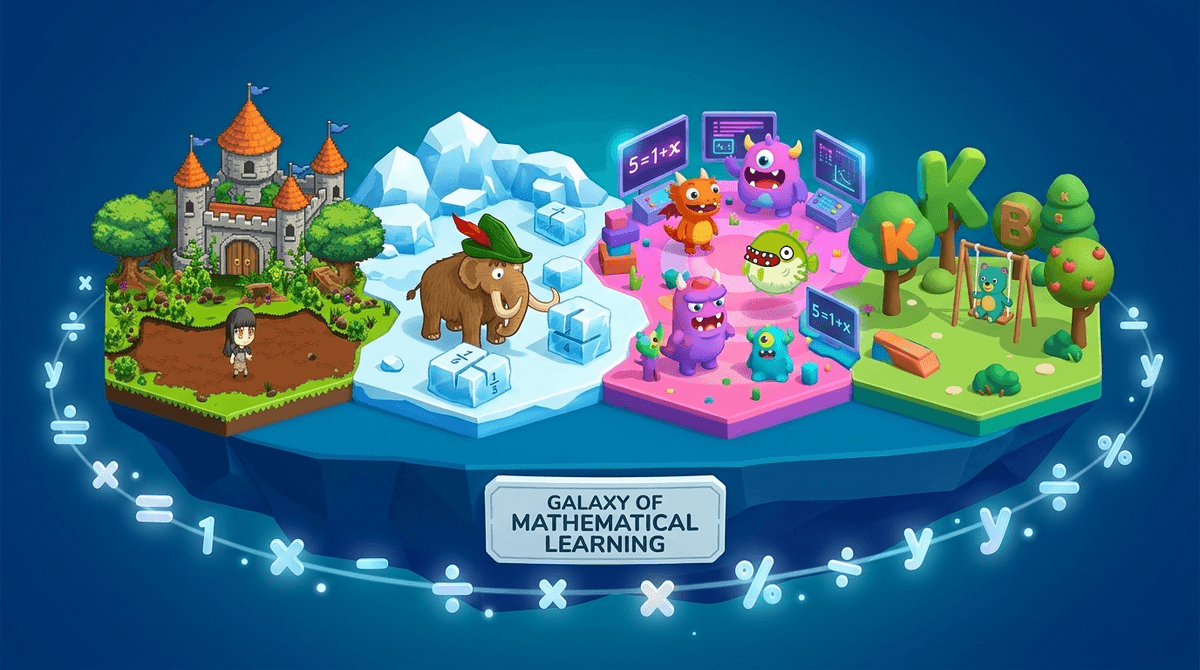
Fractions are usually where the wheels fall off the bus in 3rd or 4th grade. This game uses physics-based puzzles (think Cut the Rope) where kids have to slice through ice and lava blocks to clear a path for a mammoth. The catch? The slices represent fractions. It builds an intuitive, visual understanding of denominators that a textbook just can't match.
Sometimes you just need an app that you can hand over without worrying about ads, data tracking, or your credit card being drained for "Math Gems."
For the 2-8 age range, this is the gold standard. It’s 100% free, forever. No ads, no subscriptions. It covers everything from basic counting to early multiplication. The characters are charming, and the "Circle Time" videos are actually high-quality.
If you have an older kid (middle or high school) who thinks they "hate math," show them Mathigon. It’s often called the "Textbook of the Future." It’s highly interactive—you don’t just read about geometry; you manipulate shapes and watch them change. It’s less of a "game" and more of a digital playground for math.
If your kid mentions playing games at school, they are probably talking about these browser-based sites.
Let’s be real: Coolmath Games is mostly logic and strategy puzzles, not pure arithmetic. Your kid is probably playing Run 3 or Fireboy and Watergirl. Is it teaching them long division? No. Is it better for their brain than a mindless "unboxing" video on YouTube? Absolutely. It builds spatial reasoning and problem-solving skills.
This is the more "studious" cousin of Coolmath. It has hundreds of games categorized strictly by grade level and math topic (ratios, decimals, etc.). It’s a great place to go if they have a specific test coming up and need targeted practice that doesn't feel like a chore.
- Preschool - Kindergarten: Focus on "Number Sense." Apps like Moose Math or Endless Numbers are great for visual counting and basic patterns.
- Grades 1-3: This is the sweet spot for Prodigy Math and Math Tango. They need the "gamified" hooks to stay interested as the math gets harder.
- Grades 4-6: Focus on fractions and early algebra. Slice Fractions and DragonBox Algebra 12+ are your best friends here.
- Middle School & Beyond: Shift toward tools like Mathigon or even Brilliant.org, which focus on high-level logic and computer science.
The "Math-Washing" Trap
Not every game with "Math" in the title is good. Many low-budget apps on the App Store are just "ad-delivery systems" disguised as education. If the game interrupts your kid every 2 minutes to show a 30-second ad for a violent war game, delete it. It’s breaking their "flow state," which is exactly where the learning happens.
The "Forced Fun" Factor
If you force a "math game" during their precious one hour of Minecraft time, they will hate it on principle. Try "The Screen Time Trade." For every 15 minutes they spend in Prodigy Math, they earn 15 minutes of YouTube. It positions the math game as the "work" and the other screen time as the "reward," which matches the real-world logic they'll face later.

Math games aren't a magic wand that will turn every kid into a Fields Medal winner, but they can stop the "I'm not a math person" narrative before it takes root. By turning abstract numbers into monsters, puzzles, and spells, these apps give kids a reason to care about the answer.
If you’re only going to download one thing today, make it DragonBox Algebra 5+. It’s the rare piece of software that actually respects a child’s intelligence while still being genuinely fun.
- Survey your kid: Ask them what games they play at school during "Free Choice" time. If it's Coolmath Games, check out the "Strategy" section together.
- Check the "Freemium" settings: If you download Prodigy Math, make sure your "Ask to Buy" settings are turned on in your phone's parental controls.
- Play with them: Sit down for 10 minutes of Slice Fractions. Seeing you struggle with a puzzle (and then solve it) is the best way to model "growth mindset" without using the annoying buzzwords.
Learn more about building a healthy digital culture in your home