

Look, we all know the struggle. You want screen time to actually mean something occasionally, but you're tired of the same nature docs on repeat, and you're definitely not putting on another true crime series while your 10-year-old is in the room (learned that lesson the hard way).
Hulu has a surprisingly solid documentary collection that goes beyond "here's a penguin waddling" — though honestly, penguin waddles are underrated. These picks can actually spark the kind of dinner table conversations where your kids aren't just asking what's for dessert.
The key is finding documentaries that are genuinely engaging (not just "educational"), age-appropriate (without being condescending), and conversation-worthy (because passive viewing is still just... passive viewing).
Before we dive in, let's be real about why this matters. Documentaries teach kids that:
- Real stories can be more compelling than fiction (wild concept in the age of Marvel everything)
- Critical thinking is a skill — documentaries show perspectives, biases, and how stories get told
- The world is bigger than their school/town/bubble — and that's exciting, not scary
Plus, they're one of the few screen activities where sitting together and talking during the show is actually encouraged. Revolutionary.
Ages 6-9: Gateway Documentaries
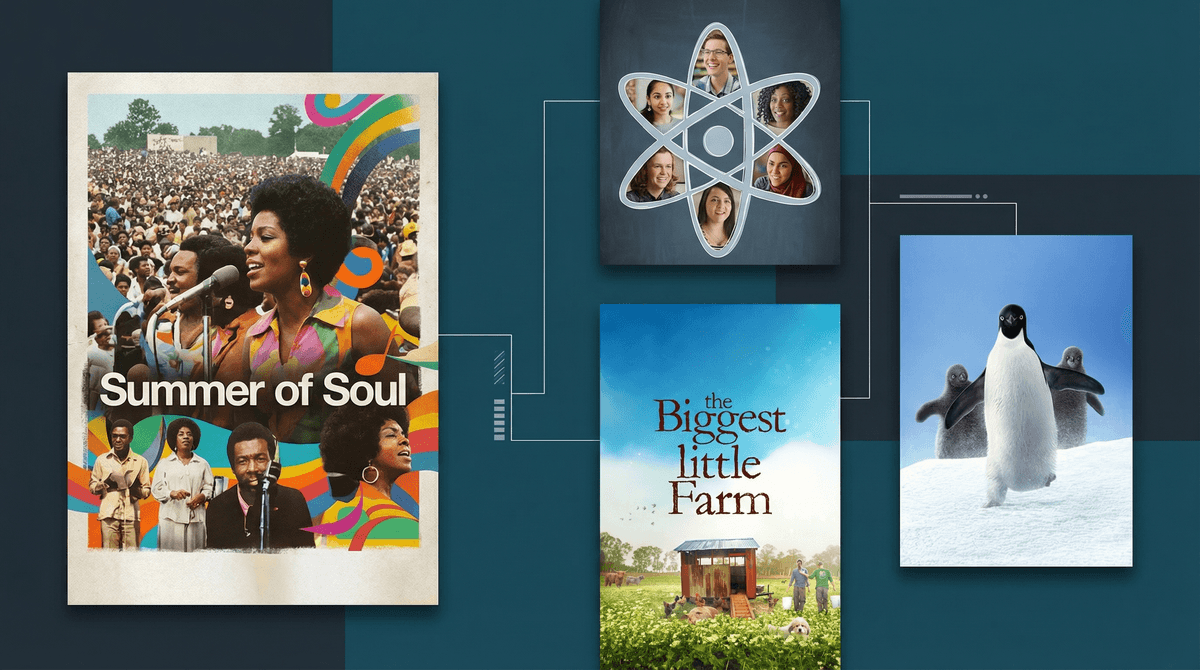
Penguins (Disneynature) Yes, I'm starting with penguins. Steve the Adélie penguin is trying to find a mate and raise chicks in Antarctica, and it's genuinely funny and sweet. The narration (by Ed Helms) doesn't talk down to kids, and there are real stakes — predators exist, chicks don't always make it. It's nature without being traumatic.
Best for: Kids who love animals but are ready to graduate from pure fluff content. Great conversation starter about ecosystems and survival.
The Biggest Little Farm A couple decides to start a farm from scratch, and it's basically an 8-year time-lapse of everything that can go wrong and right. There's a pig named Emma who becomes the emotional center of the film (you've been warned).
Best for: Kids who think food comes from stores. Shows the actual work and problem-solving that goes into sustainable farming, without being preachy about it.
Ages 10-13: Building Critical Thinking
Science Fair Follows high school students competing in the International Science Fair, and it's structured like a sports movie — complete with underdogs, rivalries, and nail-biting finishes. The kids featured are brilliant but also kids — they stress about social stuff, make TikToks (well, this was pre-TikTok, but you get it), and aren't all stereotypical "nerds."
Best for: Middle schoolers who think STEM is "not for them" or who need to see that smart kids are also cool kids. Fair warning: might inspire your kid to commandeer your kitchen for experiments.
The Social Dilemma Okay, controversial pick because some parents find it too alarmist. But for older tweens/young teens who are already on social media or begging for it, this is essential viewing. Former tech executives explain how platforms are designed to be addictive, and the dramatized segments (which some critics hate) actually help younger viewers understand abstract concepts.
Watch together and pause frequently to discuss. Don't just drop this on them and walk away — that's the digital parenting equivalent of showing a driver's ed crash video and calling it education.
Best for: Ages 12+ who are navigating or about to navigate social media. Here's how to actually talk about it afterward .
.
Ages 14+: Real-World Complexity
Minding the Gap Three young men bond over skateboarding in their Rust Belt hometown, but this evolves into something much deeper about friendship, domestic violence, and what it means to break cycles. It's raw and real — there's some language and mature themes, but it's the kind of film that treats teenagers like they can handle complexity.
Best for: High schoolers who are ready for documentaries that don't wrap everything up in a neat bow. Great for discussing masculinity, friendship, and how people process trauma differently.
Summer of Soul The 1969 Harlem Cultural Festival was basically "Black Woodstock" — same summer, 300,000 attendees, incredible performances — but the footage sat in a basement for 50 years. Questlove's directorial debut is a music documentary, yes, but it's also about cultural memory, what gets preserved vs. forgotten, and why that matters.
Best for: Teens learning about civil rights beyond the standard textbook narrative. The music is legitimately incredible, and it's a gateway to conversations about cultural erasure and whose stories get told.
Not all documentaries are created equal. Some are thinly veiled propaganda (looking at you, random conspiracy docs). Check Common Sense Media ratings if you're unsure, or honestly, just watch the first 10 minutes yourself. You'll know pretty quickly if it's legit or if it's going to tell you that aliens built the pyramids.
Co-viewing is the move here. Unlike scripted content where you can kind of zone out, documentaries benefit from the "pause and discuss" approach. "Wait, why do you think they interviewed that person?" or "Do you think this is showing both sides?" turns passive watching into active media literacy.
Some kids hate documentaries. And that's okay! If your kid is a hardcore fiction lover, don't force it. But maybe try framing it as "we're watching this together" rather than "this is educational" — the second you say educational, half of them check out mentally.
- 6-9: Stick with nature docs and feel-good stories. Avoid anything with intense animal predation or human conflict.
- 10-13: Can handle more complex topics but still need context. Watch together for anything involving social issues.
- 14+: Can engage with mature themes, but "mature" doesn't mean "traumatizing." Know your kid's sensitivities.
Hulu's documentary selection isn't as massive as some platforms, but quality over quantity, right? The key is matching the content to where your kid is developmentally — not just age-wise, but emotionally and intellectually.
And look, if you try one of these and your kid hates it? That's data. You learned something about their interests. Try again in six months, or try a different genre entirely. Sometimes the best family viewing is just rewatching Bluey for the 47th time, and that's perfectly fine too.
The goal isn't to turn every screen moment into a teachable moment. It's to have some screen moments that open doors to bigger conversations, spark curiosity, or just show your kids that real life can be as compelling as fiction.
Want more recommendations? Check out our guides on best Netflix documentaries for kids or educational YouTube channels that don't suck.
Struggling with how much documentary watching counts toward screen time limits? Let's talk about that — because honestly, it's more nuanced than you'd think.