

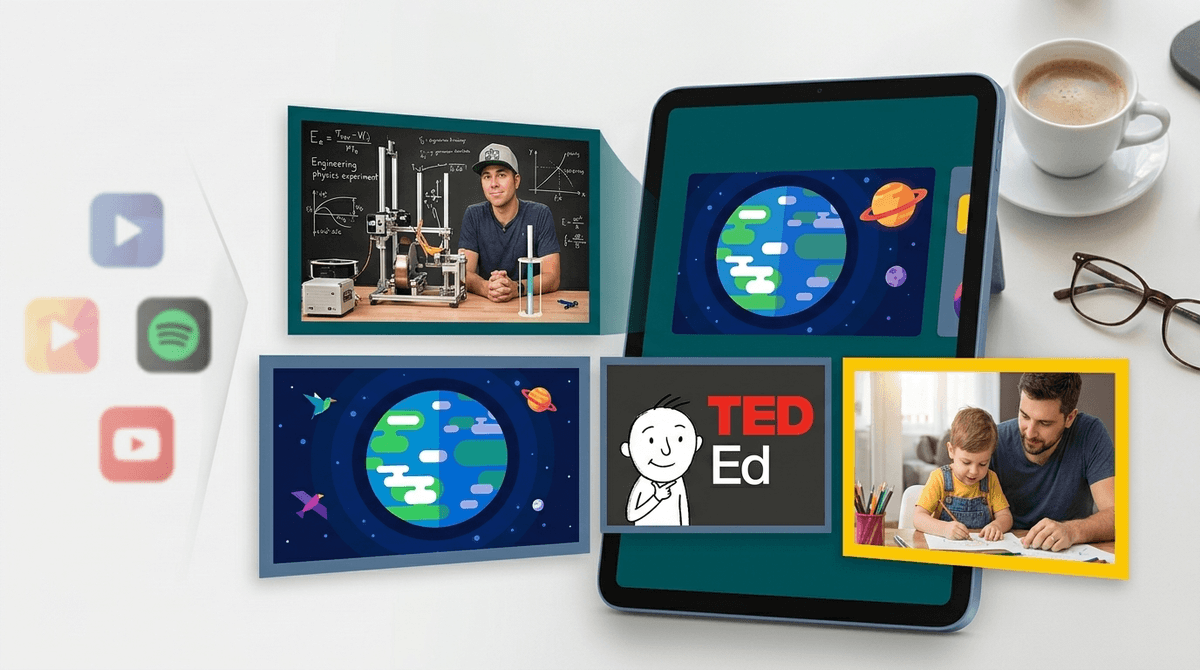
TL;DR: If you’re tired of the "Skibidi Toilet" songs echoing through your house and want to swap the brain rot for something that actually sparks a conversation at dinner, here are the heavy hitters:
- For Science & Engineering: Mark Rober and SmarterEveryDay
- For Deep Thinkers: Kurzgesagt – In a Nutshell
- For History Buffs: OverSimplified and TED-Ed
- For Creative Souls: Art for Kids Hub
Get a playlist based on your kid's interests
We’ve all been there. You hand over the iPad so you can finish a single hot cup of coffee, and twenty minutes later you find your kid deep in a rabbit hole of "Ohio" memes, loud-mouthed gamers screaming at Roblox, or those bizarre AI-generated nursery rhymes that feel like a digital fever dream.
It’s called "brain rot" for a reason. It’s low-effort, high-stimulation content designed by algorithms to keep kids clicking without ever actually engaging their brains. But here’s the thing: YouTube is also home to some of the most incredible educational content ever created. You just have to know where to point the ship.
According to recent data, over 80% of kids ages 6-12 are on YouTube weekly. Instead of fighting the platform entirely, we can curate it. Here is how to turn YouTube from a mindless time-sink into a legitimate learning tool.
If you want your kid to actually understand how the world works (and maybe learn how to build a better glitter bomb), these are the gold standard.
Mark Rober is basically the "cool uncle" of the internet. He’s a former NASA engineer who builds giant science experiments—think world-record super soakers or squirrel proof bird feeders.
- Why it works: He explains the "why" behind the physics without it feeling like a lecture.
- Age Range: 6-16. Younger kids love the spectacle; older kids actually catch the engineering principles.
Destin Sandlin explores everything from how cats always land on their feet to the physics of deep-sea creatures. It’s wholesome, deeply intellectual, and fueled by genuine wonder.
- Why it works: It models "lifelong learning." He’s not afraid to say "I don't know, let's find out."
- Age Range: 8+.
For the younger crowd who isn't quite ready for complex engineering, SciShow Kids is fantastic. They tackle "why" questions—like why is the sky blue or why do we have snot—with great visuals and clear explanations.
- Age Range: 4-8.
Sometimes kids need to see the big picture—literally. These channels use high-end animation to explain concepts that are usually too abstract for a textbook.
If you haven't seen this channel, you're missing out. They use beautiful, flat-design animation to explain things like black holes, the immune system, or the Fermi Paradox.
- The Vibe: It’s existential but accessible.
- Age Range: 10+. Some topics (like nihilism or nuclear war) might be a bit heavy for the littles, so preview the titles first.
TED-Ed is a library of short, animated lessons on... well, everything. Riddles, history, mythology, and biology.
- Why it works: They are short (usually under 6 minutes), making them perfect for kids with shorter attention spans.
- Age Range: 8+.
Check out our guide on how to use YouTube safely with supervised accounts
History in school can be dry. History on YouTube is often hilarious and weirdly memorable.
This channel explains major historical events (The French Revolution, WWII, The Cold War) using stick-figure animations and a lot of snarky humor.
- The No-BS Take: It’s funny, but it’s definitely "PG-13" in its humor style. It’s perfect for middle schoolers who think history is boring.
- Age Range: 12+.
While it leans more toward science and "truth-seeking," Veritasium often dives into the history of discoveries. It’s high-level thinking that challenges kids to question their assumptions.
- Age Range: 12+.
The best kind of screen time is the kind that leads to off-screen activity.
This is a family-run channel where a dad draws with one of his kids. It’s the most wholesome thing on the internet.
- Why it works: They show two versions of the drawing—the "pro" dad version and the "kid" version. It removes the pressure of being perfect.
- Age Range: 4-12.
For kids who want to learn 3D drawing and more technical skills, Mark Kistler is a legend (some of us might remember him from PBS back in the day).
- Age Range: 7+.
When we talk about "educational" content, we have to be careful. There is a whole genre of YouTube—think Blippi—that markets itself as educational but is mostly just high-energy "edutainment."
Is Blippi going to hurt your kid? No. Is it teaching them critical thinking? Also no. It’s the digital equivalent of a lollipop. Fine in moderation, but not a meal.
As kids get older, the risks shift from "mindless" to "misinformation." Channels like PragerU Kids or various "alpha male" commentary channels often use educational-style formatting to push specific political or social agendas. This is where your "intentional parent" radar needs to be up.
Even if you subscribe your kid to all the "good" channels, the YouTube sidebar is a temptress. It will eventually try to serve them "MrBeast-style" challenges or loud, bright, dopamine-loop videos because that’s what keeps them on the app longer.
A few pro-tips for managing the flow:
- Turn off Autoplay: This is the #1 way to stop the spiral. When one video ends, the screen should go dark.
- Use Subscriptions, Not the Home Feed: Teach your kids to go straight to their "Subscriptions" tab rather than scrolling the "Home" feed, which is just the algorithm's best guess at what will addict them.
- Watch Together (Sometimes): Watching a Mark Rober video together is a shared experience. Watching a kid unbox toys alone in a dark room is... well, depressing.
YouTube doesn't have to be the enemy. In fact, for a kid who is obsessed with a specific niche—whether it's Minecraft architecture, ancient Egypt, or how to code in Python—YouTube is the greatest library ever built.
The goal isn't to ban the "brain rot" entirely (let's be real, we all have our "trash TV" equivalents), but to ensure the ratio is skewed toward curiosity. If they’re going to be on a screen, let’s make sure they come away from it with something more interesting to talk about than a toilet with a head in it.
- Audit the Subscriptions: Sit down with your kid and look at who they actually follow. Unsubscribe from the screamers; subscribe to the creators above.
- Set a "One for One" Rule: For every "brain rot" video they watch, they have to watch one educational video.
- Check out our guide on alternatives to YouTube if you're ready to move away from the platform entirely.