

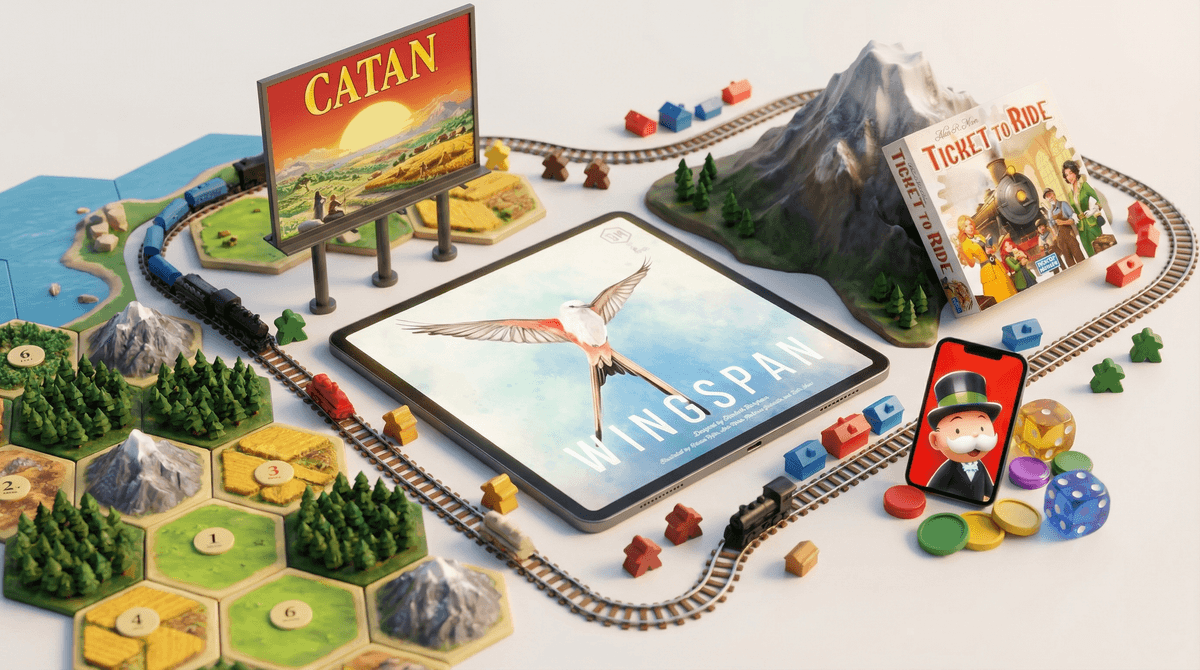
Digital board games are exactly what they sound like—your favorite tabletop games translated to screens. We're talking Monopoly, Ticket to Ride, Catan, Uno, and dozens more, all playable on tablets, phones, or gaming consoles. Some are faithful digital recreations. Others are "inspired by" versions that add gacha mechanics, daily login rewards, and in-app purchases that would make Parker Brothers blush.
The promise is beautiful: family game night without the cleanup, the lost pieces, or the inevitable flip-the-board-because-someone-landed-on-Boardwalk moment. The reality? It's complicated.
The Good Stuff:
- Accessibility: Grandma in Florida can play [Words With Friends](https://screenwiseapp.com/media/words-with-friends-game with your kid. That's genuinely cool.
- Rule enforcement: No more arguments about whether you can put a Draw 4 on a Draw 2 in Uno. The app knows the rules.
- Space-saving: A tablet holds 50 board games. Your closet thanks you.
- Solo play: Many digital versions include AI opponents, so kids can play independently.
The Tricky Part: Not all digital board games are created equal. There's a massive difference between a premium digital adaptation (you pay once, get the full game, play forever) and a free-to-play "inspired by" version that's basically a slot machine wearing a Monopoly hat.
[Monopoly Go](https://screenwiseapp.com/media/monopoly-go-game, I'm looking directly at you.
Premium Picks (Pay Once, Play Forever)
[Ticket to Ride](https://screenwiseapp.com/media/ticket-to-ride-boardgame (Ages 8+, $9.99)
This is the gold standard of digital board game adaptations. The app is gorgeous, works offline, supports pass-and-play on one device, and has online multiplayer. You can buy expansion packs (Europe, Nordic Countries, etc.) but the base game is complete. This is how it should be done.
[Carcassonne](https://screenwiseapp.com/media/carcassonne-boardgame (Ages 7+, $4.99)
Medieval tile-laying strategy that's somehow both relaxing and competitive. The digital version is excellent, with clear tutorials and multiple difficulty levels for AI opponents. Great for building spatial reasoning skills.
Splendor (Ages 10+, $6.99)
Gem-collecting strategy game that plays beautifully on tablets. Quick rounds (15 minutes), easy to learn, genuinely strategic. The digital version handles all the math, so kids can focus on planning.
[Wingspan](https://screenwiseapp.com/media/wingspan-boardgame (Ages 10+, $9.99)
Bird-themed engine-building game that's become a modern classic. The app is stunning, educational (real bird facts!), and has a peaceful solo mode. If your kid likes nature and strategy, this is it.
Free or Freemium (Proceed With Caution)
Chess.com or [Lichess](https://screenwiseapp.com/media/lichess-website (Ages 6+, Free)
Chess is chess. Lichess is completely free with zero ads—genuinely amazing. Chess.com has more features but pushes premium subscriptions. Both are excellent for learning and playing. Read more about teaching kids chess.
[Uno Mobile](https://screenwiseapp.com/media/uno-mobile-game (Ages 6+, Free with ads)
The classic card game, digitized. There are ads and some cosmetic purchases, but the core game is playable for free. Decent for quick games, though the ads can be annoying.
The "Inspired By" Games That Are Actually Slot Machines
Monopoly Go (Avoid for kids)
This is not Monopoly. This is a free-to-play mobile game that uses Monopoly branding to disguise what's essentially a slot machine with property themes. It's designed to hook you with daily rewards, limited-time events, and constant prompts to spend real money. The average player spends $8-15 per session according to some reports. Learn more about how free-to-play mechanics work .
.
Board Kings, Dice Dreams, etc.
Same deal. These are casino-style games wearing board game costumes. They're not teaching strategy or family bonding—they're teaching gambling mechanics to children.
Ages 5-7: Stick to simple classics like [Uno](https://screenwiseapp.com/media/uno-boardgame or Checkers. Look for apps with no in-app purchases and offline play. Pass-and-play on one device works better than online multiplayer at this age.
Ages 8-12: [Ticket to Ride](https://screenwiseapp.com/media/ticket-to-ride-boardgame, [Carcassonne](https://screenwiseapp.com/media/carcassonne-boardgame, Splendor, and Blokus are all excellent. These teach genuine strategy, planning, and spatial reasoning. Online multiplayer is fine with family members.
Ages 13+: [Wingspan](https://screenwiseapp.com/media/wingspan-boardgame, [Root](https://screenwiseapp.com/media/root-boardgame, Through the Ages. These are complex strategy games that can hold their own against physical versions.
Read the monetization model before downloading. If it's free, ask yourself how they're making money. Ads? Data collection? In-app purchases? A $10 game that you own forever is infinitely better than a "free" game that nickel-and-dimes you.
Physical board games still matter. Digital versions are convenient, but they can't replace the social skills built through face-to-face gameplay—reading body language, handling winning and losing gracefully, the tactile satisfaction of moving pieces. Use digital versions as supplements, not replacements.
Watch out for online multiplayer with strangers. Many board game apps have chat features and random matchmaking. If your kid is playing online, know whether they can communicate with strangers and what safety features exist.
Check if it actually works offline. Some "digital board games" require constant internet connection even for solo play. This is usually a red flag that they're tracking data or serving ads.
The best digital board games are the ones that respect your time and wallet—premium apps like [Ticket to Ride](https://screenwiseapp.com/media/ticket-to-ride-boardgame, [Carcassonne](https://screenwiseapp.com/media/carcassonne-boardgame, and [Wingspan](https://screenwiseapp.com/media/wingspan-boardgame that you pay for once and own forever. They're worth every penny for long car rides, quiet afternoons, or connecting with distant family members.
The worst are the free-to-play imposters that slap familiar branding on gambling mechanics. Monopoly Go isn't teaching your kid about real estate—it's teaching them that spending money feels exciting.
When in doubt, ask: Would this game work if you removed the ability to spend money? If the answer is no, it's not a board game. It's a store with a game attached.
- Start with one premium game that matches your family's interests. [Ticket to Ride](https://screenwiseapp.com/media/ticket-to-ride-boardgame is the safest bet for most families.
- Set up family tournaments with digital versions of games you already own physically.
- Create a "no in-app purchase" rule for kids' devices to avoid surprise charges.
- Explore alternatives to screen-based gaming with our guide to the best physical board games for families.
Digital board games can absolutely bring families together—as long as you're playing actual games, not glorified slot machines.