

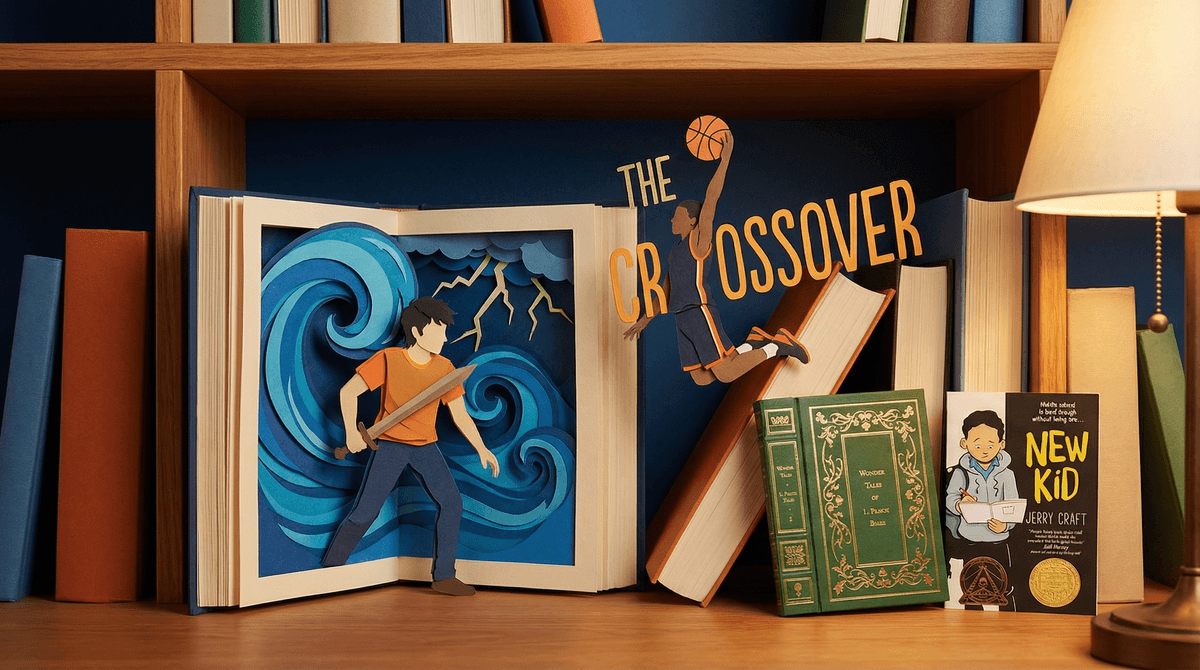
Best Books for 6th Graders: Building Readers Who Love to Read
TL;DR: Sixth grade is peak tween territory—they're too old for picture books but not quite ready for full adult themes. The sweet spot? Stories with complex characters navigating identity, friendship, and justice. Here are the books that actually get passed around classrooms and keep kids reading past bedtime:
Quick picks by vibe:
- Fantasy escapism: Percy Jackson, Keeper of the Lost Cities
- Real-world heart: Wonder, The Crossover
- Mystery & adventure: The Westing Game, Holes
- Funny & weird: The Absolutely True Diary of a Part-Time Indian
Here's what's happening developmentally: 6th graders are in this fascinating cognitive sweet spot where they can handle moral complexity, understand multiple perspectives, and grapple with abstract concepts—but they still have that magical ability to fully inhabit a fictional world. They're forming their identities, testing boundaries, and figuring out who they want to be.
And here's the uncomfortable truth: this is the year many kids stop reading for pleasure. The competition from Roblox, YouTube, and Discord is fierce. Academic reading gets heavier. Social lives get more complex. If we lose them now, we might lose them as readers entirely.
The solution isn't to ban screens (good luck with that). It's to find books that compete on the same playing field—stories so compelling they can pull kids away from infinite scroll.
Let's start with the gateway drug. If your 6th grader hasn't discovered Percy Jackson yet, drop everything and get this book. Percy is a 12-year-old with ADHD and dyslexia who discovers he's the son of Poseidon and gets pulled into a world where Greek gods are real, monsters want to kill him, and his learning differences are actually demigod superpowers.
Why it works: The humor is genuinely funny (not trying-too-hard-to-be-relatable funny), the action moves fast, and Riordan makes ancient mythology feel immediate and relevant. Plus, there are five books in the main series and multiple spin-off series, so if they love it, you've got years of reading material.
Reading level: Upper elementary to middle school, but don't let that fool you—plenty of adults are fans. The writing is accessible without being dumbed down.
Heads up: There's combat violence (monsters get defeated/killed), but it's fantasy violence without gore. The Disney+ show adaptation is solid if they want to see it come to life.
This is the book that makes middle schoolers cry in the best way. Auggie Pullman was born with severe facial differences and has been homeschooled his whole life. In 5th grade, he decides to go to regular school for the first time. The book follows his first year through multiple perspectives—Auggie's, his sister's, his friends'—showing how kindness and cruelty ripple through a school community.
Why it works: It's the rare book that tackles empathy and difference without being preachy. The multiple perspectives show that everyone is fighting their own battles, and the precepts ("When given the choice between being right or being kind, choose kind") actually resonate with kids.
Real talk: Some parents worry this book will teach kids to be mean because it shows realistic middle school cruelty. That's missing the point. Kids already know kids can be mean—this book shows them why that matters and how to be better.
Perfect for: Kids navigating friendship drama, anyone who's ever felt like an outsider, families talking about inclusion and disability.
A novel in verse about twin brothers who are basketball stars navigating family, first love, and growing apart. Josh and Jordan Bell have always been a unit—on and off the court. But this year, everything's changing.
Why it works: The verse format makes it feel fast-paced and accessible (great for reluctant readers), but the emotional depth is real. Alexander captures the intensity of sibling relationships, the pressure of living up to parental expectations, and the fear of losing what defines you.
Bonus: This book makes basketball feel like poetry, even if your kid has never touched a ball. And there are sequels (Rebound, Booked) that work as standalone novels.
Content note: There's a significant family health crisis that's handled with care but might be heavy for some kids. Good opportunity for conversations about grief and loss.
Stanley Yelnats is sent to Camp Green Lake (which is neither green nor a lake) for a crime he didn't commit. The boys there are forced to dig holes in the desert every day, supposedly to build character. But Stanley starts to suspect there's more to the story.
Why it's brilliant: This book is a masterclass in plotting. Multiple timelines weave together in ways that feel magical when they click. It's funny, it's weird, it deals with justice and injustice, and the ending is so satisfying you want to immediately reread it knowing what you know.
Perfect for: Kids who like puzzles and mysteries, anyone interested in stories about systemic injustice, reluctant readers (it moves fast and the chapters are short).
Fun fact: The movie adaptation is one of the rare cases where it's actually good and faithful to the book. Shia LaBeouf's breakout role.
In a seemingly perfect community where pain, war, and suffering have been eliminated, 12-year-old Jonas is chosen to be the Receiver of Memory—the one person who holds all the memories of the past, both beautiful and terrible.
Why it matters: This is often assigned reading, but it holds up as genuine literature. It's a gateway to dystopian fiction and raises profound questions about free will, emotion, and what makes life worth living.
Discussion gold: The ending is famously ambiguous, which drives kids crazy (in a good way). Great for family book clubs or dinner table debates.
Content considerations: There are mature themes—euthanasia, the suppression of sexuality, state control. But they're handled in age-appropriate ways that open up important conversations rather than shutting them down.
Sophie Foster has never fit in—she's a 12-year-old genius who can hear people's thoughts. Then she discovers she's not human; she's an elf who was raised in the human world. She's brought to the Lost Cities, a magical elf civilization, where she finally belongs... or does she?
Why kids devour it: This is an 800+ page book that 6th graders will finish in days. It's got everything—magic, mystery, conspiracy, found family, and a slow-burn romance subplot that doesn't overwhelm the story. Plus, there are currently nine books in the series with more coming.
Parent perspective: These books are LONG, and the series commitment is real. But if your kid is a fantasy reader, this will keep them occupied for months. Think of it as the middle-grade answer to Harry Potter.
Bonus: The author is active on social media and engages with fans, which makes kids feel connected to the story world.
Junior is a 14-year-old budding cartoonist living on the Spokane Indian Reservation. When he decides to transfer to an all-white high school off the reservation to get a better education, he's caught between two worlds—seen as a traitor by his community and an outsider at his new school.
Why it's powerful: This book is funny and heartbreaking, often on the same page. It deals with poverty, alcoholism, racism, and loss without being a "problem novel." Junior's voice is authentic and his cartoons (drawn by Ellen Forney) add another layer of storytelling.
Real talk: This book is frequently challenged/banned, which tells you it's doing something right. There's some profanity, sexual references, and discussions of masturbation—all age-appropriate for 6th grade and handled with humor rather than gratuitousness. That said, know your kid and your family values.
Perfect for: Kids ready for more mature content, discussions about identity and belonging, understanding perspectives different from their own.
Sixteen people are invited to the reading of eccentric millionaire Samuel Westing's will. They're divided into pairs and given clues to solve the mystery of who killed him. The winner gets his $200 million fortune.
Why it's a classic: This is one of those books that rewards close reading. The clues are all there if you pay attention. Kids love trying to solve it before the characters do, and it's genuinely clever—not dumbed down or obvious.
Perfect for: Mystery lovers, puzzle solvers, kids who like escape rooms, anyone who needs to understand that books written in 1978 can still slap.
Pro tip: This is excellent for family read-alouds because everyone can participate in solving the mystery together.
Thirteen-year-old Brian is flying to visit his father when the pilot has a heart attack and the plane crashes in the Canadian wilderness. Armed with only a hatchet his mother gave him, Brian must survive alone.
Why boys especially love it: (Though plenty of girls do too.) It's a pure survival story—building shelter, making fire, hunting food. No romance subplot, no chosen-one prophecy, just a kid figuring out how to not die. The writing is spare and immediate.
What parents appreciate: It's about resourcefulness, resilience, and self-reliance. Brian makes mistakes, learns from them, and grows. There's real character development wrapped in adventure.
Series note: There are several sequels, but Hatchet works perfectly as a standalone.
A graphic novel about Jordan Banks, a Black kid from Washington Heights who gets a scholarship to a prestigious private school where he's one of the few kids of color. He navigates microaggressions, code-switching, and figuring out how to stay true to himself.
Why it matters: This book won the Newbery Medal (the first graphic novel to do so), and it earned it. It's funny, it's insightful, and it makes complex issues around race, class, and identity accessible without being didactic.
For reluctant readers: Graphic novels are REAL BOOKS, full stop. If your kid is more likely to read a graphic novel than a traditional novel, that's a win. New Kid is substantial and sophisticated—over 250 pages of genuine storytelling.
Series: Class Act is the companion novel, equally good.
6th grade reading levels vary wildly. Some kids are reading at a 9th grade level, others are still building fluency. The books here range from upper elementary to early high school reading levels, but they're all developmentally appropriate for 11-12 year olds in terms of themes and content.
What to watch for:
- Violence: Most middle-grade books have some conflict/action, but it's rarely graphic. Percy Jackson has monster battles, Holes has a violent scene with a rattlesnake. Know your kid's sensitivities.
- Romance: There might be first crushes or hand-holding, but nothing beyond that. If there's kissing, it's brief and sweet, not detailed.
- Language: Some books (The Absolutely True Diary) have realistic language including profanity. Others are squeaky clean.
- Mature themes: Books like The Giver deal with heavy concepts (euthanasia, control), but in ways that prompt discussion rather than nightmares.
The golden rule: If you're unsure, read it first or read it together. But also trust that your 6th grader can handle more than you think. They're navigating complex social dynamics at school every day—books give them a safe space to process those experiences.
"My kid says reading is boring": They probably mean "the books I've been assigned are boring" or "I haven't found MY book yet." The solution isn't to force them to read classics—it's to help them find books that match their interests. Loves Minecraft? Try books about game design. Into true crime podcasts? Mystery novels. Obsessed with YouTube gaming channels? There are books about esports.
Graphic novels count: If your kid will read Dog Man but won't touch a chapter book, that's still reading. Build from there. New Kid, Smile, and Amulet are graphic novels with real substance.
Series are your friend: Once a kid finds a series they love, they'll read voraciously. Don't fight it. Yes, the 47th Wings of Fire book might not be high literature, but a kid who's reading is a kid who's building vocabulary, empathy, and imagination.
Reading time competes with everything: You can't just say "read more"—you have to create space for it. That might mean designated screen-free time, reading before bed instead of scrolling, or family reading time where everyone reads their own book in the same room.
Let them quit books: If they're not into it after 50 pages, let them move on. Life's too short to finish books you hate, and forcing it creates negative associations with reading.
The best book for your 6th grader is the one they'll actually read. That might be Percy Jackson for the third time, or a graphic novel you've never heard of, or—yes—even fanfiction they found online.
The goal isn't to create a literary scholar. It's to build a human who sees reading as pleasure, as escape, as a way to understand themselves and others. Everything else is bonus.
Next steps:
- Take your kid to the library or bookstore and let them browse. Let them pick books by covers, by vibes, by whatever draws them in.
- Ask their teacher or librarian what's popular right now in their school. Kids are social readers—they want to read what their friends are reading.
- Read some of these books yourself. You'll understand your kid better, and you'll have something to talk about together that isn't homework or screen time.
- If they love a book, help them find similar ones. Get recommendations based on what they've already loved
 based on what they've already loved.
And remember: a kid reading on a Kindle is still reading. A kid listening to audiobooks while drawing is still experiencing stories. Don't let perfect be the enemy of good.