

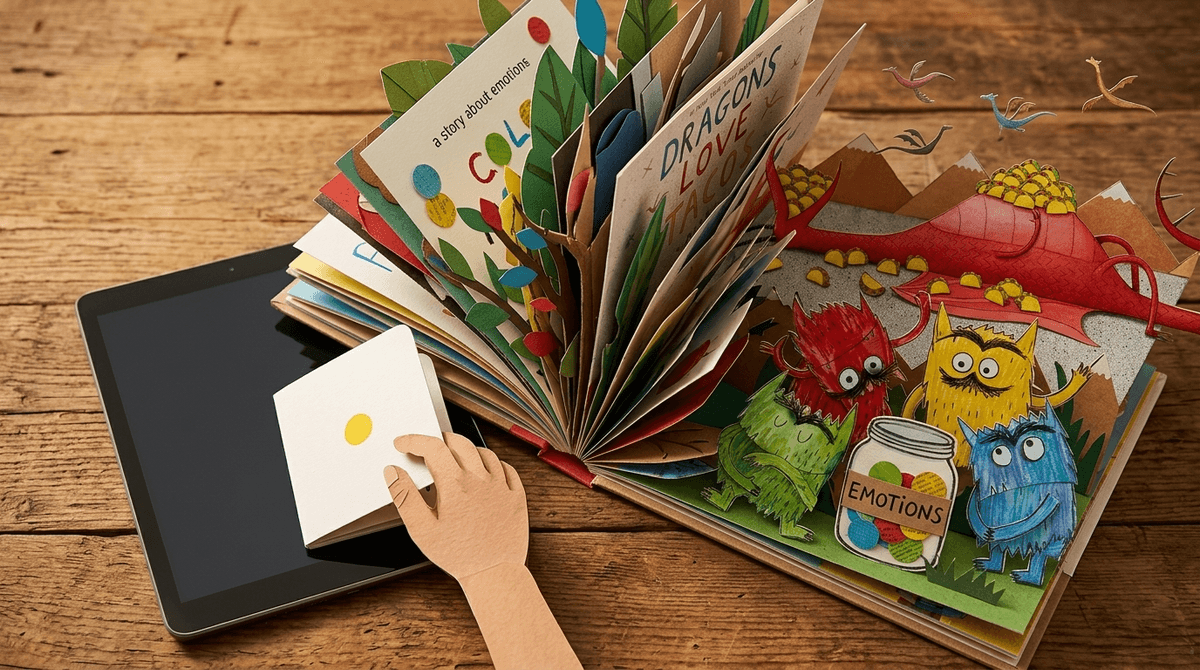
TL;DR: The 5-Book Starter Pack for 3-Year-Olds If you only buy five books this year to keep your preschooler away from the YouTube Kids algorithm, make it these:
- The "Interactive" One: Press Here by Hervé Tullet
- The "Laughter" One: The Book with No Pictures
- The "Feelings" One: The Color Monster
- The "New Classic": Dragons Love Tacos
- The "Bedtime" One: Goodnight, Goodnight, Construction Site
At age three, your kid is at a massive developmental crossroads. They’re moving away from the "point and say the word" phase of toddlerhood and into the "wait, why did the dragon do that?" phase of actual storytelling.
This is also the age where the siren call of the tablet becomes incredibly loud. If they’ve already discovered the hypnotic, high-speed dopamine loops of Cocomelon or the chaotic energy of Blippi, a standard board book might feel… well, boring.
To compete with a 60-fps animated screen, a book for a 3-year-old needs to do one of three things: it needs to be hilarious, it needs to be interactive, or it needs to tap into their burgeoning sense of "I can do it myself."
Here is how to build a library that actually builds their brain without making you want to claw your eyes out during the tenth consecutive reading.
If your kid is used to tapping and swiping, you need books that treat the page like an interface. These are the gateway drugs to longer attention spans.
This book is genius because it’s "analog interactive." It asks the child to press a yellow dot, tilt the book, or shake it. When they turn the page, the dots have moved or changed color. It teaches cause-and-effect better than most "educational" apps without the blue light.
Three-year-olds are starting to understand the power of language and the absurdity of adults saying "wrong" things. This book forces the reader (you) to say ridiculous things like "Beedle (the movie) Bub" or "I am a monkey who taught myself to read." It’s a power trip for the kid and a masterclass in why books are fun.
Similar to Press Here, this relies on the "forbidden fruit" of a single red button. It’s short, punchy, and perfect for kids who are currently obsessed with pushing every actual button in your house.
Three is the year of the "Threenager." They have big, "Ohio-level" weird emotions and zero ways to process them. Books are the best tool we have to give them a vocabulary for their meltdowns.
This is the gold standard for teaching kids that emotions aren’t "bad," they’re just jumbled. It associates colors with feelings (Yellow = Happy, Blue = Sad, Red = Anger). It’s basically Inside Out but for the preschool set.
If your 3-year-old has separation anxiety at bedtime, this is your bible. It acknowledges the "drama" of a child waiting for their parent without being dismissive. Plus, the rhyme scheme is catchy enough that they’ll start "reading" it back to you within a week.
Sometimes kids (and parents) are just in a bad mood for no reason. This book is a great reminder that you don’t always have to "fix" a mood immediately. It’s okay to just be grumpy for a bit.
This is where we move away from simple concepts and into actual plots. We’re trying to build the focus they’ll eventually need for school (and to eventually handle longer media like Bluey or Minecraft without losing their minds).
It’s weird, it involves a party, and there is a "disaster" involving spicy salsa. It has a clear beginning, middle, and end. It’s also visually stimulating enough to keep them off the "brain rot" path.
This might be on the edge of the 3-to-4-year-old range, but the humor is top-tier. It introduces the idea of different perspectives—why is the Blue crayon tired? Why is the Orange crayon fighting with the Yellow one? It’s a great intro to "theory of mind."
Look, we all know Bluey is the only show we actually enjoy watching with them. The book version of the "Sleepytime" episode is a masterpiece. It’s beautiful, it’s emotional, and it bridges the gap between their favorite screen character and the physical act of reading.
Check out our guide on why Bluey is the gold standard for kids' media
At 3, you aren't just looking for "cute" stories. You're looking for specific mechanical features in a book:
- Rhythmic Language: Books with a beat (think Dr. Seuss or Chicka Chicka Boom Boom) help with phonological awareness.
- Predictability: 3-year-olds love to know what’s coming next. It makes them feel smart and in control.
- Detailed Illustrations: They should be able to "read" the pictures even if they can't read the words. Look for books where the background art has its own little sub-plots.
- Durability: They’re still a little rough. While we’re moving into paper pages, "heavyweight" paper or reinforced bindings are your friend.
We aren't anti-tech here at Screenwise, but we are pro-balance. Research shows that when parents read a physical book with a child, the "dialogic reading" (the back-and-forth conversation about the story) is significantly higher than when they use an e-book or a tablet app.
That conversation is where the magic happens. It’s where they learn that "frustrated" is a word for how they feel when their LEGO tower falls. It’s where they learn to predict consequences.
If your kid is currently "brain-rotted" from too much YouTube, don't panic. Just start swapping one 15-minute video session for two of the "Interactive" books mentioned above.
Learn more about the impact of early screen time on attention spans
You will be asked to read the same book 400 times. This isn't your kid trying to torture you. It’s how they learn. Each time you read The Very Hungry Caterpillar, they are picking up a new nuance—the days of the week, the names of the foods, the concept of metamorphosis.
Pro-tip: If a book is "simply unwatchable" (or in this case, unreadable) for you, get rid of it. If you hate reading it, they’ll sense it. There are enough incredible books out there that you don't need to suffer through poorly written celebrity-authored vanity projects or cheap tie-ins for Paw Patrol.
The best book for a 3-year-old is the one that makes them forget the tablet exists for twenty minutes. Focus on humor, interaction, and emotional resonance. You're not just teaching them to read; you're teaching them how to focus in a world designed to distract them.
Next Steps
- Audit your shelf: Donate the "baby" board books they've outgrown.
- Create a "Book Nook": Make books as accessible as the TV remote.
- Get a library card: Let them pick out books based on the covers—it builds autonomy.
Check out our full guide on transitioning from board books to picture books