

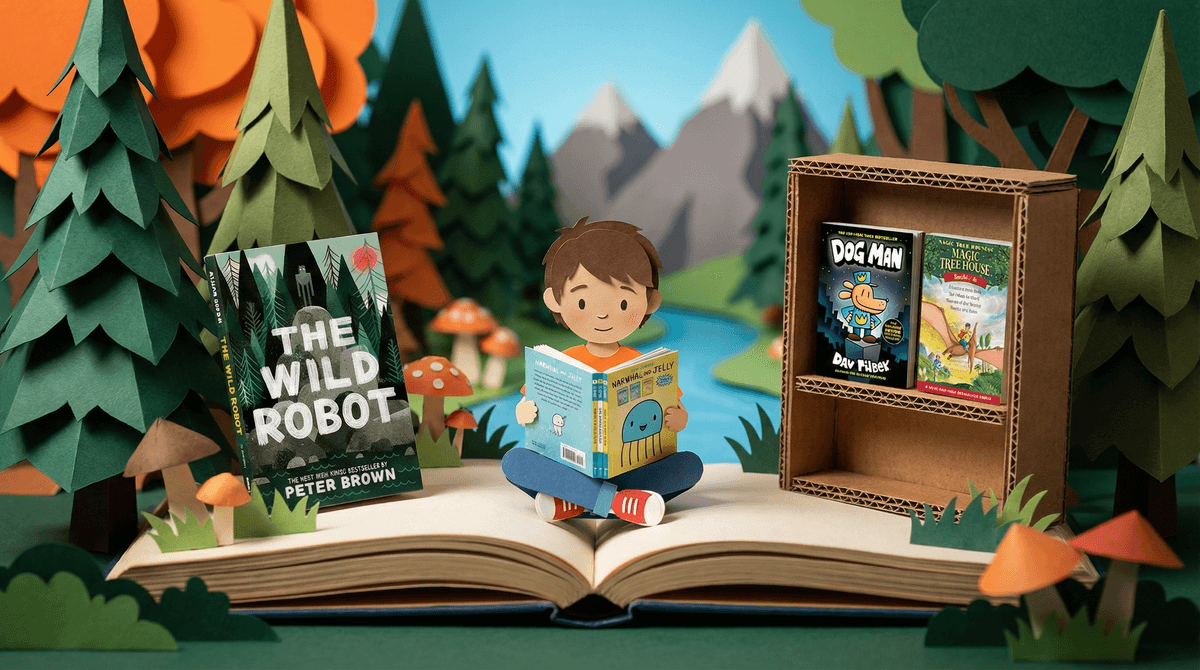
Here's the thing about second grade reading lists: they're everywhere, they're all different, and most of them are either too easy (your kid finished those in kindergarten), too hard (hello, tears at bedtime), or just... boring.
Second graders are at this wild sweet spot where they're transitioning from "learning to read" to "reading to learn." Some are devouring chapter books independently, while others are still working through early readers. And here's what makes it even more fun: both kids might be in the same classroom, and both are totally normal.
The best reading list for your second grader isn't the one that some curriculum committee decided was "grade appropriate." It's the one that gets your kid actually excited to read. Which means we need to talk about what makes a book click for a 7-year-old.
If you're feeling overwhelmed, you're not alone. Second grade is when the reading pressure really amps up. Schools start tracking reading levels more seriously (hello, Lexile scores and DRA levels). Other parents start humble-bragging about their kid reading Harry Potter. And suddenly you're wondering if your kid is "behind" because they'd rather look at the pictures in Dog Man than tackle a "real" chapter book.
Let's clear something up right now: graphic novels are real books. Comics are real reading. And a kid who's engaged with "easier" books is doing better than a kid who's struggling through "harder" books just to hit some arbitrary level.
The research is pretty clear here: kids who enjoy reading become better readers. Kids who are forced to read books that are too hard or don't interest them? They start to hate reading. And that's way harder to fix than a reading level.
Here's what to look for when building your second grader's reading list:
Books at the right level: Your kid should be able to read about 95% of the words independently. If they're stopping to sound out words every other sentence, the book is too hard for independent reading (though it might be perfect for reading together).
High-interest topics: Does your kid love dogs? Space? Fart jokes? Princesses who fight dragons? Start there. A book about their passion at a slightly lower reading level will do more for their skills than a "grade-level" book about something they don't care about.
Series books are your friend: Once a kid finds a series they love, they'll often power through books way faster because they already know the characters and the world. Don't fight this. Lean into it.
Mix it up: Graphic novels, chapter books, poetry, nonfiction, joke books, comics. All of it counts. All of it builds different skills.
For Kids Who Love Funny Books
-
Dog Man series by Dav Pilkey: Yes, it's basically potty humor in comic form. It's also getting millions of kids to read voluntarily. The series teaches about storytelling, has surprising emotional depth, and the comic format helps struggling readers follow along.
-
Junie B. Jones series: Controversial because Junie B. has terrible grammar, but kids absolutely love her. And you know what? Kids don't actually start talking like Junie B. They just enjoy reading about a kid who makes mistakes.
-
The Bad Guys series: Graphic novels about villains trying to be heroes. Fast-paced, funny, and surprisingly sophisticated storytelling.
For Kids Who Love Adventure
-
Magic Tree House series: The gateway chapter book series. Jack and Annie travel through time, and each book sneaks in actual history and science. There are like 30+ books, so if your kid likes them, you're set for months.
-
The Wild Robot by Peter Brown: A robot stranded on an island learns to survive with the animals. Beautiful illustrations, touching story, and works great as a read-aloud if your kid isn't quite ready to tackle it solo.
-
Mercy Watson series by Kate DiCamillo: About a pig who loves toast and gets into adventures. Short chapters, big illustrations, perfect for kids just moving into chapter books.
For Kids Who Love Real Stuff
-
Who Was/What Was series: Biographies and history books written at an accessible level. If your kid is obsessed with dinosaurs, space, or historical figures, start here.
-
National Geographic Readers: Leveled nonfiction with actual photographs. Great for kids who find fiction boring but will read about sharks for hours.
For Kids Who Love Characters Like Them
-
Ivy and Bean series: Two very different girls become best friends. Great for exploring friendship dynamics.
-
Yasmin series: Features a Pakistani American second-grader solving everyday problems. Short chapters, relatable situations.
-
Stella Díaz series: About a shy Mexican American girl finding her voice. Deals with anxiety and bilingual family dynamics in an age-appropriate way.
Let's address the elephant in the room: "But are graphic novels real reading?"
Short answer: Yes. Full stop.
Longer answer: Graphic novels require kids to synthesize information from text and images, follow complex narratives across panels, and interpret visual storytelling cues. That's sophisticated literacy work. Plus, for reluctant readers or kids with dyslexia, graphic novels can be the gateway that keeps them reading.
Some solid graphic novel series for second grade:
Here's the dirty secret about reading levels: they're useful tools for teachers, but they're not the whole story. A book can be "level M" and still be completely wrong for your kid if the content doesn't interest them or if the themes are too mature (or too babyish).
Most second graders fall somewhere between Guided Reading levels J-M, or Lexile levels 300-600. But that's a huge range, and your kid might be outside it and still be totally fine.
Instead of obsessing over levels, watch for these signs a book is working:
- Your kid picks it up without being nagged
- They can retell what happened
- They're not stopping to sound out words constantly
- They're asking for the next book in the series
You know what gets kids excited about reading? Letting them pick books that interest them, even if those books seem "too easy" or "too weird" to you.
Make regular library trips. Let your kid wander the shelves. Let them check out books about Minecraft or Pokémon or whatever they're into, even if you think it's junk. You can sneak in your picks too ("Hey, this one looks cool, should we try it?"), but give them agency.
And if they want to reread the same book seventeen times? That's actually great for fluency and comprehension. Let them.
Don't worry if:
- Your kid prefers graphic novels or comics
- They're rereading the same books over and over
- They're "behind" other kids but making progress
- They'd rather have you read to them sometimes
Do check in if:
- Your kid is actively avoiding reading or getting very upset about it
- They're not making any progress over several months
- They can't retell anything about what they just read
- Reading is causing major family stress
If you're genuinely concerned, talk to their teacher. They can help you figure out if your kid needs extra support or if you just need to find the right books to spark their interest.
The best second grade reading list is the one that gets your specific kid reading. Not your neighbor's kid, not some idealized version of your kid, but the actual 7-year-old in front of you who might love fart jokes or horses or robots or all three at once.
Your job isn't to force them through some prescribed list of "quality literature." Your job is to help them discover that reading can be fun, interesting, and worth their time. Everything else—the skills, the levels, the comprehension—follows from that.
So yes, let them read Dog Man. Let them read the same book about sharks twelve times. Let them read books that seem too easy. Just keep books in front of them, keep the pressure low, and trust that a kid who enjoys reading will become a good reader.
This week: Take your kid to the library or bookstore and let them choose three books. Any three books. Don't veto their choices. See what happens.
This month: Try a new series based on their interests. If they love one book, grab the next three in the series.
Ongoing: Read together every day, even if it's just 10 minutes. Let them read to you, you read to them, or you take turns. Make it cozy and low-pressure.
And if you want to dig deeper into specific books or series, Find age-appropriate books for your kid —because the right book for a second grader who loves science is very different from the right book for one who loves princesses or sports.