

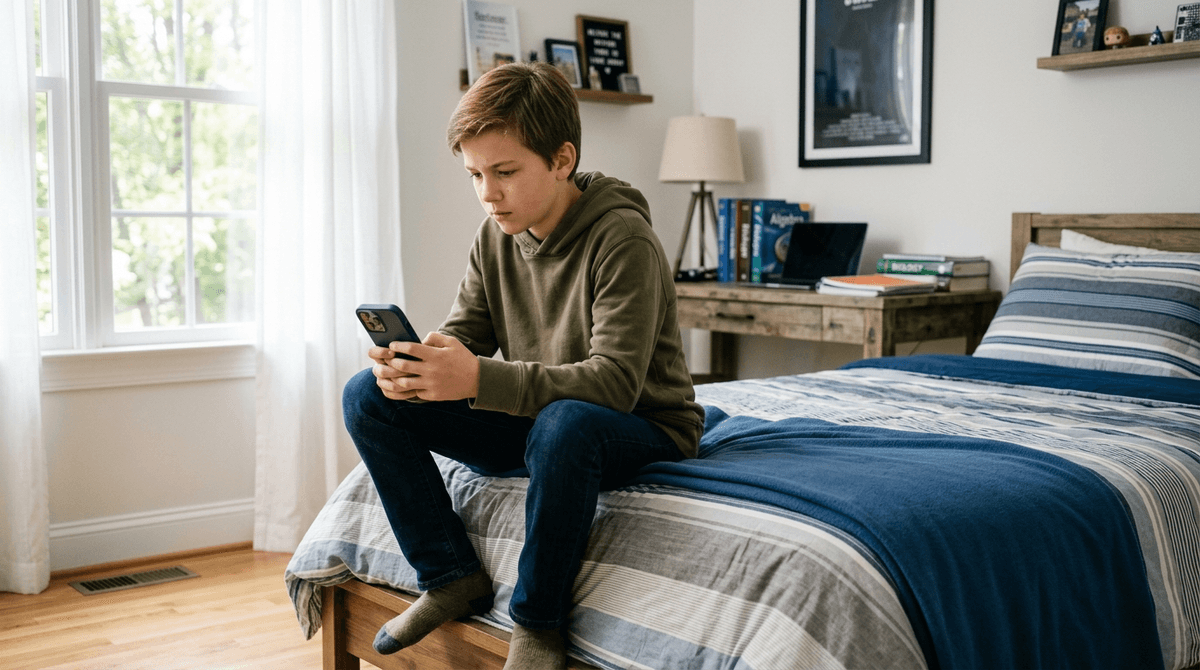

Keeping devices out of your child's bedroom and setting strict caps on daily screen time are two of the strongest digital boundaries you can enforce to protect them from cyberbullying. Meanwhile, weaponizing screen time as a reward or punishment actually backfires, making kids more vulnerable online.
Keeping screens out of bedrooms and off the dinner table reduces an early adolescent's risk of being cyberbullied, while using device time as a bargaining chip for behavior raises their odds of online harassment.
Most parents try to prevent online harassment by monitoring what their kids watch or installing tracking apps. This research shows that basic environmental rules—like where devices live and when they get turned off—matter significantly more than micromanaging content.
Establishing clean physical boundaries gives middle schoolers a safe harbor from group chats and social media drama during vulnerable evening and mealtime hours.
As kids enter middle school, their digital lives migrate from shared family spaces to private channels, making unmonitored harassment harder for parents to catch. Researchers wanted to identify which daily parenting habits actually buffer against cyberbullying versus which ones accidentally amplify it.
Analyzing data from nearly 10,000 American middle schoolers reveals that physical boundaries and strict time limits protect kids online, while using tech as leverage causes harm.
- Bedrooms are high-risk zones: Kids allowed devices in their bedrooms had nearly a third higher chance of being cyberbullied and almost a 45% higher chance of cyberbullying others.
- Dinner table screens invite trouble: Allowing devices during family mealtimes was associated with a 14% higher chance of being cyberbullied.
- Carrots and sticks backfire: Using screen time as a reward or taking it away as a punishment raised a child's odds of being cyberbullied by 18%.
- Time caps work: Setting firm rules on total daily screen time was the only studied tactic linked to a lower risk (a 20% reduction) of being cyberbullied.
- Your own scrolling isn't the problem: A parent's personal screen habits had zero measurable impact on whether their child experienced or participated in cyberbullying.
When screen time becomes a currency for good behavior or bad grades, kids stop coming to their parents when things go wrong online. If a child fears losing their phone as punishment, they will hide online harassment rather than seek help, leaving them exposed to ongoing abuse.
Similarly, bedroom screen access strips away the natural cooling-off period kids need late at night when group chat dynamics turn hostile.
Because this study looked at a snapshot in time, it shows clear links between parenting rules and cyberbullying, but it cannot definitively prove that screen limits directly prevent bullying.
The findings rely on self-reported answers from teenagers, who frequently underreport when they are the ones picking on others. Additionally, while these parenting practices move the needle, broader social dynamics at school play an equally large role.
- If your child currently sleeps with their phone or tablet in their room… …move charging stations to a shared area like the kitchen counter before bedtime.
- If you frequently take away phone privileges as a discipline tactic… …switch to non-digital consequences so your child stays comfortable confiding in you about online problems without fearing device confiscation.
- If your family struggles with screens during dinner… …establish a strict "no devices at the table" rule to ensure unmonitored active screen time stops during shared family meals.
- If you are deciding which digital boundary to prioritize first… …focus on setting a hard daily cap on interactive screen time rather than attempting to review every message or post.
You don't need to hover over your middle schooler's screen or feel guilty about your own device habits to keep them safe online. Focus your energy on two non-negotiables: keep devices out of bedrooms overnight and set a firm daily limit on total screen time.
Nagata JM, Yen F, Paul A et al. (2026). Media Parenting Practices and Early Adolescent Cyberbullying: Findings From the Adolescent Brain Cognitive Development Study. The Journal of adolescent health : official publication of the Society for Adolescent Medicine. doi:10.1016/j.jadohealth.2026.04.021 — pubmed.ncbi.nlm.nih.gov