

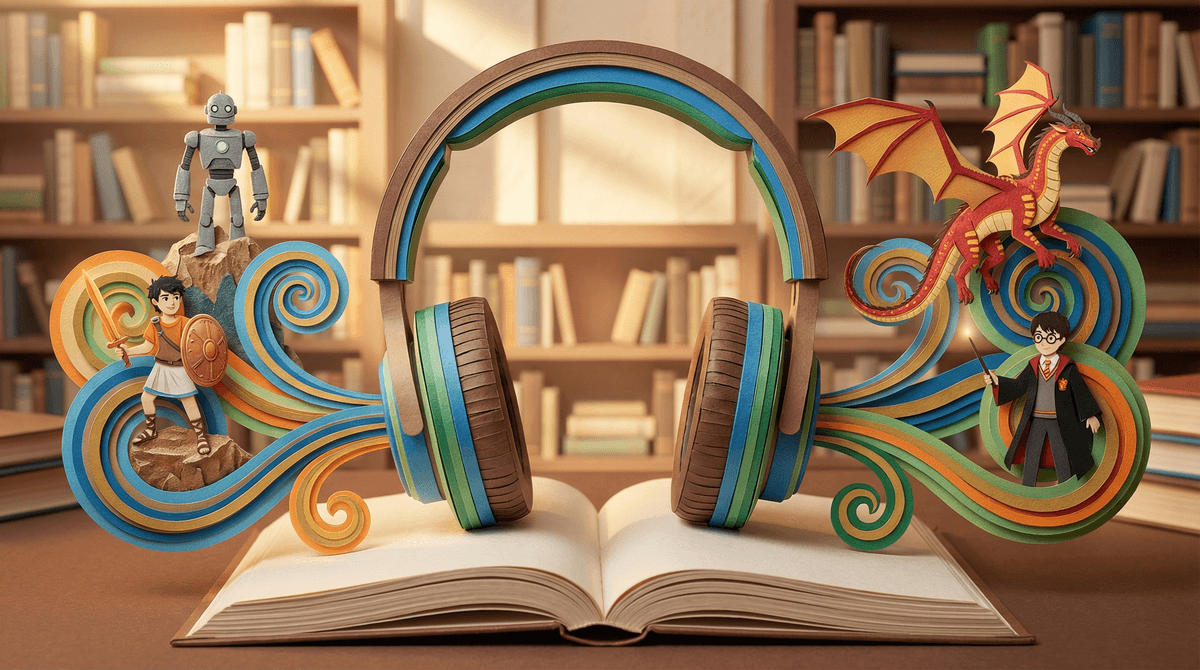
TL;DR: Science shows that the brain processes stories similarly whether you’re reading with your eyes or your ears. Audiobooks aren't a "shortcut"—they’re a legitimate literacy tool that builds vocabulary, improves focus, and can actually turn "reluctant readers" into book lovers.
Quick Links for the Audiobook Journey:
- Best Apps: Libby, Audible, Epic!
- Top "Listen-Aloud" Books: The Wild Robot by Peter Brown, Percy Jackson, Wings of Fire
- Non-Fiction/Podcasts: Wow in the World, Brains On!
We’ve all been there: your kid is sprawled on the couch, eyes glazed over, headphones on. You think they’re watching some questionable "Skibidi Toilet" remix on YouTube, but then they look up and say, "Did you know that in the 1800s, people used to use bread as erasers?"
They’re listening to a book. And while a part of you is thrilled they aren't rotting their brain with Roblox tycoons, another part of you—the part that remembers the smell of library paste and the struggle of "silent reading time"—is wondering: Does this actually count?
There’s a nagging feeling that audiobooks are "cheating." That if they aren't decoding the letters on a physical page, they aren't doing the "work" of reading. But it’s time to retire that guilt. If your kid is obsessed with audiobooks, they aren't taking the easy way out; they’re engaging in a high-level cognitive process that might be doing more for their brain than you realize.
In 2019, researchers at the University of California, Berkeley, did something pretty cool. They put people in MRI machines and had them listen to stories from The Moth Radio Hour. Then, they had those same people read the same stories.
The result? The brain maps for both activities were nearly identical. The "semantic system"—the part of the brain responsible for processing the meaning of words—lit up in the exact same spots regardless of whether the input was visual or auditory.
When your kid listens to Harry Potter, their brain is building the same mental imagery, making the same emotional connections, and following the same complex plot lines as it would if they were holding a 500-page hardcover.
For a lot of intentional parents, the goal is "literacy." But literacy isn't just the ability to turn a "C-A-T" sound into a "cat" image. It’s about comprehension, vocabulary, and narrative stamina. Audiobooks actually have some unique advantages over physical books in these departments:
1. Vocabulary Exposure
Kids can often understand spoken language at a much higher level than they can read it. A 3rd grader might struggle to decode words like "formidable" or "melancholy" on a page, but if they hear a professional narrator use them in the context of The Chronicles of Narnia, they get it. Audiobooks allow kids to access "stretch" content that would be too frustrating to read physically.
2. Emotional Intelligence and Nuance
A great narrator—like Jim Dale or Stephen Fry—brings a level of sarcasm, irony, and emotion to a text that a developing reader might miss. Hearing the tone of a character helps kids understand subtext, which is a massive part of critical thinking.
3. Narrative Stamina
We live in a world of 15-second TikTok videos. Getting a kid to sit with one story for ten hours is a win, period. Audiobooks build the "stamina" for long-form storytelling, which eventually translates back to physical books.
To be clear: audiobooks are not a replacement for learning how to read.
If you have a 1st or 2nd grader who is still learning "decoding" (the physical act of turning letters into sounds), they still need that "eyes on page" time. Audiobooks don't teach phonics. They don't help with spelling. If your kid only ever listens and never looks at a word, they’re going to have a hard time writing a grocery list, let alone a college essay.
Think of it like this:
- Physical Reading is the workout. It’s the heavy lifting of decoding and visual processing.
- Audiobooks are the protein shake. They provide the "nutrition" of story, vocabulary, and complex ideas that fuel the desire to keep working.
If you want to lean into this, you need content that actually works in audio format. Not every book makes a good audiobook. (Pro tip: books with lots of diagrams or "choose your own adventure" styles are usually a disaster in your ears).
Ages 5-8: The Gateway Listens
At this age, you want high energy and clear voices.
- This is the gold standard. The narration is calm but engaging, and the story about a robot stranded in the wilderness is basically "Baby's First Existential Crisis" in the best way possible.
- Short, funny, and great for kids who still need a bit of a "cartoon" vibe in their stories.
- Okay, it’s a podcast, but for this age group, it’s the perfect bridge. It’s loud, it’s "Ohio" (weird/random), and it’s actually educational.
Ages 9-12: The "Hooked" Years
This is where audiobooks can save a kid from the "middle grade slump."
- Rick Riordan’s humor translates perfectly to audio. If your kid thinks reading is "boring," give them this.
- There are a billion of these. If they get into the audiobooks, you’ve just secured about 100 hours of quiet car rides.
- For parents who want something "literary" but still cool. It’s told by multiple narrators and feels like a medieval movie.
Ages 13+: The YA Deep Dive
- The tension is even higher when someone is whispering the "Girl on Fire" exploits into your ears.
- If you have a kid who likes science or Minecraft, this is the one. The audiobook version uses actual sound effects for one of the characters that makes the physical book feel almost inferior.
Check out our full guide on best audiobooks for reluctant readers
Don't just default to the most expensive option.
- Libby: If you aren't using Libby, you’re literally throwing money away. It connects to your local library card and lets you borrow audiobooks for free. The interface is great, and it works with CarPlay.
- Audible: Best for those niche titles Libby doesn't have, or for building a permanent library. Their "Plus Catalog" has a lot of "brain rot" adjacent stuff that kids love but parents might find annoying.
- Epic!: Great for the younger set (under 10). It has "Read-to-Me" books which highlight the words as they go—a perfect middle ground.
- Yoto Player: If you want to keep your kids off screens entirely, the Yoto is a physical device that plays "cards." It’s expensive, but it’s a great way to give a 6-year-old autonomy over their listening.
Here is the truth: some audiobooks are terrible. If the narrator sounds like a depressed Siri, your kid will check out in five minutes. If the book is a "novelization" of a video game like [Minecraft](https://screenwiseapp.com/media/minecraft-game, the quality is usually... questionable. It’s okay to be a bit of a snob here. A bad audiobook is just noise; a good one is an experience.
Also, watch out for "Autoplay." Some apps will roll straight from a wholesome story into a random podcast or a more mature title. Always check the queue.
Instead of asking "Did you finish your reading?", try:
- "What’s happening in the story right now?"
- "Does the narrator make the characters sound how you imagined?"
- "I heard a cool word in your book—do you know what it means?"
Treat it like a movie or a show you’re watching together. When you validate audiobooks as "real" stories, you remove the stigma and make your kid feel like a "reader"—even if they haven't picked up a physical book in weeks.
Is it "cheating"? No. Is it different? Yes.
In a world where we are constantly fighting for our kids' attention against algorithms designed to keep them scrolling, an audiobook is a massive win. It’s a way to reclaim the "theatre of the mind."
If your kid is "reading" with their ears, they are still building the infrastructure of a literate, imaginative human being. Let them hit play.
Learn more about how to balance audiobooks and physical reading