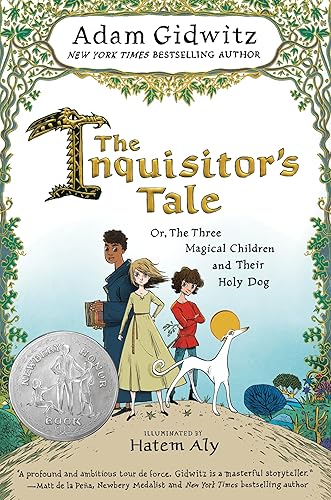
The Inquisitor's Tale

The Inquisitor's Tale

book

2018, Children's Books, Literature & Fiction

WISE
85%

WISE Score

4.6

Amazon

Three magical kids and a zombie dog race across medieval France fighting prejudice, farting dragons, and the Inquisition—Newbery Honor brilliance.

Amazon4.6
Common Sense Media

Where to Read

Our reviews and ratings are 100% unbiased, but as an Amazon Associate, Screenwise earns an affiliate fee if you buy a book or game by clicking one of our links. We don't get any credit if you just Google it instead :)

Screenwise Verdict

This is what a smart middle-grade novel looks like: Newbery Honor winner that doesn't sacrifice fun for worthiness. Gidwitz nails the balance between absurdist medieval romp (zombie greyhound! farting dragon!) and genuinely important themes about religious tolerance and persecution.

The Canterbury Tales structure is brilliant—multiple narrators at an inn telling stories about three magical kids—and teaches narrative framing without feeling like homework. The historical research is deep (there's a bibliography), but it never bogs down the adventure.

The intensity is real though. A dog gets killed, a Jewish village burns, knights are set on fire. It's significantly less gory than Gidwitz's Grimm series, but sensitive kids might struggle. One Catholic parent found the irreverent treatment of relics off-putting, so if your family takes miracles very seriously, heads up.

But for kids ready for it? This is the rare book that's both genuinely entertaining and enriching. It'll spark conversations about prejudice, what makes someone holy, and why people fear what they don't understand. At 350+ pages with complex storytelling, it's for confident readers—but they'll actually finish it, which is more than you can say for most award winners.
Age Fit

Best for confident readers 9-14 who can handle medieval violence (dog death, village burning, battle scenes) in the context of historical adventure. The sophisticated narrative structure and heavy themes (religious persecution, anti-Semitism) require emotional maturity, but Gidwitz's humor keeps it accessible.

WISE Breakdown
Wholesome
78

Models friendship across religious and social divides (Christian oblate, Jewish refugee, peasant girl with visions). Themes of tolerance, courage, and standing up against persecution are emotionally healthy. Some intense scenes (dog killed, village burned, knights set on fire by dragon) but handled within medieval adventure context. Less gory than Gidwitz's Grimm series. Tone balances humor with serious themes of prejudice.

Imaginative
88

Brilliantly structured as Canterbury Tales-style frame narrative with multiple storytellers at an inn. Three kids with magical powers (super-strength, healing, visions) plus a resurrected greyhound. Farting dragon, chase across medieval France, showdown at Mont Saint-Michel. Manuscript illuminations throughout. Gidwitz's signature blend of absurdist humor and genuine historical detail creates a world that's both fantastical and grounded.

Safe
72

Several dramatic/disturbing scenes per parent guides: dog killed, village burned by anti-Semitic mob, William battles fiends with donkey leg, knights set alight, armies swallowed by quicksand. Addresses heavy themes of religious persecution, book burning, prejudice. Not graphic by modern standards but intense for sensitive readers. Significantly less gory than A Tale Dark and Grimm. No sexual content, profanity, or modern trigger warnings beyond violence/persecution themes.

Enriching
91

Newbery Honor winner with serious historical depth—detailed historical note and bibliography included. Tackles religious tolerance, anti-Semitism in 1242 France, book burning, questioning authority and miracles. Canterbury Tales structure teaches narrative framing. Richly researched medieval period detail. Prompts questions about faith, persecution, what makes someone holy. Strong 4.6 Amazon rating suggests broad appeal. Sophisticated without being preachy.

Parent Info
✓

Why It Might Be Great

  • Newbery Honor winner that's genuinely funny and adventurous, not just worthy—kids actually want to read it
  • Tackles religious tolerance and anti-Semitism in 1242 France without being preachy; models friendship across divides
  • Canterbury Tales frame narrative is sophisticated storytelling that teaches narrative structure organically
  • Richly researched historical detail with bibliography—actual learning disguised as dragon-fighting fun
  • Gidwitz's signature absurdist humor (farting dragon, resurrected greyhound) balances heavy themes perfectly
⚠

What to Watch For

  • Several intense scenes: a beloved dog is killed, Jacob's village is burned by an anti-Semitic mob, knights are set on fire
  • Heavy themes of religious persecution and book burning—emotionally mature content even if not graphically violent
  • One parent review noted it's 'not for Catholic kids' due to irreverent treatment of relics/miracles—depends on your family's comfort with questioning religious authority
  • At 350+ pages with multiple narrators, this requires a confident middle-grade reader who can track complex storytelling

Conversation Starters

  • "Why do you think people in 1242 were so afraid of anyone different from them? Do you see that happening today?"
  • "The kids all have 'miraculous' powers—do you think they're actually miracles or just things people didn't understand?"
  • "Jacob has to run away because people burned his village just for being Jewish. How do you think that felt?"
  • "The book is told by different people at an inn, and each person remembers things differently. Have you ever noticed how two people remember the same event in different ways?"

Ask Anything

Get a personalized guide on any topic