

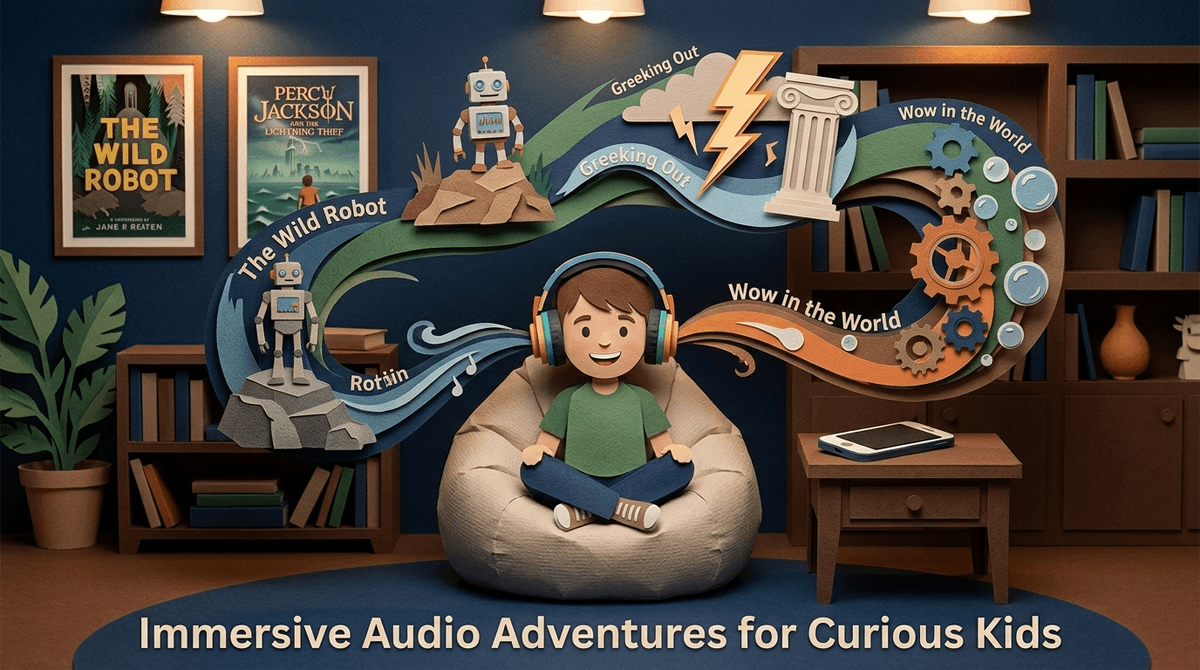
TL;DR: Audio stories are the ultimate parenting "cheat code." They offer the narrative engagement of a movie without the dopamine-induced "iPad zombie" stare or the inevitable meltdown when the screen goes away. By shifting even 30% of screen time to audio, you're building a "listening ear" that translates directly to better reading comprehension and a massive vocabulary boost.
Quick Links to the Good Stuff:
- The Best App for Free Audio: Libby (Connects to your local library)
- The Best for Science Nerds: Wow in the World
- The Best "Gateway" Book: The Wild Robot by Peter Brown
- The Best for History Buffs: Greeking Out
- The Best for Car Rides: Brains On!
We’ve all been there. You’re in the car, or you’re trying to make dinner, and the siren song of YouTube Kids starts calling. It’s easy. It’s quiet. But we also know that "quiet" often comes with a side of "brain rot"—the kind of overstimulating, fast-cut content that leaves kids with the attention span of a goldfish and a vocabulary that’s 40% "Ohio" and 60% "Skibidi."
Audio stories are the antidote. Research shows that a child’s listening level is significantly higher than their reading level until about the 8th grade. When kids listen to a story, they are doing the heavy lifting of "mental movie-making." They have to visualize the characters, the setting, and the action. This builds the same neural pathways as reading a physical book, but without the barrier of decoding words on a page, which can be a struggle for younger kids or those with dyslexia.
In our Screenwise community, we see that parents who introduce audiobooks early report fewer "tech tantrums." There’s something about the lack of blue light and visual overstimulation that keeps the nervous system regulated. It’s the difference between a kid being "hypnotized" by a screen and "immersed" in a story.
Get audio story recommendations based on your kid's favorite games
If your kid is currently addicted to Roblox or Minecraft, you can't just hand them a boring 19th-century classic and expect them to be thrilled. You need high-engagement audio that matches the energy of their digital lives.
This is the gold standard for moving kids from screens to audio. It’s about a robot named Roz who gets stranded on an island. It’s got survival, "tech" vs. nature, and short, punchy chapters that keep the momentum going. The audio performance is top-tier. If your kid likes building in Minecraft, they will vibe with Roz building her life on the island.
If you have a kid in the 8-12 age range, Rick Riordan is your best friend. The audiobooks are narrated with a snarky, first-person energy that feels very "modern kid." It’s fast-paced, funny, and honestly, way better than the movies. It’s a great way to introduce complex mythology without it feeling like a school assignment.
Dragons, war, and "chosen one" prophecies. This series is like crack for the elementary school set. The world-building is intense, which is exactly what kids who love open-world games crave. Switching from a screen to this is an easy sell because the "lore" is just as deep as anything they’ll find in a video game.
Not all platforms are created equal. Some are "set it and forget it," while others are a bit of a data-privacy nightmare.
- Libby: If you aren't using Libby, you are essentially setting money on fire. You just plug in your library card and you get access to thousands of audiobooks for free. The interface is clean and there are no ads.
- Audible: The giant. It has everything, but the subscription model can get pricey. Use it for the "Audible Originals" that you can't find elsewhere.
- Epic!: Great for younger kids (ages 4-10). It has a "Read-to-Me" feature where the words are highlighted as they are read. It’s technically a screen, but it’s a high-value educational one.
- Spotify: Now included with many Premium plans is a certain number of audiobook hours per month. It’s a great way to "test drive" a book before committing.
Check out our guide on the best free apps for audiobooks
Sometimes a 10-hour audiobook feels like too much of a commitment. Podcasts are the perfect "snack" for the car ride to soccer practice.
Mindy Thomas and Guy Raz are basically the rockstars of kid-podcasting. It’s science-based, but it’s delivered through high-energy comedy. It’s loud, it’s silly, and it’s genuinely educational. It’s the perfect replacement for those "unboxing" YouTube videos that offer zero value.
National Geographic Kids nailed it with this one. It covers Greek, Norse, and Egyptian myths with a kid-friendly tone and great sound effects. It’s a "must-listen" for any kid who thinks history is boring.
Preschool (Ages 3-5): Keep it short. Use a dedicated player like a Toniebox or Yoto (which use physical cards or figures to start stories) so they have autonomy without needing your phone. Focus on familiar characters like Bluey or classic picture books.
Early Elementary (Ages 6-8): This is the sweet spot for series. Once they get hooked on a character, they’ll want to listen to all 10+ books. The Magic Tree House is a classic for a reason—it’s predictable, educational, and easy to follow.
Middle Grade (Ages 9-12): This is where you can introduce narrative non-fiction or more complex fantasy. Kids this age are often dealing with "digital envy" (everyone has a phone but them), so audiobooks can be a way to give them "cool" content that feels mature.
Teens (13+): They probably already have Spotify. Encourage them to check out memoirs read by the authors or "true crime" style investigative podcasts (that are age-appropriate) like Mars Patel.
One of the biggest hurdles is the "I'm bored" phase. When you switch from a visual stimulant like Fortnite to an audio story, your kid's brain is going to go through a bit of withdrawal. They might say it’s "boring" for the first 10 minutes.
The Trick: Pair the audio with a "low-brain" physical activity.
- Legos + Audiobooks = Success.
- Coloring + Audiobooks = Success.
- Cleaning their room + Audiobooks = The Holy Grail of Parenting.
If their hands are busy, their ears are open. Don't expect them to just sit on the couch and stare at the wall while listening; that’s not how kids work.
Learn more about how to manage screen time transitions
Audio stories aren't just a way to "avoid" screens; they are a superior form of entertainment for a developing brain. They build empathy, expand vocabulary, and allow for a shared family experience that doesn't involve everyone staring at their own individual glowing rectangle.
If you’re looking to lower the "digital temperature" in your house, start with a 20-minute podcast in the car. No big announcement, no "we're doing a digital detox" lecture. Just hit play on Wow in the World and watch what happens.
- Download Libby and find your library card.
- Pick one "Gateway" book like The Wild Robot for your next long drive.
- Invest in a decent pair of headphones for your kid so they can listen while you have some actual silence.
- Take the Screenwise Survey to see how your family's audio-to-screen ratio compares to other families in your community.