

Anti-racist books for kids are children's literature that actively works to dismantle racist ideas and systems — not just by showing diversity, but by teaching kids to recognize, question, and challenge racism. They go beyond "we're all different and that's nice" to actually explore power, history, identity, and justice in age-appropriate ways.
These aren't just books with Black or Brown characters (though representation matters enormously). Anti-racist books help kids understand that racism isn't just individual meanness — it's baked into systems and structures. They center marginalized voices, tell honest stories about history and current events, and give kids language to talk about race, privilege, and fairness.
And look, I get it — talking about race with kids can feel uncomfortable, especially if you're white and worried about saying the wrong thing. But here's the thing: kids are already noticing race. Research shows children as young as 3 months old can distinguish racial differences, and by age 4, they're already internalizing racial bias from the world around them. Silence doesn't protect them from racism — it just means they're learning about it from less intentional sources.
The "colorblind" approach many of us grew up with — "I don't see color" — actually doesn't work. When we pretend not to see race, we're also pretending not to see racism. Kids need help making sense of what they're observing, and anti-racist books give them frameworks to understand their own identities and experiences, as well as those of others.
For white kids, these books help them understand their own racial identity and the concept of privilege without shame — just awareness. For Black, Indigenous, and kids of color, these books offer mirrors that reflect their experiences, validate their feelings, and show them heroes who look like them fighting for justice.
Plus, representation in books literally shapes how kids see the world and their place in it. When a kid sees themselves as the hero, the scientist, the adventurer — not just the sidekick or the token friend — it expands their sense of what's possible.
Ages 2-5: Building Empathy and Identity
Start with books that celebrate diverse identities and families while introducing basic concepts of fairness and kindness:
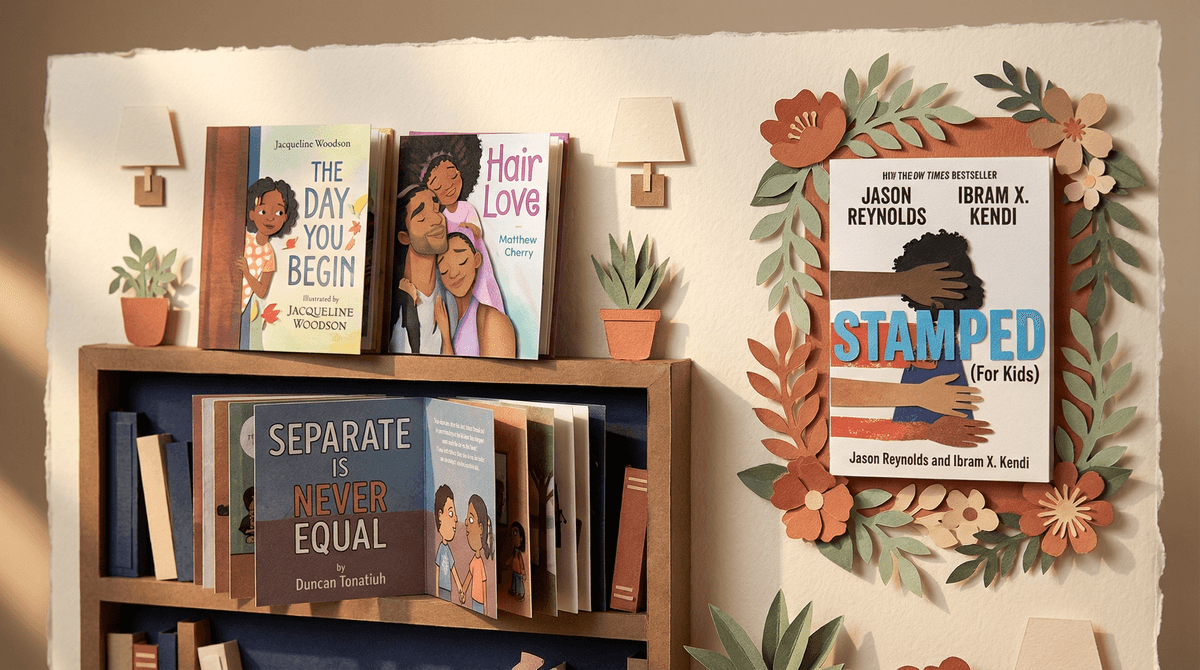
- Hair Love by Matthew A. Cherry — A father learns to do his daughter's hair, celebrating Black hair texture and father-daughter bonds
- Sulwe by Lupita Nyong'o — A beautiful story about colorism and learning to love your dark skin
- The Colors of Us by Karen Katz — A girl discovers the many beautiful shades of brown skin
- All Are Welcome by Alexandra Penfold — Celebrates diversity in a school setting
At this age, focus on books that normalize diversity and help kids build positive racial identity. The goal isn't heavy conversations about systemic racism — it's laying groundwork that all people are valuable and differences are beautiful.
Ages 6-9: Understanding Fairness and History
Kids this age are developing a strong sense of fairness and can start understanding that rules and systems can be unfair:
- Something Happened in Our Town by Marianne Celano — Addresses police violence and racism directly but age-appropriately
- The Undefeated by Kwame Alexander — Powerful poem celebrating Black excellence and resilience
- Let the Children March by Monica Clark-Robinson — True story of children in the 1963 Birmingham Children's March
- Separate Is Never Equal by Duncan Tonatiuh — The story of Sylvia Mendez and school desegregation
- The Day You Begin by Jacqueline Woodson — About feeling different and finding courage to connect
These books introduce real history and help kids understand that racism is about systems and power, not just individual choices.
Ages 10-13: Deeper Conversations About Justice
Tweens can handle more complex narratives about racism, activism, and identity:
- Stamped: Racism, Antiracism, and You by Jason Reynolds and Ibram X. Kendi — A remix of Kendi's work specifically for young readers
- Ghost Boys by Jewell Parker Rhodes — About a Black boy killed by police, confronting and necessary
- New Kid by Jerry Craft — Graphic novel about being one of the few Black kids at a fancy private school
- Brown Girl Dreaming by Jacqueline Woodson — Memoir in verse about growing up Black in the 1960s and 70s
- The Hate U Give by Angie Thomas — For older tweens/teens, powerful story about police violence and activism
At this age, kids can engage with activism, understand institutional racism, and start thinking about their own role in fighting injustice.
"But won't this make my kid feel bad/guilty?"
Teaching kids about racism isn't about making white kids feel guilty — it's about giving all kids tools to recognize and interrupt injustice. Guilt isn't the goal; awareness and action are. Frame it as "we're learning about something unfair so we can help fix it."
"I'm worried I'll say the wrong thing"
You probably will sometimes, and that's okay. Model learning and apologizing. Say "I'm learning too" or "Let me think about that and we'll talk more." Kids benefit more from imperfect conversations than perfect silence.
"My kid's school is really diverse — isn't that enough?"
Proximity to diversity isn't the same as anti-racist education. Kids need help processing what they observe and understanding the historical and systemic context. Otherwise they might just absorb the biases present in the environment without critical thinking tools.
"Won't this be divisive?"
Teaching accurate history and helping kids recognize injustice isn't divisive — it's honest. What's actually divisive is pretending racism doesn't exist while some kids experience it daily.
Read and discuss together
Don't just hand your kid a book and walk away. Read together when possible, and ask open-ended questions: "What did you notice?" "How do you think that character felt?" "Does that seem fair to you?" "What would you do?"
Building an anti-racist home library isn't about checking boxes or performing wokeness — it's about giving your kids the tools to understand the world honestly and the courage to make it better. These books are conversation starters, not conversation enders.
Start where you are. Pick one book that feels right for your kid's age and interests. Read it together. Talk about it. Then pick another. You don't need to overhaul your entire bookshelf overnight.
And remember: anti-racist parenting isn't about being perfect — it's about being intentional. You're going to stumble, say awkward things, and realize you should have handled something differently. That's part of the process. What matters is that you're trying, learning, and showing your kids that this work is worth doing.
- Check out this guide to talking about race with kids for conversation starters and scripts
- Look for diverse books beyond just anti-racist themes — representation should be everywhere in your home library, not just in "serious" books
- Visit your local library and ask the children's librarian for recommendations — they're usually incredible resources
- Follow We Need Diverse Books and EmbraceRace for ongoing recommendations and resources
Building a more inclusive home library is one small, concrete way to raise kids who see, understand, and actively work against racism. And honestly? These are often just really, really good books. Start reading.