

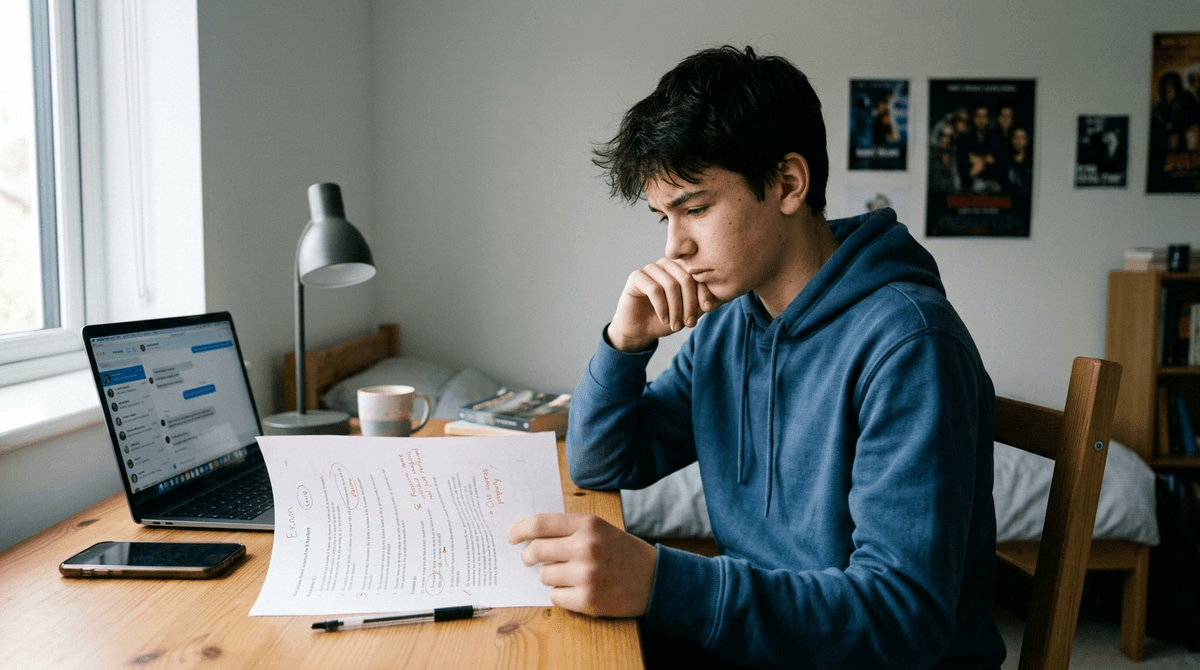
Kids who use AI assistants to bypass homework struggle pay a steep price on test day, scoring nearly a fifth lower on unaided exams than classmates who work through problems on their own.
Bypassing homework effort with AI creates a dangerous "illusion of learning" that drops unassisted exam scores by 17%.
Homework feels smooth and painless when an AI tool generates answers or writes essays, but that friction-free experience is a trap. When test day arrives and the screen disappears, kids who let AI do the heavy lifting struggle to perform on their own.
If an assignment feels effortless, learning is likely not happening. Brains require "productive struggle" to build lasting neural pathways, and outsourcing that friction leaves kids dangerously unprepared for real-world evaluation.
Generative AI defaults to being an eager assistant rather than a patient teacher. Standard chatbot models are built to deliver direct solutions instantly, stripping away the exact problem-solving steps kids need to master a subject.
Unfiltered AI use destroys exam performance, but structured AI tutoring delivers massive gains.
- The crash: Students who used standard, unguarded AI assistants scored 17% worse on unaided exams than peers who used no tech at all.
- The pivot: AI models configured to act as tutors—withholding final answers while prompting kids with guiding questions—erased that gap and roughly doubled learning outcomes compared to unguided AI.
- The illusion: Students using raw AI reported high confidence in their mastery despite being completely unable to replicate the work without the tool.
Banning AI in schools misses the mark entirely. The real choice isn't whether kids use AI, but whether the tool sits before or after their initial mental effort.
When AI acts as a ghostwriter or calculator, cognitive growth halts. When AI acts as a drill sergeant that asks probing questions after a student makes a genuine first attempt, it becomes a force multiplier for learning.
This paper is a preprint published on arXiv and has not yet undergone formal peer review. Additionally, while the authors report strong causal evidence regarding high school performance, they do not disclose the exact sample size of the students analyzed.
- If your child uses AI for homework: configure the prompt to act strictly as a tutor that asks guiding questions and refuses to give direct answers.
- If your child finishes assignments in record time with high confidence: ask them to explain the main concepts or solve a fresh problem on paper without any digital assistance.
- If your child gets stuck on a difficult topic: require them to write down a full first attempt before using AI to check their work or explain alternative approaches.
Erase the friction from homework and you erase the learning. Protect your child's productive struggle, and restrict AI tools to prompting and testing rather than answering.
Mario Brcic, Stjepan Frljic (2026). The Effortless Trap: Productive Struggle, AI, and the Illusion of Learning. arXiv (preprint). — arxiv.org