

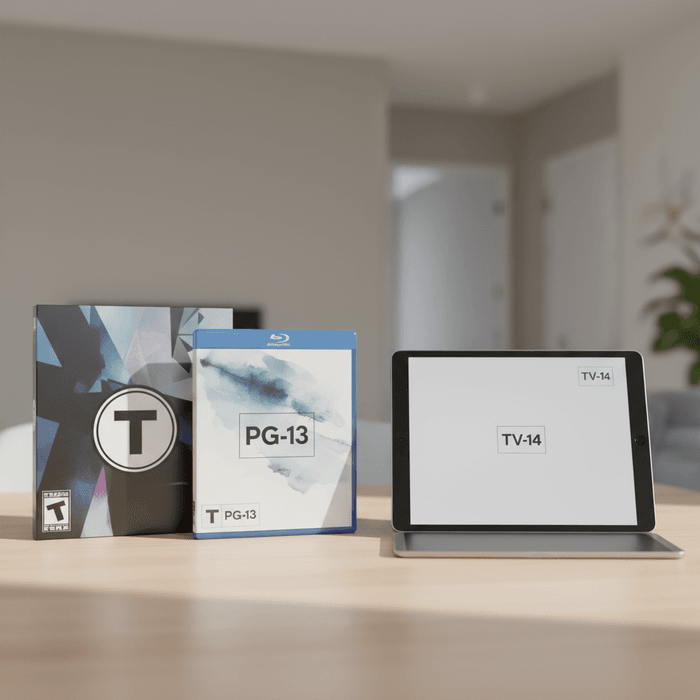
TL;DR: Age ratings are a helpful baseline, but they are often outdated the moment a game connects to the internet. A "Teen" rating covers scripted violence, but it doesn't cover the 22-year-old in the Roblox chat or the "Ohio" memes on TikTok. Use ratings as a starting point, but look for the "Interactive Elements" to see where the real risks live.
Quick Links for Context:
We see the little black and white boxes on game covers and the "PG-13" in the corner of a movie poster, but most of us treat them like the "Terms and Conditions" page—we know they're there, but we rarely read the fine print.
In the US, we primarily deal with three systems:
- ESRB (Entertainment Software Rating Board): These are for games like Minecraft or Fortnite.
- MPAA (Motion Picture Association): The classic G, PG, PG-13, R system for movies like Inside Out 2.
- App Store/Google Play Ratings: These are often the most confusing because they are self-reported by developers or based on slightly different algorithms.
The problem is that these ratings are static. They evaluate the content created by the developers (the graphics, the script, the "official" gameplay). They are notoriously bad at evaluating the community that lives inside the app.
If you’ve ever wondered why your kid is suddenly obsessed with Skibidi Toilet or calling everything "Sigma" or "Ohio," you know that digital culture moves faster than a rating board can meet.
Ratings matter because they give us a window into what a child’s brain is being asked to process. A 7-year-old’s brain is still developing the hardware to distinguish between "fantasy violence" and "scary reality." When a game is rated E10+ for "Fantasy Violence," it means the board thinks a 10-year-old can handle the abstraction of a character disappearing in a puff of smoke, whereas a 6-year-old might find that same visual distressing.
But here is the "no-BS" truth: The rating on the box is often the least important thing about the media your kid is consuming. The real "brain rot" or safety concerns usually come from the features the rating boards don't grade.
Ask our chatbot about the specific safety features of any app
Every parent needs to look for the fine print: "Online Interactions Not Rated."
This is the "get out of jail free" card for developers. It means that while Roblox might have an ESRB rating of E10+, that rating does not apply to what another user says to your child in a private message, or the weird, hyper-suggestive "condo" maps that users occasionally bypass filters to create.
Technically rated E10+, but because it is a platform for user-generated content, it’s a gamble. It can be a brilliant tool for teaching kids about entrepreneurship, or it can be a place where they get scammed out of their "Robux" by a "friend" they met five minutes ago.
The App Store says 12+, but Discord’s own terms say 13+ (to comply with COPPA). In reality, Discord is a "wild west" of servers. A 13-year-old on a moderated Minecraft server is having a very different experience than a 13-year-old on a public "meme" server where the content is essentially unrated and often toxic.
The MPAA is famously inconsistent. You’ll have a movie like Barbie which is PG-13 largely for some suggestive humor and existential dread (which, let's be honest, the kids won't even get), and then you’ll have older PG movies that feature things that would definitely be PG-13 today.
Rated TV-14. This is a prime example of where the rating matters for "intensity." It’s not just about the gore; it’s about the psychological stress. For a kid who struggles with anxiety, a TV-14 rating for "horror" is a much bigger deal than a TV-14 rating for "suggestive dialogue."
Rated TV-Y. This is the gold standard. It’s one of the few shows that is genuinely "all ages" because it respects the child’s intelligence without exposing them to garbage. If you’re looking for "non-brain-rot" content, this is the baseline.
Check out our guide on the best non-brain-rot shows for elementary kids
Based on community data, here is what is actually happening in the "wild," regardless of what the ratings say:
- Grades K-2: Most kids are on YouTube Kids or playing PBS Kids Games. If they are on Roblox, they should be on a restricted account with chat turned OFF.
- Grades 3-5: This is where the pressure for Fortnite (Teen) and TikTok (12+) begins. About 40% of kids in this bracket are using apps rated for older teens. This is the "danger zone" where the brain's desire for social belonging outpaces its ability to spot a scam or a predator.
- Grades 6-8: By middle school, the ratings are almost entirely ignored by the kids, but they should be used by parents to set boundaries on spend and time. Even if they play Call of Duty (Rated M), the conversation should be about the "why"—why do we play this, and how does it affect your mood?
Ratings are not a substitute for "The Sit-Down." A rating can tell you if there is profanity, but it can't tell you if a game is designed to be addictive.
For example, [Royal Match](https://screenwiseapp.com/media/royal-match-game or [Monopoly Go!](https://screenwiseapp.com/media/monopoly-go-game are rated 4+, implying they are perfectly safe for a toddler. In reality, these apps are "draining the bank account" machines. They use psychological "dark patterns" to encourage spending that a 4-year-old (and many 40-year-olds) can't resist.
The rating says "Safe," but your credit card statement might say "Danger."
Instead of saying, "You can't play this because it's rated Teen," try:
- "The rating board says this has 'Interactive Elements.' Let's look at the chat settings together before you start."
- "I noticed this movie is PG-13 for 'thematic elements.' Usually, that means it deals with some pretty heavy stuff. Do you feel like you're in the mood for a sad/intense story today?"
- "The App Store says this is for ages 12+, and you're 10. Let's play it together for 20 minutes so I can see why they gave it that extra two years."
Ratings are a floor, not a ceiling. They are a quick way to filter out the obvious "no" items, but they don't do the heavy lifting of parenting in a digital world.
If an app allows your child to talk to strangers, the age rating is effectively irrelevant—the safety of that app depends entirely on your child's maturity and the guardrails you’ve put in place.
Next Steps:
- Check the "Privacy & Safety" settings on any app rated "Teen" that your child uses.
- Look for the "Interactive Elements" label on the ESRB website for your kid's favorite games.
- Take the Screenwise Survey to see how your family's digital boundaries compare to your actual community.
Ask our chatbot for a breakdown of any specific game's rating