

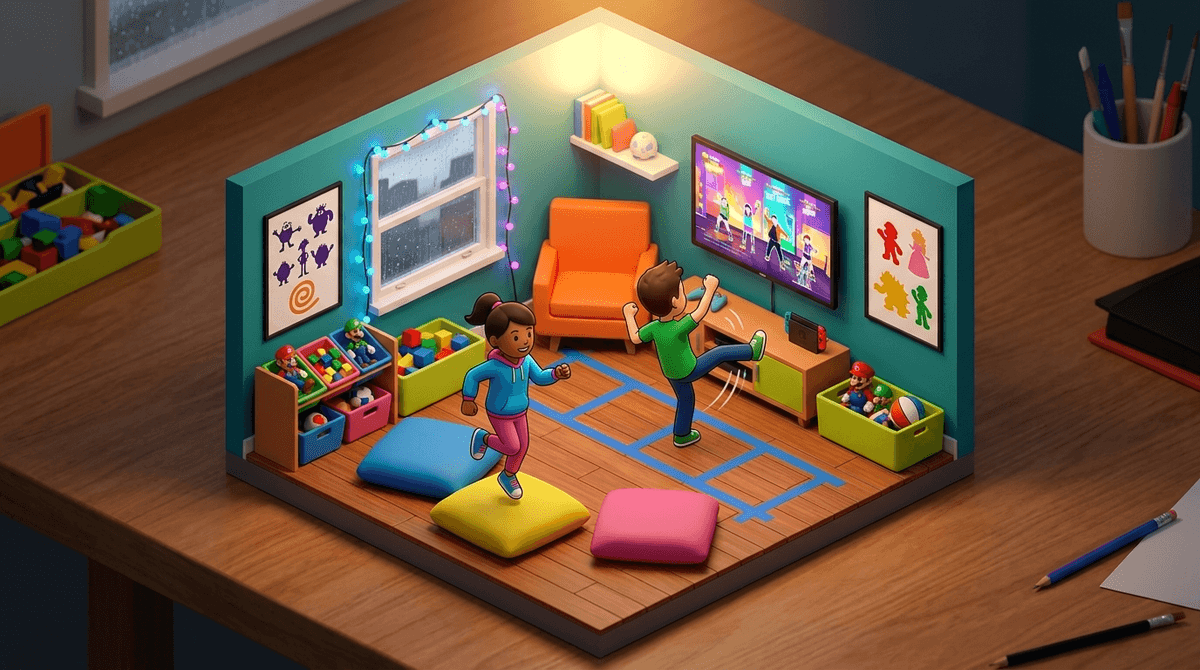
Indoor recess doesn't have to be a slow descent into cabin fever or a default to three hours of mindless scrolling. When the wind chill hits "nope" and the kids are vibrating with that specific brand of trapped-animal energy, the goal isn't just to kill time—it's to burn calories in a way that doesn't cost you a lamp or your patience.
The win here is "physics comedies." These are games where the movement is the point, the space is tight, and the stakes are just high enough to keep them from checking out. You don't need a gymnasium; you just need a 10x10 patch of floor and a few low-tech props.
TL;DR: When outdoor recess is canceled, the win is high-intensity, low-impact games like Silent Ball, Balloon Tennis, or a high-stakes round of The Floor is Lava—all of which turn a 10x10 patch of floor into a sweatbox without a single screen. Keep a roll of painter's tape and a bag of balloons in the closet and you can burn an hour of trapped-animal energy with zero setup.
You don't need to reinvent the wheel. Some games have survived decades of elementary school teachers for a reason: they work in tight quarters and they don't involve projectiles that can shatter a window.
This is the undisputed heavyweight champion of indoor recess. The rules are simple: everyone stands in a circle (or just around the room). You toss a soft ball (foam is best) to each other. If you drop it, you're out. If you make a bad throw, you're out. If you make a single sound, you're out. It builds focus, coordination, and—crucially—it is the only game that guarantees five minutes of absolute silence.
Balloon Tennis
Air resistance is your best friend in a small space. Grab a balloon and a couple of paper plates taped to rulers (or just use hands). The goal is to keep the balloon off the floor. It sounds basic, but for a 7-year-old, it’s a high-intensity cardio workout. Because balloons move slowly, kids have to use big, controlled movements rather than frantic lunges. It’s the safest way to get them jumping without risking the drywall.
You can do this with the actual board game or just a few strategically placed cushions. The psychological shift from "walking across the room" to "navigating a volcanic wasteland" is enough to turn a boring hallway into an obstacle course. It encourages balance and core strength, and if you want to level it up, add "safe zones" that require a specific movement to reach (e.g., "you can only step on the blue pillow if you’re hopping on one foot").
If your kids are more into "mastery" than pure cardio, pivot to games that require precision. These are great for the "I'm bored" tween who thinks Balloon Tennis is for babies.
Painter’s Tape Agility Grid
Grab a roll of blue painter's tape and lay down a ladder or a "laser grid" in the hallway. Challenge them to get from one end to the other without touching the lines. Time them. Then make them do it backward. Then make them do it while carrying a spoon with a ping-pong ball on it. It’s a cheap way to turn a 10-foot hallway into a professional training camp.
Bottle Flip 2.0
The bottle flip trend peaked years ago, but as a "physics comedy," it still hits. Instead of just flipping for the sake of it, set up a "trick shot" course using books and chairs. The movement comes from the setup and the constant retrieval. It’s surprisingly meditative and burns off that fidgety energy that leads to sibling bickering.
When you've got more than a couple of kids, the fastest way to drain a tank of energy is a game everyone plays at once. No props, no screen, no waiting your turn.
Dance Freeze (No DJ Required)
You don't need a music app for this. One kid claps, hums, or beatboxes; everyone else dances; when the sound cuts, the room freezes mid-pose. Anyone who wobbles is out (or does five jumping jacks and rejoins). Rotating the "DJ" gives the shy kid a low-pressure way to run the room. It's pure cardio dressed up as a game, and it scales from two kids to a whole class.
Sock Skee-Ball and Indoor Bowling
Roll up six pairs of socks, set up a few cups or empty bottles at the end of the hallway, and you've got a tournament. The retrieval is half the workout—they sprint down, reset the pins, and sprint back. For a twist, assign point values to each target and make them do the math out loud.
Animal Charades Relay
Split into two teams. One kid acts out an animal (bear crawl, frog hops, crab walk) while their team races to guess. The acting is the exercise—a 30-second bear crawl across the room hits the legs harder than it looks. It burns energy and keeps the quieter kids in the mix because everyone gets a turn to perform.
The hardest part of indoor recess isn't the games; it's the transition back to "normal" life once the energy is spent.
The Cooldown: Always end with a "cooldown" game. After 20 minutes of Balloon Tennis, don't just tell them to go sit down—they'll crash or stay revved up. Transition to a 5-minute drawing challenge, a round of "tell me three things you can hear right now," or a slow-motion "statue" walk where the goal is to move as little as possible. It brings the heart rate down and resets the room.
If you’re looking for more ways to fill a stuck-inside afternoon without a screen, check out our screen-free activities pillar for board games, building kits, and quiet-time ideas that actually hold a kid's attention.
Q: How do I keep kids from breaking stuff during indoor games?
The trick is to use "slow-motion" props. Balloons, foam balls, and rolled-up socks are the way to go. If the object can't gain enough momentum to knock over a picture frame, the game is inherently safer. Also, use painter's tape to define "no-go zones" around electronics.
Q: What is the best indoor game for a small apartment?
Silent Ball is the winner here because it requires zero equipment and zero noise. If you need more movement, a painter's tape "hopscotch" in a hallway is a great way to use vertical space without needing a wide radius.
Q: Are there active games that don't involve a screen?
Absolutely. Beyond the classics, try "Indoor Scavenger Hunt" with a twist: "Find something blue, something fuzzy, and something that weighs more than a shoe—and you have 60 seconds to bring them all back to the rug." The time pressure creates the "active" component.
Indoor recess is a test of intentionality. You can either let the day dissolve into "screen-time by default," or you can spend five minutes setting up a "laser grid" in the hallway. The latter usually leads to better moods, fewer fights, and kids who actually sleep when bedtime rolls around.
