

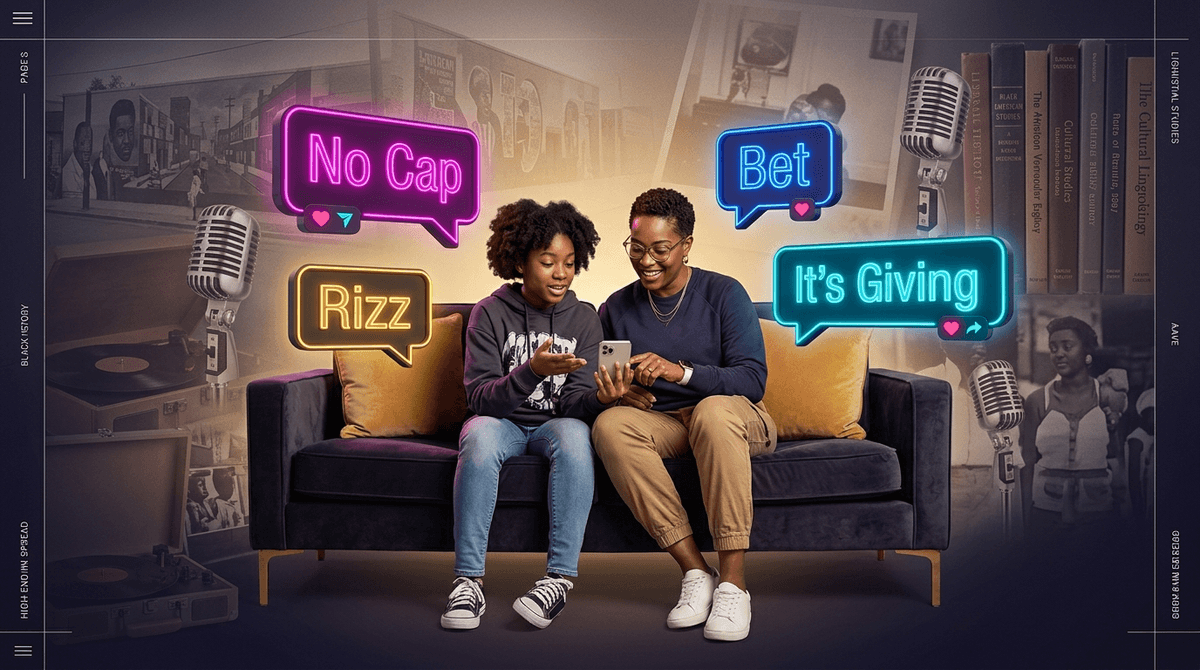
TL;DR: Your kid isn’t just speaking "Internet." They are using AAVE (African American Vernacular English), a complex linguistic dialect that has been rebranded by social media as "Gen Z/Alpha slang." While it’s natural for kids to pick up the lingo of the platforms they haunt, there is a fine line between cultural appreciation and "digital blackface." This guide helps you explain the difference.
Quick Resources for Context:
If you’ve heard your kid say "no cap," "bet," "finna," "periodt," or "it’s the [blank] for me," you might think they’ve just spent too much time on TikTok. But here’s the reality: those aren't just "internet words." They are part of AAVE, or African American Vernacular English.
AAVE is a legitimate, rule-governed dialect of English with its own complex grammar and syntax. It’s been around for centuries, rooted in the history of Black Americans. It isn't "slang" in the way we think of temporary fads; it’s a cultural language.
The "problem"—if we want to call it that—is that Instagram and YouTube have acted like a giant centrifuge, spinning AAVE out of its original cultural context and into the mouths of every suburban ten-year-old with a tablet.
Kids don't usually set out to "appropriate" culture. They just want to sound cool. In the digital age, "cool" is largely defined by Black creators, musicians, and gamers.
When a kid hears their favorite streamer on Twitch or a creator on YouTube Shorts say "that’s mid" or "he’s got rizz" (which is derived from "charisma" but popularized within Black digital spaces), they adopt it. To them, it’s the language of the community they belong to—the internet community.
But there’s a disconnect. Because these terms are often labeled as "Gen Z slang" or "Brain Rot" (like the Skibidi Toilet phenomenon), kids often have no idea that the words they’re using have deep roots in Black history and identity.

This is where it gets tricky for us as parents. We want our kids to be culturally fluent, but we also don't want them to be "that kid"—the one who adopts a "blaccent" (a Black accent used by non-Black people) or uses AAVE as a costume to seem "edgy" or "funny."
Cultural Appreciation
This is when your kid enjoys media created by Black artists and understands the context. They might use a term correctly because it’s become part of the universal English lexicon (like "cool" or "rock and roll" did decades ago), but they respect the source.
Cultural Appropriation (and Digital Blackface)
This happens when kids (and adults!) use AAVE to be "sassy," "aggressive," or "funny" in a way that leans into stereotypes. Digital Blackface is a specific term for when non-Black people use Black emojis, GIFs of Black people making exaggerated expressions, or AAVE to project a certain "vibe" that they don't actually live.
If you want to help your kid understand the weight of language and the richness of Black culture beyond just TikTok memes, check out these titles. They offer great entry points for conversations about identity and voice.
Ages 13+ This is the gold standard for explaining "code-switching"—the way Black people often have to change how they speak depending on whether they are in their neighborhood or at a majority-white school. It’s a powerful lesson in why language is political.
Ages 8+ Miles Morales is a masterpiece of a character. The way he speaks is authentic and grounded. It’s a great example of AAVE and Afro-Latino culture existing naturally without being a "caricature."
Ages 10+ This show is literally built around the nuances of Black identity in a "modern" (often white-adjacent) world. There are several episodes specifically about language, slang, and cultural ownership.
Ages 9+ It’s funny, it’s clean, and it showcases a wide range of Black voices and dialects in a way that is respectful and hilarious.
Ages 7-11 (The "Mimic" Phase)
At this age, kids are just parrots. They hear "gyatt" on Roblox and they say it.
- The Strategy: Don't freak out. Just gently point out that some words belong to specific cultures. You can say, "Hey, that word actually comes from Black culture. When you use it to be funny, it can sometimes feel like you're making fun of how people talk. Let's find a different word."
Ages 12-15 (The "Identity" Phase)
Middle schoolers are trying on identities like clothes. They want to fit in with the "cool" digital crowd.
- The Strategy: Talk about context. Explain that using AAVE when you aren't Black can be seen as "costuming." Ask them: "Do you know where that phrase came from, or did you just see it on Discord?"
Ages 16+ (The "Nuance" Phase)
High schoolers can handle the "No-BS" conversation about appropriation and the history of systemic racism in language.
- The Strategy: Discuss the irony of Black students being disciplined in schools for using AAVE, while white influencers make millions using the exact same language on TikTok.
If you’re feeling lost, here’s a quick translation of AAVE terms that have been "colonized" by the internet:
- Cap / No Cap: Lying / Truthfully. (Origin: 1900s Black culture).
- Bet: "Yes" or "I agree" or "Watch me."
- Finna: "Fixing to" or "About to."
- Periodt: Adding emphasis to the end of a statement.
- Main Character Energy: While not strictly AAVE, the delivery often mimics AAVE "diva" tropes.
- Slay: To do something exceptionally well (Rooted in Black and Brown queer ballroom culture).
You don't need to be the "Grammar Police." In fact, please don't be. That’s a fast way to get your kid to stop talking to you. Instead, be the Context Provider.
When your kid says something like, "That's mid, no cap," you can say: "I’ve been hearing 'no cap' everywhere lately. I was reading that it actually started in the Black community way before it was a TikTok thing. It’s wild how the internet just grabs stuff and makes everyone think it’s new, right?"
This does three things:
- It shows you aren't out of the loop.
- It educates them on the cultural origin without a lecture.
- It plants the seed that their "internet speak" isn't just a vacuum—it has real-world roots.
Your kid isn't "talking wrong," and they probably aren't trying to be offensive. They are navigating a digital world where cultural lines are incredibly blurred. Our job isn't to ban the words, but to make sure our kids aren't using someone else's culture as a punchline.
Encourage them to find their own voice while respecting the voices of others. And maybe, just maybe, remind them that saying "Ohio" is already over.