

TL;DR: The Official Rules (And What They Actually Mean)
Under 18 months: No screens except video chatting with grandma. Yes, really.
18-24 months: You can introduce high-quality media if you want, but watch together and talk about it. This isn't "stick them in front of Cocomelon" time.
Ages 2-5: Max 1 hour per day of quality programming, co-viewed when possible.
All ages: No screens during meals or an hour before bed. Create screen-free zones in bedrooms.
The American Academy of Pediatrics updated these guidelines in 2016 after basically admitting their previous "no screens under 2" rule was both unrealistic and not nuanced enough for modern life. Let's break down what they actually mean and how to implement them without losing your mind.
The AAP's current guidelines aren't pulled from thin air—they're based on decades of research about early brain development, language acquisition, sleep patterns, and parent-child interaction.
Here's the thing: babies' brains are doing absolutely wild amounts of development in those first two years. We're talking about forming 700 new neural connections per second. Their brains are literally building the architecture for everything that comes later—language, emotional regulation, problem-solving, relationships.
And here's what the research consistently shows: screens don't help with any of that. In fact, for kids under 18 months, screens can actually interfere with the kind of learning that matters most at this age.
Young babies learn through:
- Back-and-forth interaction (serve and return, as researchers call it)
- Hands-on exploration of physical objects
- Face-to-face communication with caregivers
- Unstructured play that lets them figure stuff out
Screens? They're passive. Even "educational" content for babies doesn't translate to real learning because infants can't transfer what they see on a 2D screen to the 3D world. Researchers call this the "video deficit effect"—kids under 2 learn significantly less from screens than from real-world interactions, even when the content is identical.
The guideline: Avoid digital media use (except video chatting) for children younger than 18 months.
Why video chatting is okay: Because it's actual interaction. When your 14-month-old waves at Grandma on FaceTime and Grandma waves back and says "hi sweetie!" that's real communication. There's a human responding in real-time. That's fundamentally different from watching a character on Bluey (even though Bluey is genuinely great for older kids).
What this means in practice:
- No background TV while they're playing
- No "educational" apps or videos (yes, even the ones marketed for babies)
- No handing them your phone at restaurants (I know, I KNOW)
- No Cocomelon or Ms. Rachel yet
The reality check: Is your 16-month-old going to see a screen sometimes? Probably. Older sibling watching something? You're on a video call for work and they're in the room? You're on a five-hour flight and losing your mind? The world exists. The AAP guidelines are about habitual use, not absolute perfection.
But the research is pretty clear that making screens a regular part of a baby's day doesn't benefit them and may actually slow language development and reduce parent-child interaction time.
The guideline: If you want to introduce media, choose high-quality programming and watch it together. Avoid solo media use.
This is where the AAP basically said "okay, we know some of you are going to do this, so here's how to do it in a way that's less likely to be harmful."
What "high-quality" actually means:
- Slow-paced (not the frenetic quick cuts of Cocomelon)
- Educational content that's actually age-appropriate
- Shows that model positive interactions and problem-solving
- Content designed by people who understand child development
Good options for this age:
- Daniel Tiger's Neighborhood (specifically designed for social-emotional learning)
- Sesame Street (the gold standard for 50+ years)
- Bluey (though it's really better for 3+)
What "watch together" means: This isn't background noise while you fold laundry. This is sitting down, watching WITH your kid, and talking about what you're seeing:
- "Look, Daniel is feeling frustrated. What do you do when you feel frustrated?"
- "That's a big red truck! Can you say truck?"
- "Uh oh, she fell down. Is she okay?"
This kind of co-viewing and conversation is what helps kids actually learn from media. It bridges that video deficit effect by connecting what's on screen to real concepts and language.
The guideline: Limit screen time to 1 hour per day of high-quality programming. Continue co-viewing when possible.
By age 2, kids' brains are ready to start learning from screens in a more meaningful way. They can begin to transfer what they see to real-world situations. But the key word is limit.
Why one hour? Because research shows that kids who exceed 1-2 hours of daily screen time show:
- Reduced language development
- Lower attention spans
- More behavioral issues
- Less physical activity
- Worse sleep (especially if screens are used near bedtime)
What counts toward the hour:
- TV shows and movies
- YouTube Kids
- Educational apps like Khan Academy Kids or PBS Kids
- Video calls with family (though the AAP is more lenient about this)
What doesn't count:
- You using your phone while they're playing nearby (though minimize this too)
- Screens used for homework or school (not relevant yet at this age)
- Brief moments like taking a photo
The reality: One hour is actually not that much. That's like one movie, or two episodes of a show. Many preschoolers are getting 2-4 hours daily. If that's your family right now, don't panic—but do think about gradually reducing.
No Screens During Meals
Meals are prime time for language development, family connection, and learning to eat mindfully. Background TV during dinner is associated with less conversation, less healthy eating, and more family conflict.
No Screens an Hour Before Bed
The blue light from screens suppresses melatonin production, making it harder to fall asleep. Plus, stimulating content right before bed can make it harder for little brains to wind down. This is non-negotiable if you want decent sleep (for them and you).
Keep Screens Out of Bedrooms
Kids with TVs or tablets in their rooms get less sleep, have more sleep problems, and have higher rates of obesity. Just don't start this habit.
Create a Family Media Plan
The AAP actually has a tool for creating a family media plan that lets you set goals around screen time, screen-free zones, and media choices.
Let's be honest: the baby/toddler app market is full of garbage claiming to teach your kid to read, do math, or become bilingual. The research on educational media for very young kids is mixed at best.
What we know:
- Kids under 2 learn very little from apps, even "educational" ones
- For 2-5 year olds, high-quality educational content CAN support learning—but it's not better than real-world learning
- Interactive apps are better than passive viewing, but still not as good as playing with actual toys
- ABCmouse and Khan Academy Kids have some research backing, but they're better for 4-5 year olds
The bottom line: If you're going to use the screen time hour, prioritize shows over apps for younger kids. Co-viewing a quality show beats solo time with an "educational" app.
Let's address the elephant in the room: sometimes you need to take a shower, make dinner, or answer an email, and screens are the only thing that works.
The AAP guidelines are ideals, not laws. They're based on what's optimal for child development, not what's realistic for every moment of every day.
Some thoughts:
- Using screens occasionally as a babysitter won't break your kid. The research is about habitual, daily patterns, not occasional use.
- But if you're relying on screens multiple times daily just to get through the day, it might be worth problem-solving other solutions: baby-wearing, safe play spaces, adjusting expectations about what gets done.
- The younger the child, the more this matters. A 6-month-old watching TV while you shower is very different from a 4-year-old watching a show while you make dinner.
Beyond the time limits, the AAP guidelines emphasize some things that are harder to quantify:
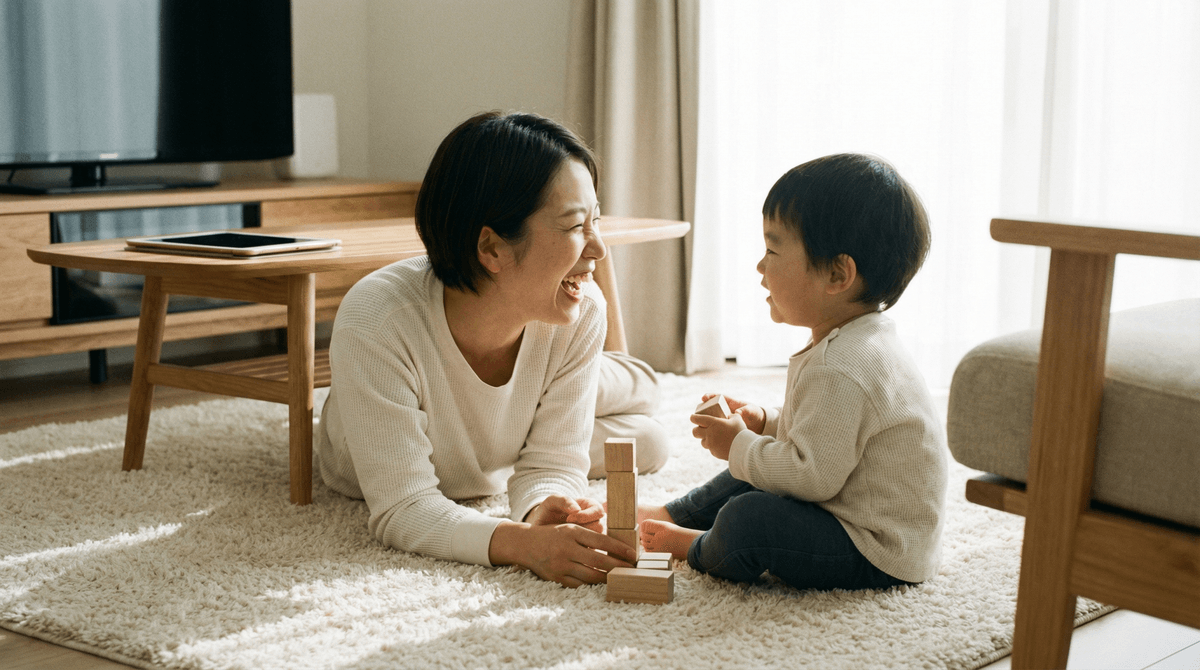
Prioritize creative, unplugged play. Blocks, dolls, play kitchen, dress-up, outdoor play—this is where the real learning happens for young kids. Screens should never crowd out this time.
Model healthy screen habits. If you're on your phone constantly, your kid will want screens constantly. Toddlers learn more from what you do than what you say.
Pay attention to content, not just time. Thirty minutes of Daniel Tiger is not the same as 30 minutes of Cocomelon or YouTube autoplay.
Watch for signs screens are interfering with development:
- Is your toddler's language developing on track?
- Are they sleeping well?
- Do they engage in pretend play?
- Can they entertain themselves for short periods?
- Are they physically active?
If screens are interfering with any of these, that's a bigger red flag than the specific number of minutes.
The AAP guidelines aren't about perfection or parent-shaming. They're about giving you the research-based information to make informed choices.
The core principles:
- The younger the child, the less screen time matters (and the more it can interfere with development)
- Quality matters as much as quantity
- Co-viewing transforms passive watching into active learning
- Protect sleep, meals, and physical play from screens
- Model the behavior you want to see
If your family is nowhere near these guidelines right now, that's okay. Small changes matter. Can you replace one 30-minute screen session with outdoor play? Can you start co-viewing instead of using screens as a babysitter? Can you move screens out of the bedroom?
Remember: the goal isn't to eliminate screens entirely (that's unrealistic in 2026) but to be intentional about when, how, and why you're using them with your youngest kids. Their brains are doing incredible work right now, and they need real-world interaction, hands-on play, and your face more than they need any screen.
If you want to align more closely with AAP guidelines:
- Track current usage for a week (just to see where you actually are—no judgment)
- Identify your highest-value screen time (FaceTime with grandparents? One quality show you watch together?)
- Find one thing to replace (what could you do instead during the current highest screen time?)
- Set up screen-free zones (bedrooms, dining table)
- Create a simple routine (screens only after lunch? Only on weekends?)
Want to explore quality content for when you do use screens?
Want to talk through your specific situation? Get help with your family's screen time challenges—it's literally designed for this.
You've got this. And remember: the fact that you're reading this guide means you're already being intentional about your family's media choices. That matters more than perfection.