

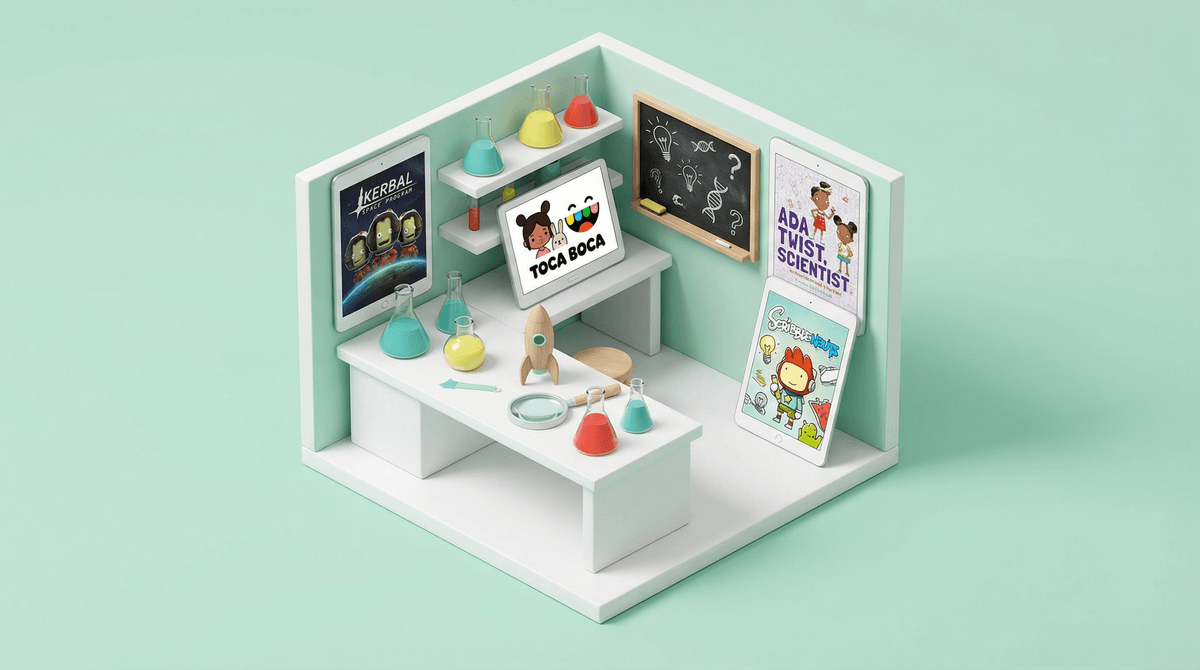
If your kid is obsessed with Ada Twist, Scientist, you know the vibe: curiosity-driven, STEM-focused, problem-solving adventures where asking "why?" and "how?" is the whole point. The good news? There are actually some excellent games that capture that same spirit of scientific inquiry without devolving into mindless tapping or gacha mechanics.
These games encourage kids to experiment, observe, hypothesize, and learn through trial and error—basically the scientific method wrapped in engaging gameplay. And unlike a lot of "educational" games that feel like worksheets with sound effects, these actually respect kids' intelligence and natural curiosity.
Here's the thing about screen time: it's not all created equal. Our community data shows families average about 4.2 hours of daily screen time, with 55% of kids gaming regularly. That's a lot of hours, and the quality of what fills those hours actually matters.
Games that encourage scientific thinking and problem-solving can genuinely support cognitive development—spatial reasoning, hypothesis testing, logical sequencing. They're not going to replace hands-on science experiments or reading books, but they're also not rotting brains. They're somewhere in that middle ground where intentional parents can feel okay about saying yes.
The Ada Twist vibe specifically matters because it normalizes curiosity as cool, positions failure as part of learning, and shows that figuring things out is its own reward. That's a pretty solid foundation, whether we're talking about a TV show or a game.
Toca Lab: Elements (Ages 4-8)
This is probably the closest digital equivalent to Ada's lab. Kids experiment with 118 elements using various lab tools to discover new elements and observe reactions. It's open-ended, colorful, and genuinely encourages the "what happens if I try THIS?" mindset. No reading required, which is perfect for pre-readers who are already science-curious.
The Magic School Bus Games (Ages 5-9)
If Ada Twist and Ms. Frizzle had a collaboration, these games would be it. Various titles let kids explore everything from the human body to outer space with that same "get messy, make mistakes" energy. The Oceans and Space editions are particularly strong.
Tinybop's Explorer's Library (Ages 4-10)
This whole series (The Human Body, Plants, Simple Machines, etc.) is gorgeously designed and deeply curious. Kids can manipulate systems, see cause and effect, and explore at their own pace. No scores, no timers, no pressure—just pure exploration. This is the good stuff.
Kerbal Space Program (Ages 8+)
For older kids ready to level up, this game teaches actual physics and engineering principles through building and launching spacecraft. It's complex enough that it might require some parent co-play at first, but the learning curve is part of the appeal. Kids learn about gravity, orbits, thrust, and why their rocket just exploded (again). Very much in the "fail, learn, try again" spirit.
Incredible Machine / Crazy Machines (Ages 7+)
Classic Rube Goldberg-style puzzle games where kids build chain-reaction contraptions to solve problems. Pure cause-and-effect problem solving with a healthy dose of physics. The newer Crazy Machines 3 has updated graphics but the same solid gameplay.
Scribblenauts (Ages 8+)
While not strictly science-focused, this game rewards creative problem-solving and experimentation. Kids type in any object they can think of to solve puzzles, which encourages both vocabulary building and lateral thinking. "What if I tried a jetpack? What about a ladder? What about a FLYING ladder?"
Little Alchemy (Ages 6+)
Combine elements to create new ones—start with earth, fire, water, and air, then discover hundreds of combinations. It's simple but genuinely engaging, and it gets kids thinking about how things combine and transform. Available as a free web game, which is rare these days.
Worth noting: our community data shows 50% of families allow unsupervised tablet use, while only 35% keep it limited. For these particular games, tablets actually work great—the touch interface makes experimentation feel more tactile and direct than a mouse or controller.
That said, "unsupervised" doesn't have to mean "completely hands-off." These games benefit from occasional check-ins: "What are you discovering? What happens when you combine those?" That kind of engagement turns solo screen time into something closer to supported learning.
Ages 4-6: Stick with Toca Lab, Tinybop apps, and Magic School Bus titles. These require minimal reading and have intuitive interfaces. Co-play is ideal here—not to direct, but to ask questions and share in discoveries.
Ages 7-9: All of the above, plus Little Alchemy, Scribblenauts, and Incredible Machine. Kids this age can handle more complex cause-and-effect and enjoy the satisfaction of solving harder puzzles.
Ages 10+: Kerbal Space Program becomes accessible here, along with more advanced Crazy Machines levels. These older kids can also appreciate Minecraft with redstone circuits, which is basically electrical engineering for beginners.
Ada Twist games—the real ones that actually capture that spirit—do exist, and they're worth seeking out. They won't turn your kid into the next Marie Curie, but they also won't make you feel like you're just handing over a digital pacifier.
The key is being intentional: these games work best when they're part of a broader culture of curiosity in your home, not a replacement for it. Think of them as one more tool in the "encouraging my kid to wonder about the world" toolkit, alongside library books, nature walks, and actual science experiments that make a mess in the kitchen.
And honestly? If your kid is going to spend some of those 4.2 daily screen hours somewhere, games that encourage them to ask "what if?" and "why?" are a pretty solid choice.
- Check out educational games that don't suck
 for more recommendations
 - Explore screen time quality vs. quantity to think beyond just hours
- Ask yourself: how do I know if a game is actually educational?