The Physics of Geography
Most educational apps treat "games" as a thin sugar coating over a pill of rote memorization. You answer a question, you get a digital sticker, you move on. Stack the Countries succeeds because the "game" part—the actual stacking—requires a different kind of brainpower than the "quiz" part.
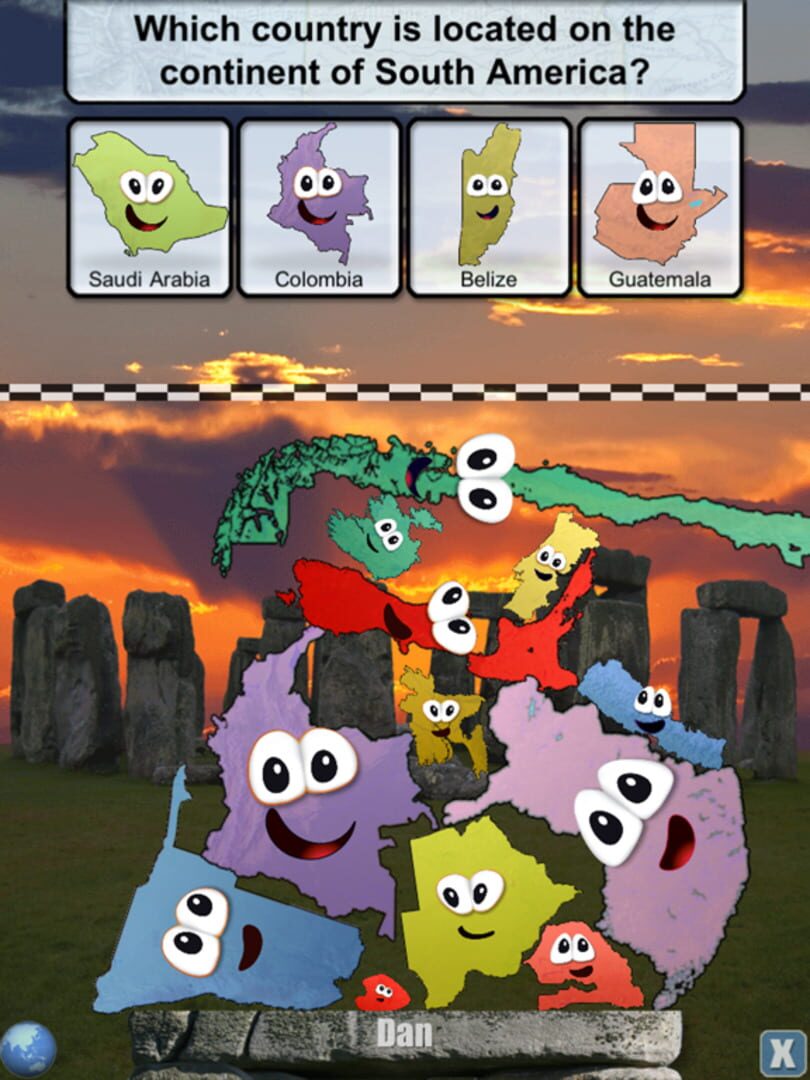
When you get a question right, you don't just earn a point; you earn a physical object with a specific, often inconvenient shape. Trying to balance a top-heavy, jagged country like Italy or a sprawling one like Russia on top of a tiny island nation creates a genuine tension that flashcards can't replicate. It turns geography into a spatial puzzle. You start to recognize borders not just as lines on a map, but as structural supports. You'll find yourself rooting for a square-ish country just to stabilize your tower. This tactile connection is why it sticks in a kid's head better than a standard classroom map.
A Time Capsule from 2011
Playing this in 2026 feels like visiting a museum of the early App Store. There are no season passes, no "daily login" rewards, and no premium currency. It’s a refreshing break from the predatory loops found in many modern global awareness apps.
The trade-off for this clean experience is a UI that looks undeniably dated. The graphics are flat, the resolution isn't optimized for the latest screens, and the "googly eyes" on the countries are a very specific 2011 aesthetic choice. If your kid is used to the high-fidelity polish of Roblox or Fortnite, they might roll their eyes at the presentation for the first five minutes. But the "just one more level" loop is strong enough to overcome the retro vibes. It’s the digital equivalent of a well-loved board game with a slightly battered box—the pieces still fit perfectly.
The Pronunciation Gap
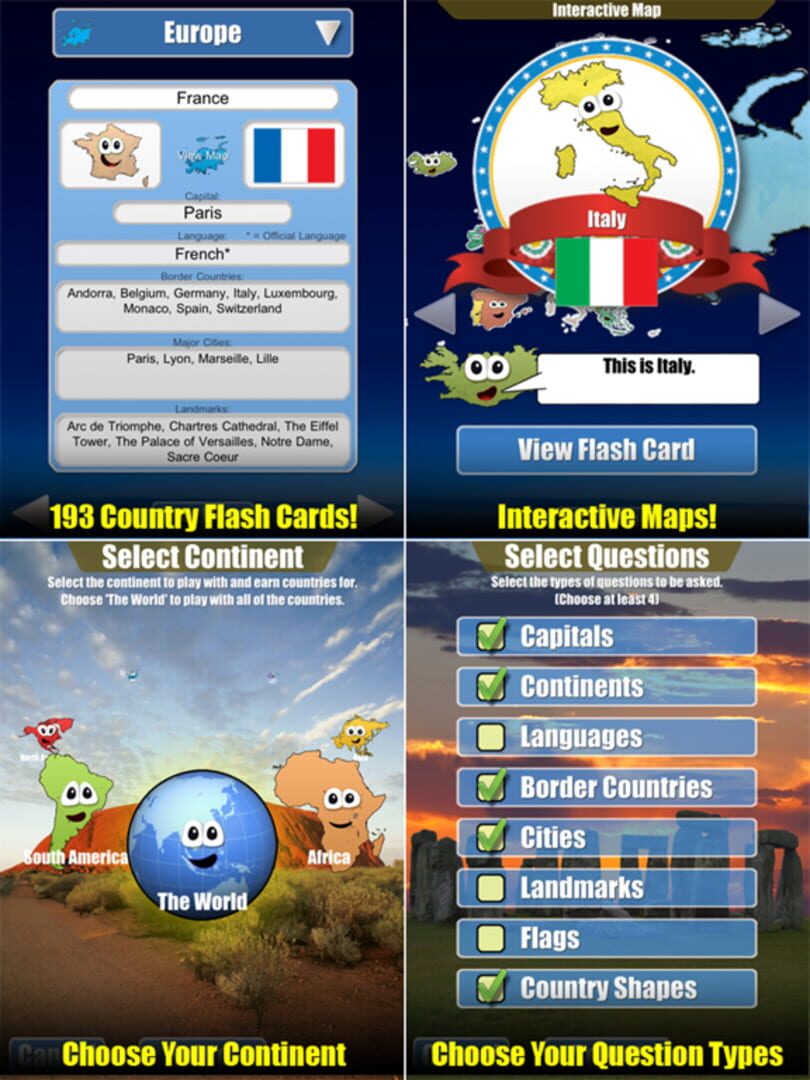
The biggest friction point isn't the graphics; it's the silence. The game is packed with 193 countries, including plenty that most American adults couldn't point to on a map, let alone pronounce. Because there is no audio for the country names or capitals, a kid can "learn" that the capital of Kyrgyzstan is Bishkek without having any idea how to say either word.
This is where you actually have to be the "friend who knows this stuff." If you leave a seven-year-old alone with this, they’ll develop a private, phonetic version of the world. To get the most out of it, you’ll want to occasionally jump in and say the names out loud. It turns a solo app session into a collaborative bit of geography games for kids learning.
The "Map It" Motivation
The endgame here is the collection. Earning a country for your personal map is a surprisingly effective hook. Kids who usually bounce off history or social studies often get hyper-fixated on filling in Western Africa or the "stans" just to complete the set.
Once the main map is filled, the bonus games like Map It! and Pile Up! provide a decent difficulty spike. They strip away the multiple-choice safety net and force kids to actually know where things go. It’s a rare app that scales from "I think that's in Europe" to "I know exactly where the Ivory Coast sits" without feeling like a chore. If you have a kid who loves sorting, collecting, or physics-based puzzles, this is the most productive $3 you’ll spend this month.