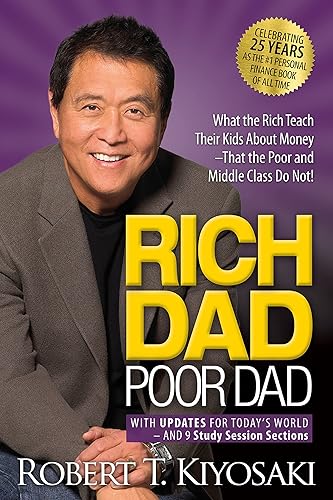
Rich Dad Poor Dad

Rich Dad Poor Dad

book

2018

WISE
82%

WISE Score

4.7

Amazon

The 'red pill' of personal finance that turns kids into entrepreneurs before they've even finished algebra.

Amazon4.7
Common Sense Media

Where to Read

Our reviews and ratings are 100% unbiased, but as an Amazon Associate, Screenwise earns an affiliate fee if you buy a book or game by clicking one of our links. We don't get any credit if you just Google it instead :)

Screenwise Verdict

Look, Robert Kiyosaki is a polarizing guy, but this book is a classic for a reason. It’s the ultimate 'gateway drug' to financial literacy.

It’s not a literary masterpiece—it’s repetitive, a bit preachy, and the 2018 edition is mostly just a polish on ideas from the 90s. But for a teenager who is starting to realize that money doesn't grow on trees, this is the manual they need. It teaches them to look at a car or a new iPhone and see a liability, not just a toy.

Is it 'brain rot'? Absolutely not. Is it a bit 'hustle culture'? Yeah, probably. But in a world where most kids graduate high school without knowing how a credit card works, this is a much-needed counterweight.

Age Fit

Best for 13 and up. Younger kids will be bored to tears by the talk of tax codes and mortgages, but middle schoolers starting their first 'hustle' will eat it up.

WISE Breakdown
Wholesome
72

It promotes self-reliance and taking care of your future self, though it can lean a bit hard into the 'money is the only metric' mindset. It's not warm and fuzzy, but it's intellectually honest about how the world works.

Imaginative
68

While it's non-fiction, it requires a massive leap of imagination for kids raised on the 'get good grades, get a job' track. It paints a picture of a different kind of life that isn't tied to a 9-to-5.

Safe
98

It's a book about accounting and real estate. Unless your kid is allergic to spreadsheets or has a panic attack over the word 'liability,' there's zero content risk here.

Enriching
92

The distinction between an asset and a liability is probably the single most important financial lesson a teenager can learn. It's foundational literacy that schools usually skip.

Parent Info

Why It Might Be Great

  • Breaks down complex financial concepts into simple, story-driven lessons that actually stick.
  • Forces a mindset shift from being a consumer to being a producer/investor.
  • Demystifies the 'magic' of wealth by explaining it as a series of deliberate choices.
  • Encourages kids to value their time and education over just chasing a paycheck.

What to Watch For

  • Kiyosaki's tone regarding his 'Poor Dad' (his actual father) can feel dismissive or harsh towards traditional education and stable jobs.
  • The specific investment advice is often dated or simplified; it’s better as a mindset book than a literal 'how-to' guide for 2026.

Conversation Starters

  • "If you had $1,000 right now, what could you buy that would make you more money next month?"
  • "Why do you think the author says a big house is a liability instead of an asset?"
  • "Do you think the 'Poor Dad' was actually a failure, or did he just have different values than the 'Rich Dad'?"

Ask Anything

Get a personalized guide on any topic