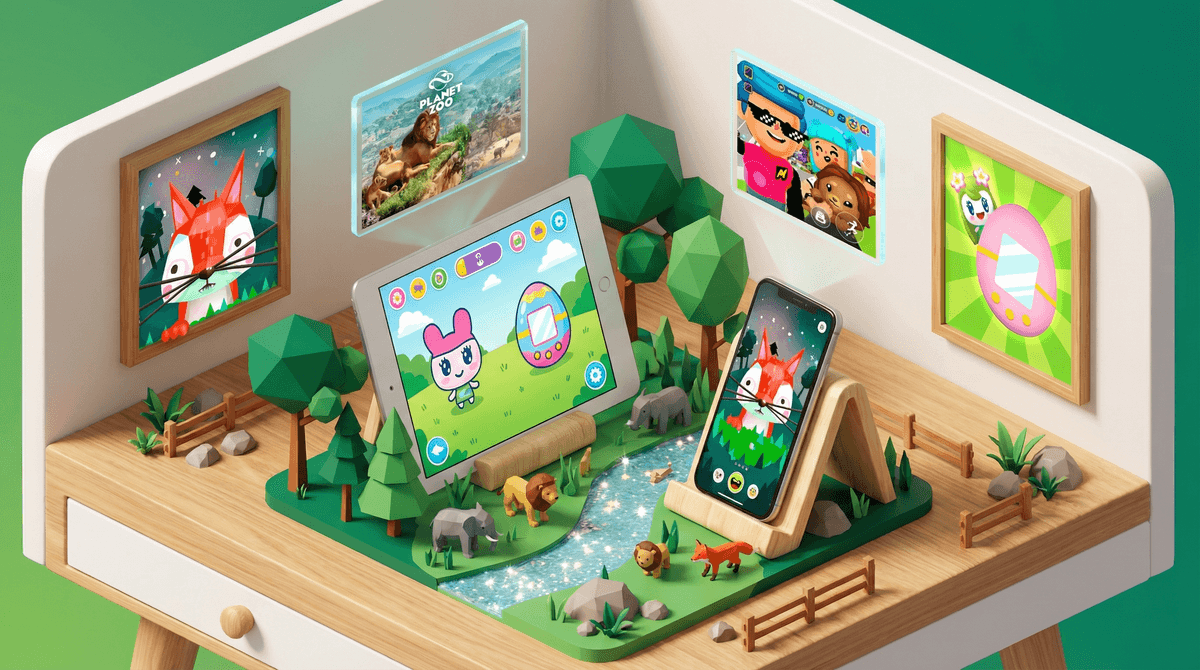
If you grew up with a plastic egg clipped to your backpack, the appeal of My Tamagotchi Forever is obvious. It’s a hit of pure nostalgia, trading the pixelated LCD screen for high-definition, kawaii 3D graphics. On paper, it’s the perfect transition for a kid who wants a pet but isn't quite ready for the real-world responsibility of a hamster.
In reality, this isn't a pet simulator so much as it is a notification engine.
The 20-Minute Notification Trap
The biggest friction point here is the math of the game. In the original 90s version, your pet was needy, but it lived on your keychain. In this mobile version, the "needs" meters for hunger and hygiene drop at an aggressive rate. We are talking about a game that wants your attention every 20 to 30 minutes.
For a kid, this doesn't feel like "caring" for a creature; it feels like being managed by an app. If they have notifications turned on, their phone or tablet will be a constant source of pings. If they turn them off, they frequently return to a miserable, sick pet. This creates a cycle of artificial urgency that can make screen time feel mandatory rather than recreational. If you’re trying to find a balance, our guide on Virtual Pets and Animal Games: Teaching Responsibility or Just Another Screen? breaks down how to tell if a game is actually teaching empathy or just building a habit.
Evolution is the Only Real Hook
The one thing the game gets right is the "what will it become?" factor. The evolution system is surprisingly deep. Depending on what you feed your Tamagotchi and how often you bathe it, it will grow into different adult forms. This is the main reason kids keep coming back—they want to unlock the whole collection.
Tamatown itself is a colorful, interactive hub, and the mini-games (like the match-3 puzzles or soccer) are decent enough to kill a few minutes. But even these feel like a means to an end. You play the games to get the coins, you spend the coins to buy the food, you eat the food to evolve. It’s a very tight loop that doesn't leave much room for the "imaginative" play you might find in a more open-ended game like Toca Boca.
The "Free" Tax
Since this is a free-to-play title from a major studio, the monetization is everywhere. You will see prompts to watch ads to double your rewards, ads to unlock specific food, and ads just for moving between rooms. Speaking of moving between rooms: the technical polish isn't quite there. Players frequently report the game crashing specifically when you try to switch locations.
If your kid is the type to get frustrated when a game "eats" their progress or freezes mid-load, this is going to be a headache. The constant push toward in-app purchases for outfits and decorations also means you’ll want to make sure your app store password is firmly in place. It’s a mid experience that relies heavily on its brand name to distract from the fact that it’s a fairly standard, ad-heavy mobile grind.