

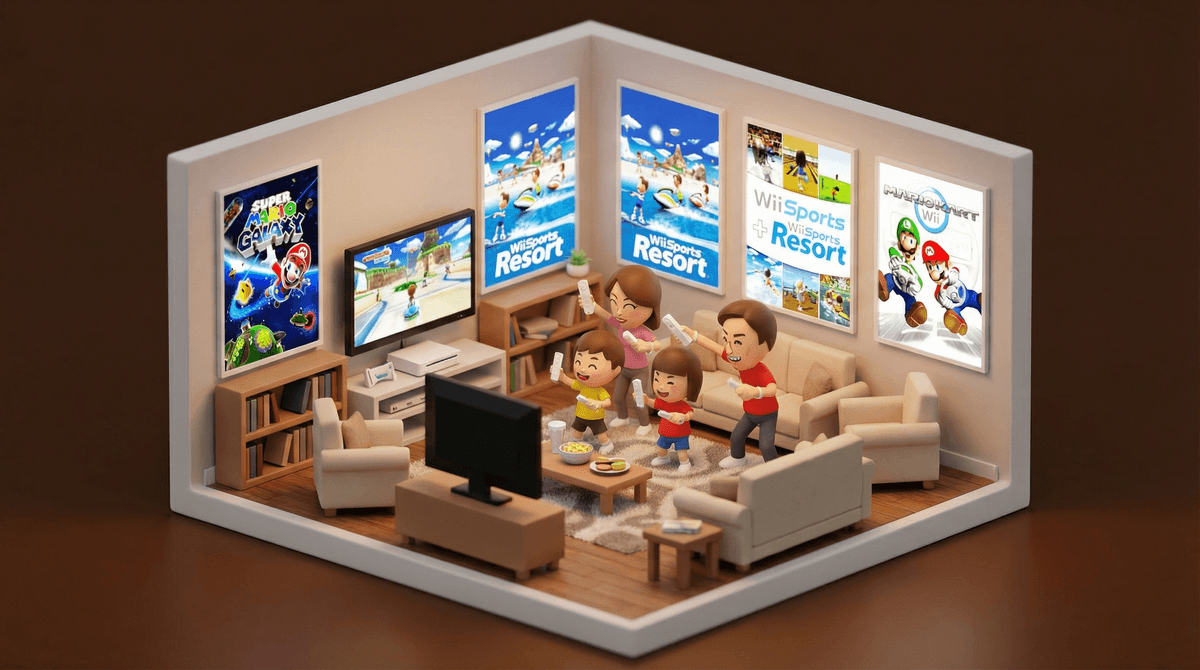
Here's the thing about the Nintendo Wii: it came out in 2006, which means it's now officially retro gaming territory. But unlike most tech from that era (RIP, my Motorola Razr), the Wii has aged surprisingly well for family gaming. It's that boxy white console with the motion controllers that got your aunt off the couch at Thanksgiving to play Wii Bowling.
The Wii's secret sauce was always its accessibility. You didn't need to memorize 47 button combinations or have the thumb dexterity of a competitive gamer. You just... moved. Swung the remote like a tennis racket. Tilted it like a steering wheel. This made it genuinely multi-generational in a way that modern consoles still struggle to achieve.
And here's the beautiful part for intentional parents in 2026: the Wii has zero in-app purchases, no online drama, no chat features, and no battle passes. You buy a game, you own it, you play it. Revolutionary concept, right?
The gaming landscape has gotten... complicated. Modern games are often designed around engagement metrics and monetization. But Wii games? They were designed around fun. Wild, I know.
No subscription anxiety. You're not paying $12.99/month for Nintendo Switch Online or worrying about whether your kid is racking up Robux charges. A used Wii console runs about $60-80, and games are $10-25 used. That's it.
Actual couch co-op. Remember when multiplayer meant sitting next to each other? The Wii was built for this. Four controllers, one TV, real-world trash talk and celebration. No headsets required.
Physical activity built in. Look, I'm not claiming Wii Sports is a gym replacement, but it's certainly better than the thumb workout kids get from Fortnite. Families report actually breaking a sweat during Wii Sports Resort or Just Dance sessions.
Grandma can actually play. This is huge. The Wii is probably the only console where a 7-year-old and a 70-year-old can compete on relatively equal footing. That motion control learning curve is way gentler than analog sticks.
Wii Sports / Wii Sports Resort
Ages: 5+
This is the gateway drug. Wii Sports came bundled with most consoles and it's still the gold standard for family gaming. Bowling, tennis, baseball, golf, boxing—all simplified but genuinely fun. Wii Sports Resort adds sword fighting, basketball, and other activities with better motion controls.
The beauty here is that everyone gets it immediately. No tutorial needed. Grandpa understands bowling. Your 6-year-old understands hitting a ball with a bat. And the skill ceiling is low enough that adults can't completely dominate.
Mario Kart Wii
Ages: 6+
This is probably the most-played Wii game ever, and for good reason. It's Mario Kart—colorful, chaotic, and engineered for maximum "DID YOU JUST BLUE SHELL ME?!" moments. The motion controls (steering wheel attachment) work well, or you can use traditional controls.
Fair warning: Mario Kart can get competitive. If your family has sore losers, maybe start with Wii Sports. But if you can handle some friendly rivalry, this is gold. And unlike modern racing games, there's no grinding for upgrades or unlockables that give older kids massive advantages.
Just Dance Series
Ages: 4+
Just Dance on the Wii is pure chaos energy, and I mean that in the best way. The Wii remote tracks one hand while players follow on-screen dancers. It's not precise, which actually makes it more fun—everyone looks equally ridiculous.
This is the game that gets reluctant movers moving. Kids who won't exercise will absolutely dance to "Dynamite" by BTS or "Can't Stop the Feeling." And parents, you're not off the hook—your kids will absolutely force you to participate.
The Wii versions (Just Dance 1-4, 2014-2020) don't require subscriptions like newer versions. You get the songs on the disc, period.
Wii Party
Ages: 6+
Think digital board game meets game show. Wii Party has 13 different party modes with 80+ minigames. It's basically Mario Party but more accessible and less likely to end in sibling warfare (though no guarantees).
The board game mode is great for teaching turn-taking and strategy to younger kids. The minigames are quick (30-60 seconds) so attention spans don't wander. And the variety means you can play for an hour without repeating activities.
LEGO Games (Star Wars, Indiana Jones, Harry Potter, etc.)
Ages: 7+
The LEGO games on Wii are co-op gold. Two players work together to solve puzzles, collect studs, and progress through beloved movie storylines. The humor is genuinely funny (lots of slapstick), and the gameplay is forgiving—characters respawn immediately when they "die."
These are perfect for parent-child bonding. The puzzles require cooperation, not competition. Younger kids can contribute meaningfully while older players handle the trickier bits. And if your family is into Star Wars or Harry Potter, the nostalgia factor is strong.
Super Mario Galaxy
Ages: 8+
This is more of a single-player adventure, but it has a brilliant co-op mode where a second player controls a star pointer to help collect items and stun enemies. It's perfect for a younger sibling who wants to "help" without needing full gaming skills.
The game itself is gorgeous (even by 2025 standards) and has that Nintendo magic—challenging but never frustrating, creative without being overwhelming. If your family wants something with more narrative than party games, this is it.
Boom Blox
Ages: 7+
This Steven Spielberg-produced gem is criminally underrated. You throw balls at block towers to knock them down. That's it. But the physics are satisfying, the puzzles are clever, and the creation mode lets kids build their own levels.
This is great for kids who like building and destruction in equal measure. Think Minecraft meets Angry Birds. The co-op mode has players working together to solve challenges, and the versus mode is competitive without being cutthroat.
Finding a console and games: Used Wiis are everywhere—Facebook Marketplace, eBay, local game stores. Make sure you get the motion controllers (Wiimotes) and nunchucks. Most family games need 2-4 controllers for full enjoyment.
The games are old, and that's okay. Your kids might initially balk at the graphics compared to modern games. But here's the secret: if the gameplay is fun, kids don't care. I've seen children who play Roblox daily get absolutely obsessed with Wii Sports bowling.
Screen time that feels different. This is active, social screen time. You're in the same room, moving together, laughing at each other's failed tennis serves. It hits different than solo gaming or passive watching. If you're trying to make screen time more intentional, this is a solid option.
No online safety concerns. The Wii's online services were discontinued in 2014. This means zero exposure to online chat, strangers, or inappropriate content. Every game is self-contained. For parents worried about online gaming safety , this is basically a fortress.
Durability concerns. The Wii is nearly 20 years old. Used consoles might be finicky. But the upside? If it breaks, you're out $60, not $500. And there's something refreshing about tech that you don't have to baby.
Ages 4-6: Start with Wii Sports (bowling and tennis) and Just Dance. The controls are intuitive, and the activities are self-explanatory. Keep sessions to 20-30 minutes—the physical activity is real, and little kids will get tired.
Ages 7-10: Add Mario Kart Wii, Wii Party, and LEGO games. These kids can handle more complex gameplay and will love the competitive elements. This is also the sweet spot for family game nights—old enough to follow rules, young enough to not be "too cool" for family time.
Ages 11+: They can handle everything, including Super Mario Galaxy. But honestly, the party games remain fun even for teens if you can get them to participate. Frame it as retro gaming or nostalgia—suddenly it's cool again.
For mixed-age families: Wii Sports and Just Dance are your best bets. The skill floor is low enough that a 5-year-old can participate, but there's enough skill ceiling that a 13-year-old won't be completely bored.
The Nintendo Wii isn't going to replace your kids' interest in modern games. It's not trying to. But it offers something increasingly rare: gaming that brings people together in the same physical space, with no hidden costs, no online risks, and no algorithmic manipulation.
Is it perfect? No. The graphics are dated. Some games have aged better than others. And you'll need to hunt for used hardware. But for families trying to create more intentional screen time—time that's active, social, and genuinely fun across generations—the Wii is still a winner.
Plus, there's something beautifully rebellious about opting out of the modern gaming industrial complex entirely. No battle passes. No microtransactions. No "Mom, I need 1,000 V-Bucks or I'll literally die." Just a disc, a TV, and your family making memories (and probably breaking a sweat).
Ready to try it? Check Facebook Marketplace or local game stores for a used Wii bundle. Look for one with 2-4 controllers and a few games to start. Wii Sports, Mario Kart Wii, and Just Dance are the holy trinity for families.
Want more screen-free alternatives? The Wii is great, but so are board games. Consider mixing digital and analog game nights.
Curious about other retro gaming options? The Wii isn't the only older console with family-friendly appeal. Ask about other retro gaming systems that might work for your crew.