

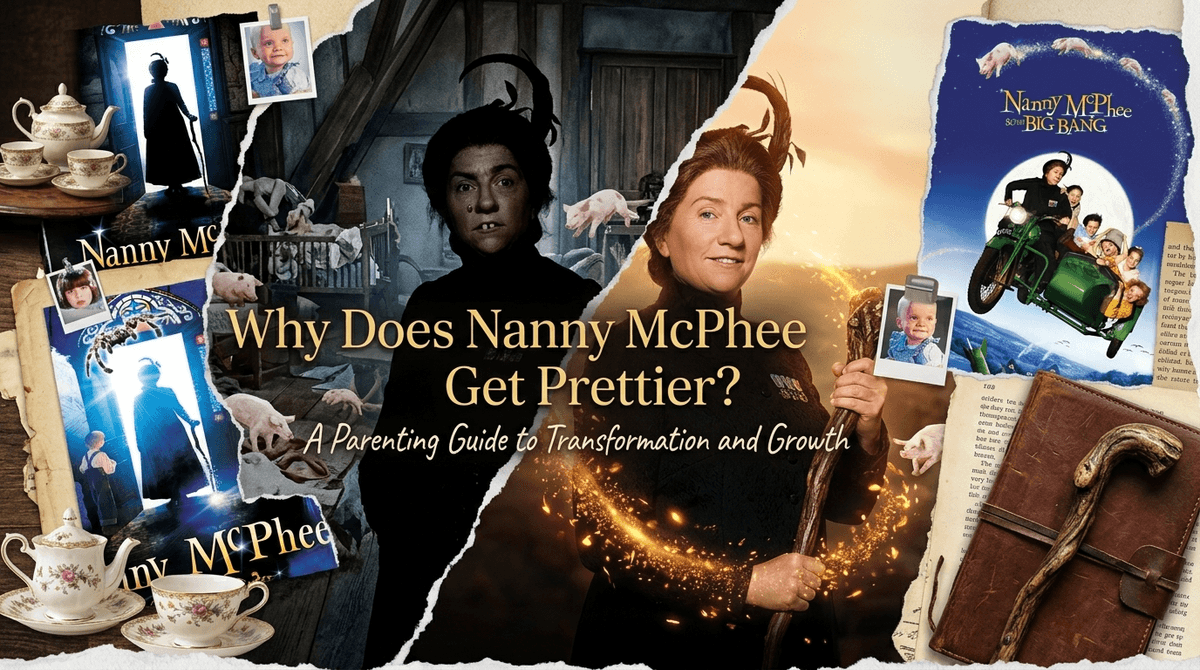
Nanny McPhee gets prettier because her physical appearance is a direct reflection of the children’s internal growth and their willingness to embrace her lessons. As the Brown children transition from being chaotic and defiant to disciplined and empathetic, the "ugly" features they initially projected onto her—the warts, the unibrow, and the snaggletooth—gradually vanish because they are finally seeing her through the lens of love and respect rather than through the lens of their own rebellion.
TL;DR: In Nanny McPhee, the titular character's physical transformation is a magical metaphor for the children's character development; as they master her five essential lessons, their perception of her changes from a "monster" to a beloved figure. Screenwise recommends this film (and its sequel, Nanny McPhee Returns) for ages 6+ as a brilliant starting point for conversations about inner beauty and the "eyes of the beholder." For more films that tackle emotional intelligence, check out our guide to movies that teach empathy.
If you’ve been sitting on the couch with your kids lately watching the 2026 re-release of Nanny McPhee, you probably noticed your kids squinting at the screen, asking, "Wait, did her wart just fall off?" It’s one of those rare cinematic moments where the special effects aren't just there to look cool—they’re doing the heavy lifting for the story’s moral.
Nanny McPhee doesn't actually "change" in the way a shapeshifter might. Instead, the movie plays with the idea that when we are angry, defiant, or "ugly" on the inside, the people who try to set boundaries for us look like monsters. To the Brown children—who have successfully driven away 17 previous nannies through psychological warfare—any authority figure is an enemy. Consequently, Nanny McPhee appears to them with exaggerated, "ugly" features.
As they learn to listen and take responsibility, those features drop away one by one. By the end of the film, when the children have fully realized their potential for kindness and discipline, they see Emma Thompson as she actually is: beautiful. It’s a visual representation of the quote from the film: "When you need me, but do not want me, then I must stay. When you want me, but no longer need me, then I must go."
The "glow-up" is tied specifically to five lessons. In an era where our kids are navigating "brain rot" YouTube content and the social pressures of Roblox, these lessons feel surprisingly grounded and necessary.
- To go to bed when told: This isn't just about sleep; it's about respecting the boundaries of the household.
- To get up when told: This builds the foundation of self-discipline.
- To get dressed when told: This is about self-reliance and preparing for the day.
- To listen: In a world of 15-second TikToks and constant digital noise, the act of truly listening is a superpower.
- To take responsibility for their actions: This is the big one. It’s the final lesson that removes the last of Nanny McPhee’s warts.
When the kids stop acting like "Ohio" is a personality trait and start acting like functional members of a family, Nanny McPhee’s appearance "improves." It’s a great way to show kids that their behavior affects how they perceive the world around them.
We live in a world of filters. Our kids see "pretty" as something you apply with a swipe on Instagram or Snapchat. Nanny McPhee flips that script. It suggests that beauty isn't something you put on your face; it’s something that is revealed through your character.
When your kid is throwing a fit because you've hit the screen time limit on their iPad, you are the "ugly" Nanny McPhee in that moment. You are the villain of their story. But as they grow and realize that those boundaries were for their own well-being, their "perception" of your parenting changes. Using the movie as a reference point can help them understand that your rules aren't about being "mean"—they’re about helping them become the best version of themselves.
If your family loved the vibe of Nanny McPhee, here are a few other picks that handle character growth and perception beautifully:
- Similar to Nanny McPhee, Matilda deals with children finding their power in a world of "ugly" adult behavior. The contrast between Miss Honey and Miss Trunchbull is a masterclass in how character defines appearance.
- While there are no magical warts here, Paddington 2 is the gold standard for showing how one person’s (or bear’s) kindness can change the "look" of an entire community. It’s essentially the inverse of the Nanny McPhee effect.
- For a more modern take on how our internal state changes our external reality, Inside Out 2 is essential viewing. It helps kids visualize the complex emotions (like Anxiety) that can make their world feel "ugly" or overwhelming.
- If you want to move from the screen to a book, Wonder is the ultimate deep dive into perception, bullying, and the reality that "you can't blend in when you were born to stand out."
Next time you're finishing up a movie night, try asking these questions to see if the metaphor landed:
- "Why do you think the kids thought Nanny McPhee was so scary at the beginning?"
- "Which lesson do you think was the hardest for the Brown children to learn?"
- "Do you think Nanny McPhee actually changed, or did the kids just start seeing her differently?"
- "In our house, when do I seem most like the 'ugly' version of Nanny McPhee to you?" (Be prepared for some honesty on this one!)

Q: Why does Nanny McPhee have a snaggletooth and warts?
These features are physical manifestations of the children's bad behavior and their negative perception of authority. As the children learn to be well-behaved and kind, these "ugly" features disappear because the children are no longer projecting their own internal ugliness onto her.
Q: What are the 5 lessons Nanny McPhee teaches?
The five lessons are: 1. To go to bed when told, 2. To get up when told, 3. To get dressed when told, 4. To listen, and 5. To take responsibility for their actions. Each time a lesson is fully learned by all the children, one of Nanny McPhee's physical "imperfections" vanishes.
Q: Is Nanny McPhee a witch?
While the movie never explicitly uses the word "witch," she clearly possesses magical abilities, such as using her walking stick to create enchantments. However, she functions more as a magical guardian or a "distilled essence of a nanny" rather than a traditional fairy tale witch.
Q: What age is Nanny McPhee appropriate for?
Screenwise recommends Nanny McPhee for ages 6 and up. While there is some slapstick humor and the initial appearance of Nanny McPhee can be slightly "spooky" for very young toddlers, the message is overwhelmingly positive and the "scary" elements are part of the moral arc.
Nanny McPhee remains a classic in 2026 because it respects a child’s ability to understand complex metaphors. It doesn't just tell kids to "be good"; it shows them that their behavior literally changes the world they see. It’s a perfect "intentional parent" movie because it rewards a second viewing—once your kids know the secret of why she’s getting prettier, they’ll spend the whole movie looking for the exact moment each wart disappears.
Check out our full review of Nanny McPhee Explore more movies about character building