

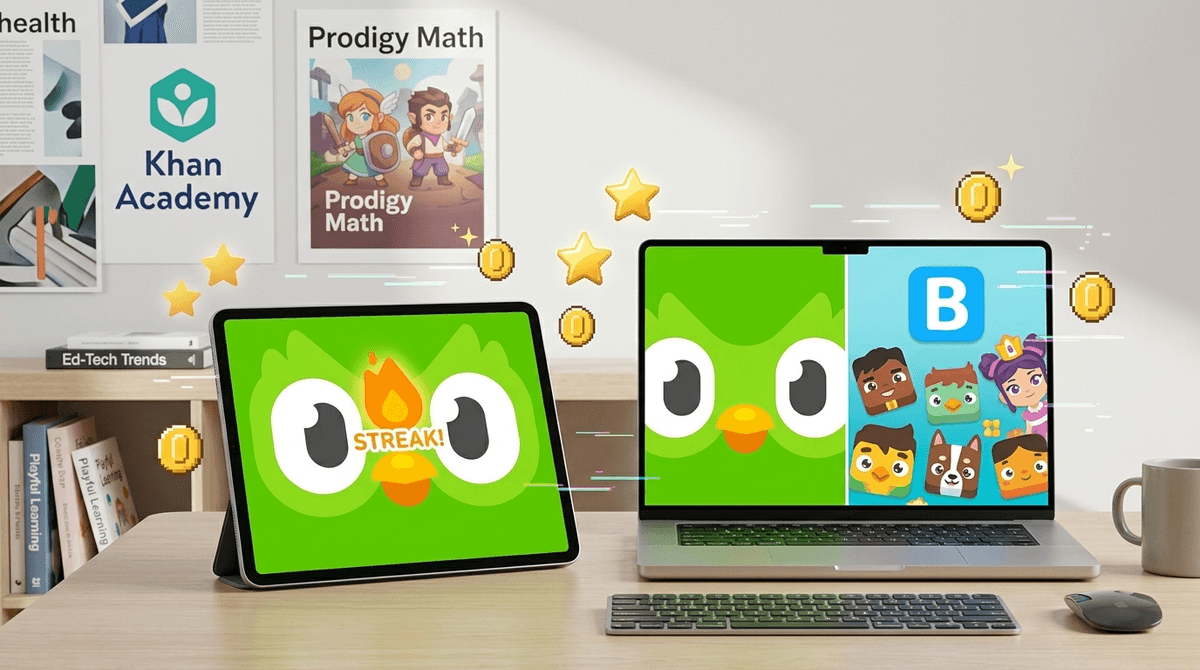
TL;DR: If your kid has a 300-day Duolingo streak but can't order a taco in Spanish, or they’re the "King of the Hill" in Blooket without knowing a single math fact, they’re "gaming the system." They aren't necessarily being "bad"—they’re just treating the educational app like a video game where the goal is to win, not to learn.
Quick Links to the Apps We're Talking About:
- Duolingo (The streak obsession)
- Blooket (The "hacker" favorite)
- Prodigy Math (Pokémon meets math, mostly)
- Khan Academy (The video-skipper's paradise)
- Quizlet (The land of copy-paste)
We’ve all been there. You see your kid hunched over their iPad, and you feel that little surge of parental pride because they aren't watching some "Ohio" level brain rot on YouTube—they’re doing math. Or French.
But then you look closer.
They’re flying through levels at a speed that suggests they’ve either become a child prodigy overnight or they’ve found a "cheese." In gaming culture, "cheesing" is using a strategy that requires very little effort to get a huge reward. In educational apps, it’s called gaming the system.
It’s when a child figures out the mechanics of the app—how the points are awarded, how the leaderboard works, or where the "skip" button is hidden—and prioritizes those over the actual curriculum. They are playing the game, not the subject.
Kids aren't always trying to be deceptive. Often, they are just responding to the gamification these apps use to keep them engaged.
When Duolingo sends a passive-aggressive notification from a crying owl, or Blooket promises a rare "Blook" (a digital avatar) for winning a round, the brain’s dopamine hit comes from the reward, not the French verb conjugation.
For a 10-year-old, the social status of being #1 on a leaderboard is way more tangible than the abstract benefit of "knowing math for the future." Plus, let’s be real: some of these kids are basically junior software testers. Finding a glitch or a shortcut feels like a win in itself. It’s a different kind of intelligence, even if it’s not the one you’re paying for.
See if your kid's app usage is actually productive
The Hack: The "Easy Lesson Grind." Duolingo is notorious for this. To stay in the "Diamond League," kids will often ignore new, difficult lessons and spend hours repeating the "Alphabet 1" lesson over and over. They get the XP, they keep the streak, but they haven't learned a new word in six months. The "Pro" Move: Using Google Translate in a split-screen window to copy-paste answers. If your kid is "typing" complex sentences in Mandarin but can't say "hello," you’ve been gamed.
The Hack: GitHub Scripts and YouTube Tutorials. This is the big one in middle schools right now. If you search YouTube for Blooket, the top results aren't "how to learn history"—they are "How to get infinite coins" or "Blooket hack script 2025." Kids go to sites like GitHub, copy a string of code, and paste it into their browser console to auto-answer every question. The Reality: Blooket is basically a chaotic gambling simulator with a few math questions sprinkled in. It’s fun, but as an "educational tool," it’s often more about the "Gold Quest" or "Tower Defense" mechanics than the content.
The Hack: The "Avoidance Strategy." In Prodigy Math, you battle monsters by solving math problems. But kids quickly learn that they can spend 90% of their time decorating their house, changing their outfit, or chatting with friends in the hub world. The Red Flag: If your kid has been on Prodigy Math for an hour and only solved three problems, they aren't doing math—they’re playing a low-rent version of Pokémon.
The Hack: The "Silent Video" and "Answer Hunting." Khan Academy is the gold standard for free education, but it’s easy to cheese. Kids will open the instructional video in one tab, mute it, let it run to get "credit," and then use a second tab to search for the specific quiz answers on Reddit or Brainly. The Warning: If they are getting 100% on every quiz but can't explain the concept to you for 30 seconds, they didn't watch the video.
Learn more about the best educational apps that are harder to hack
Here’s the non-judgmental truth: figuring out how to "game" a system is actually a high-level cognitive skill. It requires:
- Systems Thinking: Understanding how inputs lead to outputs.
- Resourcefulness: Finding tools (like GitHub or YouTube) to solve a problem.
- Efficiency: Finding the shortest path to a goal.
In the tech world, we call this "optimization." If your kid is hacking Blooket, they might not be learning long division, but they are learning how web browsers and scripts work.
However, if the goal is for them to pass their 5th-grade math test, the "hacker mindset" is currently working against them. You have to decide if the "meta-learning" (hacking) is more valuable than the "subject learning" (math). Usually, we want a bit of both.
Ages 6-9
At this age, gaming the system usually looks like guessing. In apps like IXL or Zearn, kids will just click every button until the "Correct!" sound plays.
- What to look for: Rapid-fire clicking without looking at the screen.
- The Fix: Sit with them for 10 minutes. If they can't explain why they clicked the answer, they’re just button-mashing.
Ages 10-13
This is the prime age for external help. They are old enough to use Google, YouTube, and Discord to find cheats.
- What to look for: Multiple tabs open, specifically YouTube videos with titles like "Blooket Glitch" or "How to get XP fast."
- The Fix: Check the "History" or "Progress" tab in the app. Most apps like Khan Academy show how long a student spent on a task. If they "completed" a 10-minute video in 2 seconds, you’ve caught them.
Ages 14+
High schoolers are gaming for survival. They have a lot of work and often see these apps as "busy work." They will use AI (like ChatGPT) to summarize articles or solve equations in seconds.
- What to look for: Perfectly written essays or solved complex calculus problems in record time, but zero ability to replicate it on paper.
- The Fix: Focus on the "Output." Ask them to explain the concept to you while you’re making dinner. If they can’t, the app was a waste of time.
Don't go in guns blazing calling them a "cheater." That just makes them better at hiding it. Instead, try the "Consultant" approach.
- Acknowledge the Cleverness: "I saw you figured out how to get 5,000 coins in Blooket without answering the questions. That’s actually a pretty smart use of a script."
- Reiterate the Goal: "But the reason we use this app is so you don't fail your quiz on Friday. If you game the app, you’re basically 'cheesing' your own grade."
- Set "Proof of Work" Boundaries: Tell them they can play the "game" part of the app after they show you three completed lessons where they actually had to think.
Check out our guide on setting screen time boundaries that actually work
Educational apps are businesses first. They use the same "hook" mechanics as Roblox or Fortnite to keep kids coming back. We shouldn't be shocked when kids respond to those mechanics by trying to "win" the game.
If your kid is gaming the system, it doesn't mean they are a dishonest person. It means they are a bored person or a person who is over-incentivized by digital gold stars.
Next Steps:
- Audit the App: Is Prodigy Math actually teaching them, or is it 90% fluff? If it's fluff, switch to something more direct like Mathigon.
- Check the Progress Reports: Most of these platforms have a "Parent Dashboard." Use it. Look for "Time on Task" vs. "Lessons Completed."
- Value the Struggle: Remind them that if it feels easy, they aren't learning. Learning should feel a little bit like your brain is doing a push-up.