Quizlet

Quizlet

Website

2005

WISE
86%

WISE Score

The digital flashcard king that successfully survived the AI revolution to help your kid actually pass that biology test.

Where to Find

Visit Quizlet
Screenwise Verdict

Quizlet is the undisputed heavyweight champion of digital study tools for a reason. It took the humble flashcard and made it addictive enough that kids actually use it. By 2026, it has successfully integrated AI to move beyond simple memorization into actual tutoring, making it a powerhouse for middle and high schoolers.

The catch is the business model. The free version is cluttered and data-hungry. If your kid is using this daily, the subscription is almost a 'sanity tax' to remove the distractions and tracking. It’s a high-quality tool that requires very little parental setup but benefits from a quick 'accuracy check' on the sets your kid chooses to study.

Age Fit

While technically rated for ages 4+, the real utility starts around age 10 when kids actually have vocab lists and tests to manage. It remains useful all the way through grad school.

WISE Breakdown
Wholesome
90

It is a study tool designed for academic success. There is no toxicity, no 'dark' content, and the tone is purely focused on learning and achievement.

Imaginative
60

While creating flashcards requires some synthesis, the core loop is still rote memorization. The newer AI tutoring features add a layer of interactive curiosity, but it's not a creative sandbox.

Safe
72

The free version is heavy on third-party tracking and ads. While the content is generally safe, user-generated sets aren't perfectly moderated, and 'classes' involve some social interaction.

Enriching
95

It is arguably the most effective digital study tool for vocabulary and fact-based subjects. The variety of modes (Match, Test, Learn) caters to different learning styles.

Parent Info

Why It Might Be Great

  • Gamified memorization makes boring vocabulary drills feel more like a mobile game and less like a chore.
  • AI-powered tutoring via Q-Chat provides a conversational way for kids to test their knowledge without needing a parent to quiz them.
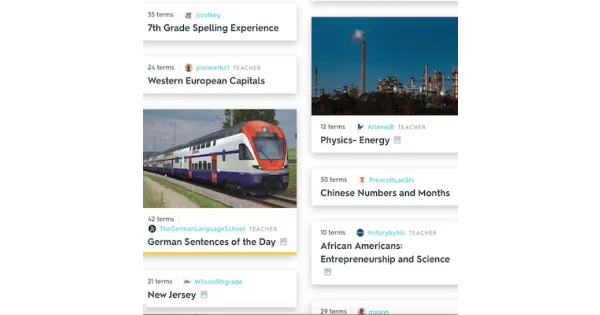
  • Massive library of pre-made sets means your kid probably doesn't have to type out every single term for their specific textbook.
  • Cross-platform sync allows them to squeeze in five minutes of studying on the bus via the app and finish up on a laptop at home.

What to Watch For

  • The free tier is an ad-fest that tracks user behavior aggressively; if you want privacy and focus, you're looking at a $35+ annual subscription.
  • User-generated sets can contain typos, flat-out wrong information, or even 'cheat sheets' for specific local exams.
  • The AI tutoring is good but not perfect—it can occasionally 'hallucinate' facts or give overly simplistic explanations for complex topics.

Conversation Starters

  • "Which study mode actually helps you remember things better: the Match game or the Write mode?"
  • "Did you find any pre-made sets from other students at your school?"
  • "Is the AI tutor actually helpful, or is it just giving you the answers too easily?"
  • "How do you know if a flashcard set someone else made is actually accurate?"

Deep Dive

The AI Pivot

For a long time, Quizlet was just a digital pile of index cards. But in the last couple of years, they've leaned hard into AI. The standout feature is Q-Chat, built on OpenAI's tech, which acts like a Socratic tutor. Instead of just showing a card, it asks the student questions, probes for deeper understanding, and provides hints. For a parent, this is a win—it's one less night you have to sit there holding a stack of paper while your kid groans.

The Accuracy Problem

Because Quizlet relies heavily on user-generated content, it's a bit like the Wild West of education. If your kid searches for 'Spanish 2 Unit 4,' they'll find fifty different sets. Some are perfect; some are full of spelling errors. Teaching your kid to vet their sources is a necessary side-effect of using the platform.

Subscription Fatigue

Quizlet used to be the 'free' alternative to expensive prep software, but those days are mostly gone. The best features—like the AI tutor and offline access—are locked behind Quizlet Plus. At roughly $36 a year, it's not a bank-breaker, but it's another subscription in an already crowded landscape. If your kid only uses it for ten minutes before a mid-term, stick to the free web version with an ad-blocker. If they're using it for every subject, the Plus tier is worth the price for the lack of distractions alone.

What Parents Ask

Ask Anything

Get a personalized guide on any topic

Related Guides