

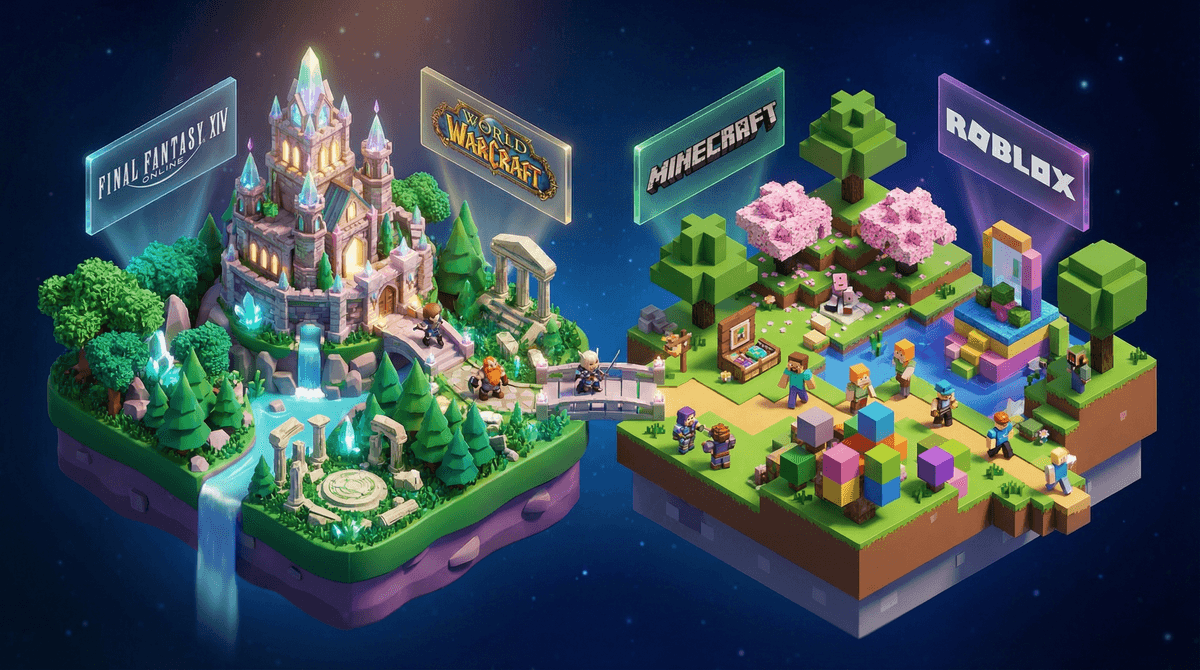
MMO stands for "Massively Multiplayer Online" game, and it's exactly what it sounds like: a game where hundreds, thousands, or even millions of players exist in the same virtual world at the same time. Think of it like a digital theme park that never closes, where your kid can run into friends, strangers, and everything in between while playing.
The "massively" part is what separates MMOs from regular online multiplayer games. When your kid plays Fortnite or Rocket League, they're in a match with maybe 100 players max, and when that match ends, everyone scatters. In an MMO, the world persists whether your child is logged in or not. Other players are still there, doing their thing, building stuff, completing quests, trading items. It's a living, breathing digital ecosystem.
The most common types of MMOs are:
MMORPGs (Massively Multiplayer Online Role-Playing Games) - Players create characters, level them up, complete quests, and usually work together to defeat big challenges. Think World of Warcraft or Final Fantasy XIV.
Sandbox MMOs - More open-ended worlds where players create their own goals. Roblox and Minecraft (in multiplayer server form) fall into this category.
MMO Shooters - Combat-focused games with persistent worlds, like Destiny 2.
Social MMOs - Games where the main point is hanging out and socializing, like Animal Jam or Club Penguin (RIP).
The appeal is pretty straightforward: MMOs are digital third spaces. Remember when we used to just... hang out at the mall or the park? MMOs are where a lot of kids do that now.
Here's what makes them sticky:
The social element is real. Your kid isn't just playing a game—they're hanging out with friends, making new ones, joining guilds or clans, and feeling part of a community. For some kids, especially those who struggle socially IRL, MMOs can be genuinely meaningful spaces for connection.
There's always something new. Because the world persists and developers constantly add content, there's always a new event, quest, or update to check out. This is great for engagement but also why these games can feel impossible to "pause."
Progression feels good. MMOs are designed around incremental progress—leveling up, earning better gear, unlocking new areas. That dopamine hit of advancement is powerful, especially for kids who might not feel that sense of progress in other areas of life.
Player-driven economies. Many MMOs have complex trading systems where kids can earn, buy, and sell virtual items. Some kids genuinely learn basic economics this way. Others learn how to beg for Robux. It varies.
Let's be real: MMOs are designed to be time sinks. That's not a value judgment—it's literally the business model. These games want players logging in daily, participating in time-limited events, and feeling like they'll fall behind if they take a break.
This is where things get tricky for families:
- Daily login rewards encourage kids to play every single day, even if just for a few minutes
- Time-limited events create FOMO (fear of missing out) that can feel genuinely stressful for kids
- Social pressure means your kid might feel like they're letting their guild down if they're not available for a raid
- "Just one more quest" syndrome is real—MMOs are designed without natural stopping points
For younger kids (ages 8-12), you're looking at games like Roblox, Adopt Me, or Wizard101. Teens gravitate toward Genshin Impact, Fortnite (in Save the World mode), or classic MMORPGs like World of Warcraft.
The persistent social nature of MMOs creates unique safety concerns:
Stranger danger is real here. Unlike single-player games, your kid is interacting with real people—adults included. Most MMOs have chat features, voice chat, or both. Some have robust moderation; many don't.
Predatory behavior happens. Not to be alarmist, but MMOs have been documented spaces where adults target kids. "Grooming" can look like an older player being extra generous with in-game gifts, asking personal questions, or trying to move conversations off-platform.
Scams and trading exploits. Kids get scammed out of valuable items or accounts. Sometimes it's other kids being jerks; sometimes it's more organized operations.
In-game purchases can add up fast. Many MMOs are "free to play" but make money through microtransactions. Learn more about how these economies work and why they're so effective at getting kids to spend.
Toxic communities exist. Some MMO communities are genuinely welcoming. Others are... not. Depending on the game, your kid might encounter racism, sexism, homophobia, or just general nastiness.
Not all MMOs are created equal. Roblox is very different from World of Warcraft, which is very different from Final Fantasy XIV. Age ratings matter, but so does the specific community culture of each game.
Privacy settings are crucial. Most MMOs have options to limit who can contact your kid, whether they can receive friend requests from strangers, and whether they can use voice chat. Learn how to set up parental controls for the specific game your kid plays.
Play with your kid, at least initially. I know, I know—you don't want to spend your evening grinding for loot. But spending even an hour in the game your kid loves will teach you more than any parent guide ever could. You'll see how the chat works, what the community is like, and what the actual gameplay loop involves.
Time boundaries are non-negotiable. Because MMOs don't have natural endpoints, you need to create them. "When this quest is done" doesn't work because there's always another quest. "When this timer goes off" does work.
Talk about the economics. If your kid is playing a game with real-money purchases, have explicit conversations about spending limits, the difference between wants and needs, and why these games are designed to make spending feel good.
Ages 6-9: Stick with heavily moderated, kid-focused MMOs like Animal Jam or Club Penguin alternatives. Turn off all chat features if possible. Play together.
Ages 10-12: Roblox and Minecraft servers are the big ones here. Enable strict privacy settings. Check in regularly about who they're playing with. Consider alternatives to Roblox if you're concerned about the platform.
Ages 13-15: Teens can handle more complex MMOs, but social risks increase. Voice chat becomes more common. Have ongoing conversations about online relationships, what information is safe to share (none of it), and what to do if something feels off.
Ages 16+: At this point, you're mostly looking at monitoring for time management and making sure gaming isn't replacing other important activities. Traditional MMORPGs like World of Warcraft or Final Fantasy XIV are options, though the time commitment can be intense.
MMOs aren't inherently good or bad—they're tools that can be used well or poorly. They can teach collaboration, problem-solving, and digital citizenship. They can also be time vampires that expose kids to risks you didn't even know existed.
The key is informed intentionality. Know what game your kid is playing. Understand its specific risks and benefits. Set clear boundaries around time and money. And keep talking about it—not in a "let me interrogate you" way, but in a genuinely curious way.
If your kid is into MMOs, they're not alone. These games are where a huge chunk of socializing happens for this generation. Your job isn't to prevent that (good luck) but to help them navigate it safely and healthily.
- Research the specific game your kid wants to play—check out our guide to popular MMO games for kids
- Set up parental controls before they start playing
- Establish time boundaries that work for your family (and stick to them)
- Check in regularly about who they're playing with and what they're experiencing
- Consider playing together for at least a few sessions to understand the appeal and the risks
Want to understand how your family's gaming habits compare to others in your community? Take the Screenwise survey to get personalized insights and recommendations.