

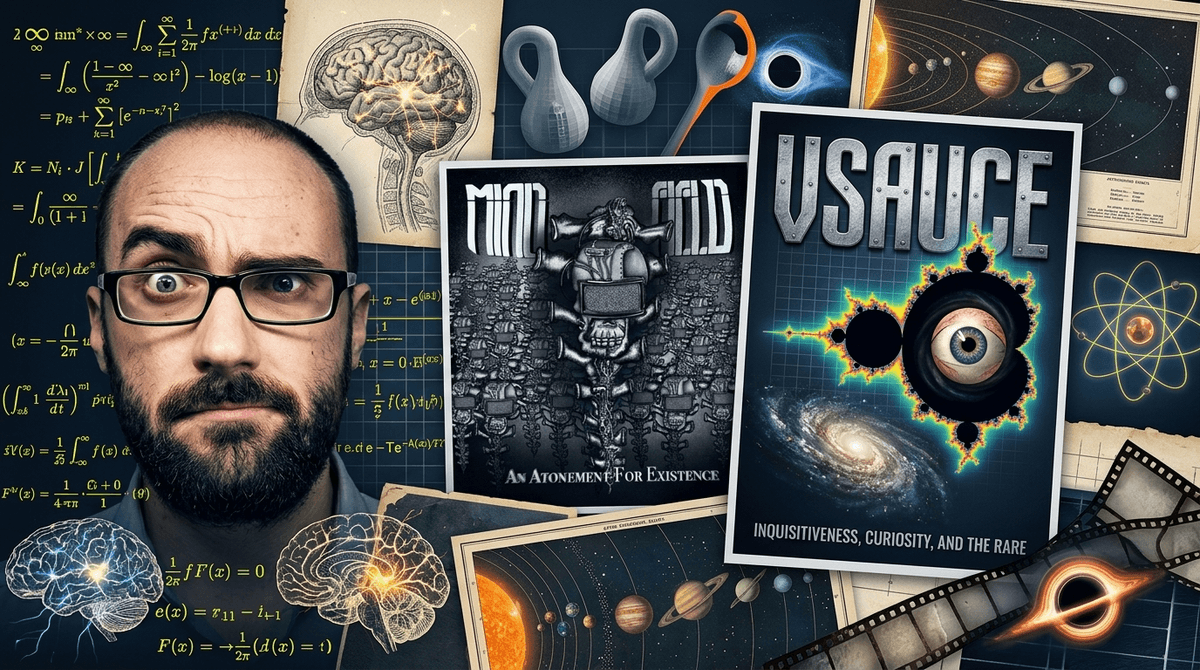
TL;DR
If your kid is spending hours on YouTube, Vsauce is exactly the kind of "rabbit hole" you actually want them falling down. It’s the antithesis of "brain rot"—think of it as a masterclass in curiosity, physics, and philosophy disguised as quirky internet culture. It’s safe, high-quality, and will likely result in your 11-year-old explaining the heat death of the universe to you over tacos.
Quick Links:
- Vsauce YouTube Channel
- Mark Rober (The "Engineer" friend)
- Kurzgesagt – In a Nutshell (Beautifully animated existentialism)
- Veritasium (Deep-dive science)
- Mind Field (Michael Stevens’ premium social science series)
If you’ve walked past your kid’s iPad and seen a bearded man in glasses staring intensely into the camera while upbeat, jazzy lo-fi music plays in the background, you’ve met Michael Stevens.
Vsauce is one of the pillars of "Edu-Tainment" on YouTube. Launched in 2010, the channel has evolved from general oddities to deep, philosophical, and scientific inquiries. Michael has a specific way of starting with a simple, almost silly question—like "How much does a shadow weigh?"—and ending up in a discussion about the nature of light, quantum physics, and the human condition.
There are actually three main channels in the network:
- Vsauce (or Vsauce1): Hosted by Michael Stevens. Focuses on "The Big Questions," math, and philosophy.
- Vsauce2: Hosted by Kevin Lieber. Focuses on paradoxes, logic puzzles, and "The Mind Blow."
- Vsauce3: Hosted by Jake Roper. Focuses on the science of fictional worlds (video games, movies) and tech.
See the differences between the three Vsauce channels
We spend a lot of time worrying about "brain rot" content like Skibidi Toilet or the endless "Ohio" memes that seem to signify a decline in literacy. But Vsauce is the "Final Boss" of the good side of YouTube.
Kids love it because Michael Stevens is genuinely funny and weird. He has mastered the "Internet Aesthetic"—the jump cuts, the dramatic pauses, and the "Vsauce Lean" into the camera. It doesn't feel like a lecture; it feels like a secret you're being let in on.
For the "Gen Alpha" crowd, Michael is also a meme icon. They might recognize his face from TikTok "Shorts" or memes before they ever watch a full 20-minute video on the Banach-Tarski Paradox. But once they click, they’re hooked by the narrative. Michael doesn't just give facts; he tells a story where the "twist" is a new way of looking at reality.
In an era of 15-second attention spans, Vsauce is doing something radical: it’s making kids sit still for 20 to 30 minutes to think about complex math.
When your kid watches a video like The Zipf Mystery, they aren't just "consuming content." They are learning about linguistics, statistics, and the weird patterns that govern our world. It encourages critical thinking and intellectual humility. Michael often ends videos by basically saying, "The more we know, the more we realize we don't know," which is a pretty healthy mindset for a middle schooler to adopt.
Check out our guide on how YouTube can actually help with school
If your kid has already binged every Vsauce video twice, they are likely looking for more "Big Brain" content. Here is how to curate that feed so it stays high-quality:
If Vsauce is the philosopher, Mark Rober is the cool shop teacher. He’s a former NASA engineer who builds glitter bombs to catch porch pirates and giant liquid sand pits. It’s heavy on engineering and the "scientific method," but with a high production value that keeps kids engaged.
- Ages: 7+
- Why it’s good: It moves from theory to practice. It’s about building things and solving problems.
This channel uses beautiful, vibrant animations to explain terrifyingly complex things like black holes, viruses, and "optimistic nihilism."
- Ages: 10+ (Some topics can get a little heavy/existential)
- Why it’s good: It’s visually stunning and breaks down massive global issues (like climate change or medicine) in a way that feels manageable rather than just scary.
Derek Muller tackles the "truth" (hence the name) behind common misconceptions. He does a lot of on-location filming and experiments.
- Ages: 12+
- Why it’s good: It’s slightly more academic but still very accessible. Great for kids who are starting to show a real interest in physics or chemistry.
Destin Sandlin explores the world through a lens of "I wonder how that works?" From how cats land on their feet to the physics of a grain silo explosion.
- Ages: 8+
- Why it’s good: It’s incredibly wholesome and celebrates the joy of learning for the sake of learning.
Recommended Age: 10+
While there is nothing "inappropriate" in Vsauce in terms of language, violence, or sexual content, the concepts can be a bit much for younger kids.
- Under 10: They might enjoy the "Shorts" or the more visual experiments, but the long-form videos on "Supertasks" or "The Philosophy of Names" will likely go over their heads.
- Ages 10-13: This is the sweet spot. They are starting to grasp abstract concepts and love the feeling of knowing a "weird fact" that their parents don't.
- Ages 14+: Great for sparking interests in specific career paths or college majors (Philosophy, Physics, Psychology).
Safety Considerations
Vsauce is hosted on standard YouTube. While Michael Stevens is a "clean" creator, the YouTube sidebar is always a gamble. You might start at "How to count past infinity" and, four clicks later, end up at a sketchy "Top 10 Scariest Ghost Sightings" video.
If you have younger kids, I always recommend using the YouTube Kids app or, better yet, creating a "Shared Account" on your TV so you can see what the algorithm is serving them.
Read our guide on setting up YouTube Parental Controls
There is one thing to be aware of: Michael Stevens loves to play with the "creepy" side of science. He has a very famous video called "Why Are Things Creepy?" and his YouTube Premium series, Mind Field, involves him doing things like spending 72 hours in total isolation to see what it does to his brain.
Sometimes, Vsauce (and especially Vsauce3) touches on "The End of the World" or "What happens after you die?" or "Are we living in a simulation?"
For most kids, this is just cool sci-fi talk. But if you have a child who is prone to anxiety or "existential dread," some of these topics might trigger a bit of a late-night "What is the point of anything?" crisis.
How to talk about it: If your kid comes to you worried about the sun exploding in 5 billion years because of a video they watched, don't dismiss it. Use the Michael Stevens approach: "Isn't it amazing that we know that? And isn't it incredible that we have 5 billion years to figure out what's next?"
Get tips on handling "existential dread" from YouTube content
Vsauce is the gold standard of what the internet can be. It’s a place where being "nerdy" is cool, where asking "Why?" is the most important thing you can do, and where screen time actually results in a higher IQ (okay, I can't prove the IQ thing, but it certainly feels like it).
If your kid is into Vsauce, you’re doing okay. You've raised a curious human. Just be prepared for them to interrupt your morning coffee to explain that, technically, you don't actually "touch" anything because of electron repulsion.
Next Steps:
- Watch together: Sit down and watch The Zipf Mystery or "Which Way Is Down?" with them. It’s actually great television.
- Check the history: Take a peek at their YouTube history. If it’s all Vsauce, Mark Rober, and Veritasium, they’ve built a great personal learning environment.
- Bridge to books: If they love the physics in Vsauce, they might love What If? by Randall Munroe. It’s the same vibe but in book form.
Check out our list of books for kids who love science and "What If" questions