

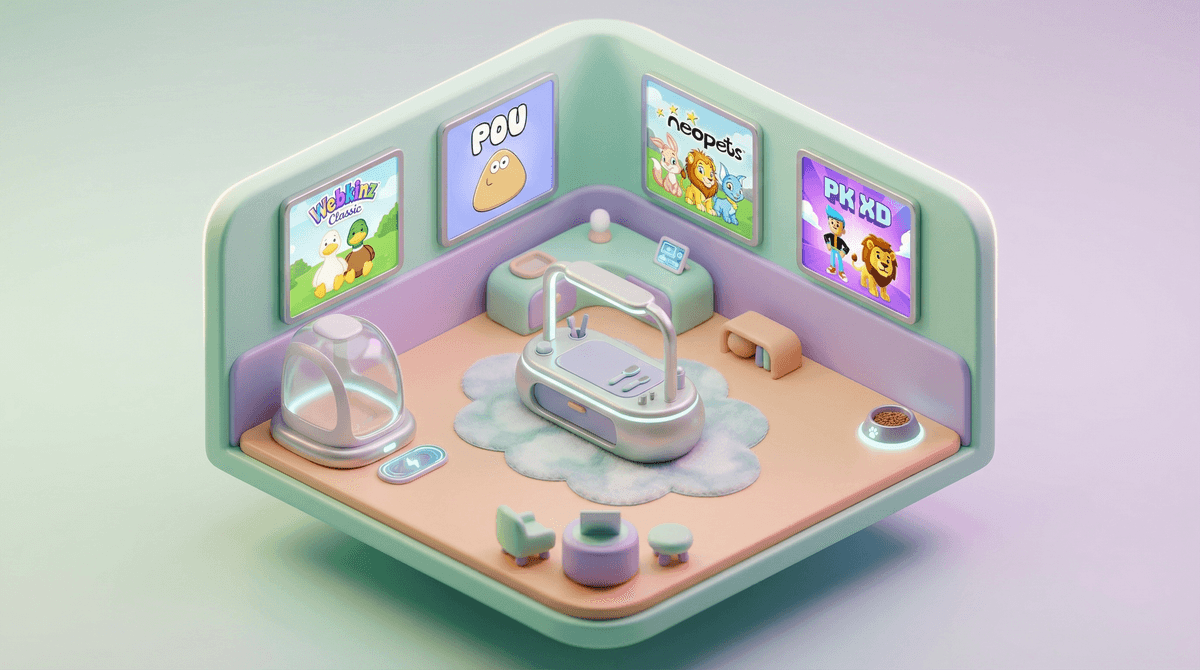
Virtual pet games are exactly what they sound like: digital versions of pet ownership where kids feed, care for, play with, and nurture creatures that exist entirely on screens. We're talking everything from the OG Tamagotchi keychain that traumatized millennials in the '90s (RIP to all the pets that died during math class) to modern juggernauts like Adopt Me on Roblox where kids are trading virtual pets worth actual hundreds of dollars.
The genre has exploded way beyond those little egg-shaped devices. Now we've got Webkinz, Neopets (yes, still somehow alive), [My Talking Tom](https://screenwiseapp.com/media/my-talking-tom-game, Pou, and dozens of mobile apps where the entire gameplay loop is: get pet, feed pet, dress pet, repeat. Some are single-player experiences, others are massive multiplayer worlds where the social dynamics get... intense.
Let's be real: virtual pets hit every dopamine button in a developing brain. They offer:
Nurturing without consequences - Your kid can experience the satisfaction of caring for something without the reality check of a real hamster dying because they forgot to feed it for three days. (Though honestly, some of these games do guilt-trip kids with sad animations when pets are "hungry" or "lonely.")
Collection and completion - Most virtual pet games are basically Pokémon logic: gotta catch 'em all. There are rare pets, legendary pets, seasonal pets, pets you can only get by trading. For kids who love organizing, categorizing, and completing sets, this is catnip.
Social currency - In games like Adopt Me, your pets ARE your status. Having a Neon Frost Dragon or a Mega Shadow Dragon isn't just cool, it's like showing up to school in a Lamborghini. Kids are literally negotiating trades during recess that would make Wall Street traders sweat.
Low-stakes responsibility - These games scratch the "I want a pet!" itch without parents having to scoop litter boxes. Kids get to feel like they're being responsible and caring, which is developmentally important, even if it's for pixels.
Here's where virtual pet games get spicy: the in-app purchases are RELENTLESS.
Most of these games are free to download, but they're designed to make kids want to spend. We're talking:
- Premium currency to buy rare pets or speed up breeding
- Cosmetic items (because your virtual cat NEEDS that superhero cape)
- Subscription services for exclusive content
- Loot boxes or eggs where you don't know what you're getting
Adopt Me alone has generated over $1 billion in revenue. That's not from adults—that's from kids begging parents for Robux to buy virtual pets. Some kids are spending $20, $50, even $100+ on these games.
The uncomfortable truth: These games are specifically designed to make the free experience feel incomplete. Your kid will absolutely feel like they're missing out if they don't have premium pets. That's not an accident—it's the business model.
The million-dollar question parents ask: "Is this teaching my kid responsibility or just screen addiction?"
The optimistic take: Yes, virtual pet games can teach some legitimate skills:
- Routine and consistency (logging in daily to care for pets)
- Resource management (budgeting in-game currency)
- Delayed gratification (saving up for rare pets)
- Basic empathy and nurturing behaviors
The realistic take: These games teach a version of responsibility that conveniently disappears when you close the app. Real pets need care when it's inconvenient. Real pets get sick, make messes, and don't have a pause button. If your kid can't remember to put their dishes in the sink, a Tamagotchi isn't going to fix that.
That said, for younger kids (ages 5-8), virtual pets can be a decent stepping stone to understanding what pet ownership involves—just don't mistake it for the real thing.
Ages 5-7: Stick with simpler, single-player games like [My Talking Tom](https://screenwiseapp.com/media/my-talking-tom-game or Pou. These have minimal social features and straightforward care mechanics. Perfect for kids who just want something cute to tap on.
Ages 8-10: This is prime Webkinz or basic Adopt Me territory. Kids can handle more complex gameplay but still need supervision around social interactions and spending. Set up parental controls and have conversations about not sharing personal info with strangers.
Ages 11+: Older kids can navigate the more complex social dynamics of multiplayer pet games, but they're also more susceptible to FOMO and peer pressure around rare pets. This is when you need to have real conversations about digital spending and in-app purchases .
.
Set spending limits BEFORE they start playing. Use parental controls, gift cards with set amounts, or require approval for all purchases. Don't hand over your credit card and hope for the best—these games are designed by people who understand behavioral psychology better than you do.
Talk about the business model. Explain that these games are free because they want you to spend money later. Help your kid understand when they're being marketed to. "Do you actually want that pet, or does the game just make you feel like you need it?"
Monitor social interactions. Many virtual pet games have chat features where kids interact with strangers. Check privacy settings, use restricted chat modes when available, and have regular conversations about online safety. Here's how to set up safety features in Roblox games like Adopt Me.
Use it as a stepping stone, not a substitute. If your kid is obsessed with virtual pets, that might be a sign they're ready for real pet responsibility—even if it's just a goldfish or helping care for a family pet. Or it might mean they just like games, which is also fine.
Set time limits. These games use daily login rewards and limited-time events to keep kids coming back constantly. Decide together on reasonable play times and stick to them.
Virtual pet games aren't inherently good or bad—they're tools that can teach some legitimate skills or become expensive time sinks depending on how they're used. The Tamagotchi your kid plays with today is wildly different from the one you had in 1997, mostly because now it's connected to the internet, other players, and your credit card.
These games can be genuinely fun and even educational in moderation, but they require active parenting. You can't just hand your kid a device with Adopt Me installed and assume they'll learn responsibility. You need to be involved, set boundaries, and have ongoing conversations about money, social dynamics, and when to close the app.
If your kid is begging for a virtual pet game, it's not the end of the world—but it's also not a babysitter or a substitute for real-world responsibilities. Treat it like any other game: set limits, stay involved, and don't be afraid to pull the plug if it becomes a problem.
And maybe, just maybe, consider getting them a real pet instead. At least goldfish don't have loot boxes.
- Check out our guide on Roblox parental controls if your kid plays Adopt Me
- Explore alternatives to virtual pet games if you want something less purchase-heavy
- Learn more about teaching kids financial literacy through gaming