

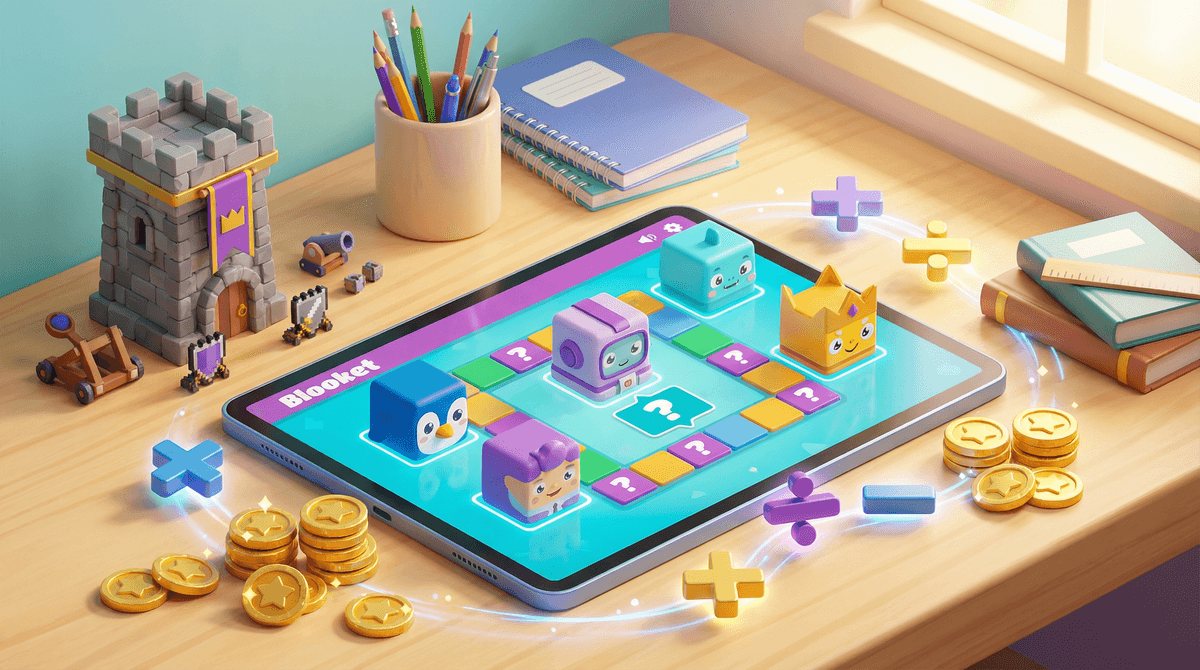
Using Blooket to Boost Homework Motivation: A Parent's Guide
If you've ever watched a kid go from "I don't want to study, this is so boring" to "five more rounds, I'm SO close to a legendary Blook," you've witnessed the Blooket effect. The platform's specialty is making rote review (math facts, vocab, history dates, science terms) feel like a game. For homework-resistant kids, this is genuinely useful — when it's used right.
TL;DR: Blooket works for homework motivation when (1) the question set actually matches what they're supposed to be studying, (2) the session is time-bound (15-25 min), and (3) you treat it as a study tool, not free time. Sign up for a free Blooket teacher account, host a game with the right questions, and let the gamification do its thing. Avoid using public/random Blooket sets as homework substitute — kids will play for an hour and not retain any of it.
Two things going on:
1. Reframing. A kid who hates "doing math homework" can be totally fine "playing Tower Defense, where you answer math questions." Same content, different wrapper. For elementary and middle school kids, this reframe genuinely helps.
2. Active recall. The actual learning science is real here — getting questions right and wrong, in fast cycles, is one of the most effective forms of practice. (Better than passive reading, better than highlighting.) Blooket happens to package active recall in a format kids opt into instead of resist.
The win condition: homework that would have been a 30-minute slog with tears becomes a 20-minute Blooket session that's net learning, not net frustration.
The risk: it's easy for the gamification to outrun the learning. We'll cover that.
Routine A: "Test Tomorrow" Cram Mode
Best for: any subject with a unit test in 1-2 days.
- Find or build a Blooket set that matches the test material. For most middle/elementary topics, there's a community-made set already. Search blooket.com for the chapter or unit. Verify it covers the right material before using it.
- Host a game in Tower Defense, Café, or Gold Quest mode. Pick what your kid likes — but stick to the calmer modes for studying (Battle Royale will pull all attention to "winning," not learning).
- 20-25 minutes. Set a timer.
- Brief debrief after. "What questions did you miss?" If they can't tell you, the game was play, not study. Adjust next time (slower mode, fewer questions, more focus).
Routine B: "Daily Review" for Math Facts or Vocab
Best for: ongoing skill practice (multiplication facts, sight words, foreign language vocabulary).
- Build one set per skill area — multiplication 1-10, weekly spelling list, etc. (Or find/import one.)
- Daily 10-15 minute sessions. Same set, repeated, until the kid is hitting 90%+ correct on speed runs. Then move to the next set.
- Solo mode is fine here. Your kid can play these on their own; the dashboard reports tell you how they're doing.
This is where Blooket genuinely beats traditional flashcards or worksheet drilling — the repetition is built into the format and the kid doesn't experience it as repetition.
Routine C: "Review After Reading" for History or Science
Best for: subjects that involve reading textbook material or watching a lesson, then applying it.
- Kid reads or watches the lesson first. No Blooket yet — the platform isn't built for teaching content, only reinforcing it. (For teaching content, Khan Academy is a better tool.)
- Then host a 15-20 min Blooket session on the material they just covered.
- Misses become next-day priorities. If they got 5 questions wrong, those 5 questions become the focus next time.
This is the highest-impact use of Blooket for homework — recall practice on material they've actually been taught.
A few patterns that fail predictably:
"Blooket = homework done." Letting your kid play any random Blooket as a substitute for actual homework is a trap. They'll play for an hour, not retain anything specific to their assignment, and the "homework done" claim won't survive a Tuesday test.
Public Blooket games for studying. When kids join public games hosted by random Blooket users, the questions are whatever the host picked — often not aligned with anything your kid is studying. Fun, but not study.
No time limit. The platform is well-tuned to keep kids playing. Without a timer, "20 minutes of studying" becomes 60 minutes, and the marginal learning per minute drops fast after the first 25-30.
The collection loop becomes the goal. If your kid is talking more about the Blooks they want than the questions they answered, Blooket has shifted from study tool to game. Reset by switching to teacher-only sets and shorter sessions.
For more on the "looks like studying, isn't studying" trap, see our guide on when kids game the system in educational apps.
Blooket alone won't carry studying; pair it with:
- Khan Academy: for the actual content delivery (especially math and science)
- Quizlet: for flashcard-style memorization with adaptive Learn mode
- A real practice problem set (from the textbook or workbook): for actually testing whether the Blooket review carried over
A high-leverage pattern for older kids: 30-min Khan Academy lesson → 15-min Blooket review → 10-min real practice problems. That's a study session that actually moves the needle.
Ages 6-8 (elementary): sit with them. Read questions out loud if needed. Stick to teacher-assigned or you-vetted sets. Sessions under 20 min.
Ages 9-11 (upper elementary): can run Blooket independently with your dashboard for visibility. 15-25 min sessions. Routines A and B work great.
Ages 12-14 (middle school): can self-direct. The risk shifts from "they'll get distracted" to "they'll game the system" — playing easy public sets to look like they're studying. Trust but verify via dashboard.
Ages 15+: Blooket starts feeling young. Quizlet, Anki, and Khan Academy usually serve high schoolers better. Blooket can still work for pure-fact subjects, but most of the homework load by then is analytical.
Scenario: Test on Friday, kid hates rote memorization, parent has Blooket dashboard set up.
Monday: Find a "US states and capitals" public set; vet it for accuracy; host in Café mode for 15 min. Score: 16/50.
Tuesday: Same set, Tower of Doom mode, 15 min. Score: 28/50.
Wednesday: Same set, kid asks for Battle Royale (more fun). 20 min. Score: 38/50.
Thursday: Solo mode for 15 min. Score: 47/50.
Friday morning: Kid scores 49/50 on the actual school test.
That's an aggressive use case (one kid, one test, one tool), but it's the platform doing what it's good at — turning rote memorization into a thing kids volunteer for.
A few kid-types where Blooket isn't the right move:
- The kid who's anxious about competition. The leaderboard pressure can backfire. Calmer game modes help, but if losing rounds creates real distress, a non-game tool like Quizlet's Learn mode is gentler.
- The kid who needs the content explained, not reviewed. If your kid genuinely doesn't understand the material, Blooket isn't going to help — they need teaching first. Khan Academy or a tutor.
- The kid who hyper-focuses on the gamification. If they're spending more energy on the game mechanics than the questions, it's not working. Switch tools or switch to short, supervised sessions.
For more on knowing when game-based learning has crossed from helpful to overstimulating, see our guide on when gamification replaces real learning.
The signs Blooket is doing its job:
- Test scores improving. Not Blooket scores. School scores.
- Kid wants to study. They're asking for Blooket review sessions instead of resisting them.
- Time-on-platform doesn't keep growing. A platform that's helping them learn means they need it less, not more, as they master content.
- They can articulate what they're learning. "I'm learning state capitals" beats "I'm playing Blooket."
The signs it's not:
- Test scores aren't moving despite hours on Blooket
- They're playing Blooks they want instead of subject material they need
- Sessions keep getting longer
- They couldn't tell you a single thing they learned in the last session
If the second list is your reality, switch the routine — different sets, shorter sessions, or different tool entirely.
Q: Can Blooket replace traditional homework?
Sometimes — for review-heavy assignments (vocab, math fact drilling), Blooket can fully substitute and often outperform worksheet practice. For analytical work (writing, problem-solving with explanation), it can't replace the actual thinking required.
Q: What's the best Blooket mode for homework?
For studying specifically: Tower of Doom, Café, and Gold Quest are calmer and keep more focus on the questions. Save Battle Royale and Crypto Hack for free-play time, not study time.
Q: How long should a Blooket study session be?
15-25 minutes for elementary, 20-30 for middle school. After 30 minutes, learning per minute drops sharply and the gamification starts crowding out content.
Q: Will my kid actually retain what they learn on Blooket?
When the question set matches what they're studying, when sessions are time-bound, and when they're focused on questions rather than just chasing tokens — yes, the active recall is genuinely effective. When any of those break down, they'll play a lot and learn little.
Q: Is it okay to give Blooket as a reward?
Sure, but if it's a reward for finishing homework rather than a way of doing homework, you're using it as screen time, not study. Both are fine, just be honest about which.
Blooket is a legitimate study tool for the homework types it's built for: rote review, fact recall, vocabulary, basic problem-solving with clear right answers. The trick is structuring it like study (right question set, time-bound, target-aligned) rather than letting it become recreational. With that structure, it can turn a kid who hates studying into a kid who's done their review without realizing they did it. Without that structure, it's an entertaining time-sink.
For more, see our parent guide to Blooket, parental controls setup, and how to monitor Blooket usage at home.

Start here: The parent's guide to Blooket — the full overview, with what Blooket actually is, what it isn't, and how it fits across ages.
Also relevant: