

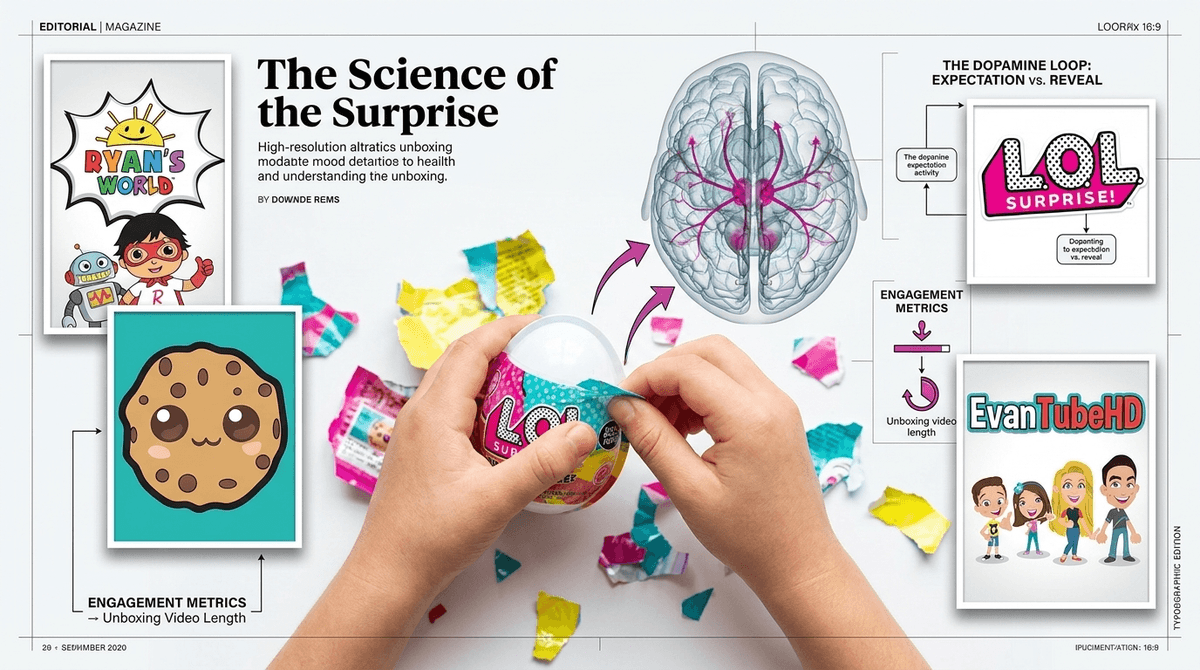
TL;DR: Unboxing videos aren't just "toy porn"—they are precision-engineered dopamine loops that exploit how a child's brain processes anticipation. While they seem harmless, they blur the line between entertainment and advertising.
- Quick Links: YouTube Kids | Ryan's World | CookieSwirlC | How to handle "I want that" tantrums
If you’ve ever found yourself staring at the back of your kid’s head while they watch a grown adult’s hands slowly peel plastic off a "surprise egg" for twenty minutes, you’ve probably asked yourself: Why?
It’s not just you. Unboxing videos are a multi-billion dollar industry. We’re talking about channels like Ryan's World (formerly Ryan ToysReview), which turned a kid opening boxes into a global empire, or the ASMR-heavy toy play of CookieSwirlC.
To us, it looks like brain rot. To a kid, it’s a high-octane hit of anticipation. If your kid is obsessed with these, it’s not because they’re "spoiled" or "materialistic"—it’s because their brain is being hacked by some very specific psychological triggers.
At their simplest, unboxing videos are exactly what they sound like: someone takes a product out of its packaging and demonstrates how it works. On the "adult" side of YouTube, this looks like tech reviewers unboxing the new iPhone.
But for kids, it’s a whole different beast. It’s often focused on "blind bag" toys—think L.O.L. Surprise! or Mini Brands—where the "surprise" is the entire point. The videos feature high-energy narration, bright colors, and the satisfying sounds of crinkling plastic and clicking parts.
It’s easy to write this off as "weird kid stuff," but there is actual neurobiology at play here.
1. The Dopamine of Anticipation
In psychology, there’s a concept called "Variable Ratio Reinforcement." It’s the same thing that makes slot machines addictive. You don’t know what is inside the box, but you know it might be something great. The brain actually releases more dopamine during the anticipation of the reward than during the reward itself. Kids are essentially "gambling" on the surprise alongside the creator.
2. Mirror Neurons
Humans are wired for empathy. When we see someone else experience joy, our "mirror neurons" fire, making us feel a version of that joy ourselves. When EvanTubeHD loses his mind over a rare toy, your kid’s brain is effectively piggybacking on that excitement. It’s a low-effort way for them to feel a "win."
3. The ASMR Factor
Notice how many of these videos have very crisp audio of paper tearing, boxes opening, and plastic clicking? That’s "Autonomous Sensory Meridian Response" (ASMR). For many kids, these sounds are physically soothing. It’s digital white noise that keeps them in a trance-like state.
Here is the "no-BS" reality: Unboxing videos are the most effective commercials ever created.
Back in the day, we had Saturday morning cartoons with 30-second ad breaks. We knew when the show ended and the commercial began. Today, the show is the commercial. When a creator like Ryan's World spends ten minutes playing with a new set, there is no "clear break" in the entertainment.
This creates a "parasocial relationship." Your kid thinks the YouTuber is their friend. And when a "friend" tells you a toy is "so cool, you guys," that carries way more weight than a faceless corporate voiceover. It’s stealth marketing, and it’s incredibly hard for a 6-year-old’s developing brain to filter.
Not all unboxing is created equal. If your kid is going to watch, here’s how to steer them toward content that has at least a shred of value.
Ages 5+ While it’s still toy-centric, she often uses the toys to act out elaborate stories. It’s more like digital dollhouse play than a straight-up sales pitch. It encourages imaginative play, even if it does trigger the "I want that" reflex.
Ages 4-10 If your kid loves the "reveal" aspect of unboxing, pivot them here. Every episode features a "surprise" scientific reaction. It scratches the same itch for a "big reveal" but teaches chemistry and physics instead of consumerism.
Ages 10+ For older kids who are obsessed with the "business" of toys, this is a great reality check. It shows the history and marketing behind the things they buy, moving them from "consumer" to "informed viewer."
Ages 4+ The "reveal" here is the finished drawing. It’s active rather than passive. If they want to see something being "made" or "opened," let it be a project they can actually do.
Check out our guide on the best YouTube channels that aren't brain rot
Unboxing is generally "safe" in terms of gore or language, but there are specific things to watch out for:
- The "Uncanny Valley" Channels: Beware of channels with millions of views that feature generic, non-speaking hands opening eggs with weird, repetitive nursery rhymes in the background. These are often AI-generated or mass-produced in "content farms" and offer zero educational value.
- Hidden Ads: Look for the "Includes Paid Promotion" banner. If it’s not there, but the creator is acting like a toy is the greatest thing since sliced bread, they’re likely being paid under the table or sent free products.
- The "Ohio" Factor: If the video feels "weird" or "off" (what the kids might call "Ohio" or "skibidi" in a negative sense), trust your gut. Some of these channels use bright colors to mask very strange, repetitive, or even slightly inappropriate themes to bypass YouTube Kids filters.
You don't have to ban these videos (unless you want to—no judgment here), but you should talk about them.
- Explain "The Hook": Tell them, "The person in the video is being paid to make that toy look as fun as possible. Their job is to make you want to buy it."
- The "One Week" Rule: If they see a toy in an unboxing video and must have it, tell them you'll put it on a list. If they still want it in a week after the dopamine from the video has worn off, then you can talk about chores/allowance. Usually, they’ll have forgotten it by Tuesday.
- Identify the "Acting": Point out the over-the-top reactions. "Do you think he's really that surprised, or is he acting for the camera?" This helps build media literacy.
Unboxing videos are the digital equivalent of eating a giant bag of Skittles. A little bit is a fun rush; too much and you've got a behavioral "sugar crash" and a kid who thinks happiness is found at the bottom of a plastic ball.
If your kid is deep in the unboxing hole, don't panic. They aren't broken; they're just human. Use it as an opportunity to talk about how ads work and why our brains love surprises. Then, maybe suggest they go make their own "unboxing" video with their old toys—you'd be surprised how much that shifts them from "passive consumer" to "creative director."
- Check the stats: See what percentage of kids in your grade are watching Ryan's World

- Set some boundaries: Read our guide on setting YouTube time limits
- Find alternatives: Explore the best creative apps for kids