

The Ultimate Guide to Finding Jesus Movies for Family Movie Night
TL;DR: Finding quality Jesus movies that work for your family means matching content to your kid's developmental stage, not just their age. Animated films like The Star work great for elementary kids, while middle schoolers might connect more with The Chosen. High schoolers can handle the intensity of The Passion of the Christ if that aligns with your family's approach. Skip the ones that feel like Sunday school filmstrips—there are actually some solid options out there.
The faith-based film industry has come a long way from the VeggieTales era (though honestly, VeggieTales still holds up). But navigating the world of Jesus movies is genuinely tricky because the quality spectrum is wide—from genuinely moving cinema to what can only be described as well-intentioned but unwatchable.
Here's what makes this harder than picking a regular family movie: you're balancing theological accuracy, production quality, age-appropriateness, and whether the film will actually spark meaningful conversations or just put everyone to sleep. Plus, some Jesus movies lean heavily into the suffering (looking at you, Passion films), which might be too intense for younger viewers but exactly what older teens need to grapple with.
Jesus movies aren't just religious content—they're often a family's entry point into discussing complex topics: sacrifice, justice, forgiveness, death, and what it means to stand up for your beliefs. A well-chosen film can open up conversations that might otherwise feel awkward or forced at the dinner table.
But a poorly chosen one? You're stuck watching wooden acting and cringe dialogue while your 10-year-old asks if they can go play Minecraft instead.
This animated nativity story told from the animals' perspective is legitimately charming. It's funny without being irreverent, the animation quality is solid, and it doesn't talk down to kids. The nativity story stays intact while making it accessible for young viewers who might zone out during traditional retellings.
Best for: Kids who loved Encanto or other modern animated films. Ages 4-9.
Technically this is Moses, not Jesus, but it's one of the best biblical films ever made, full stop. The animation is stunning, the music is incredible (that "Deliver Us" opening sequence hits hard), and it treats the story with genuine respect while being cinematically excellent.
Heads up: The plagues sequence and the Red Sea scene can be intense for sensitive kids. Ages 7+.
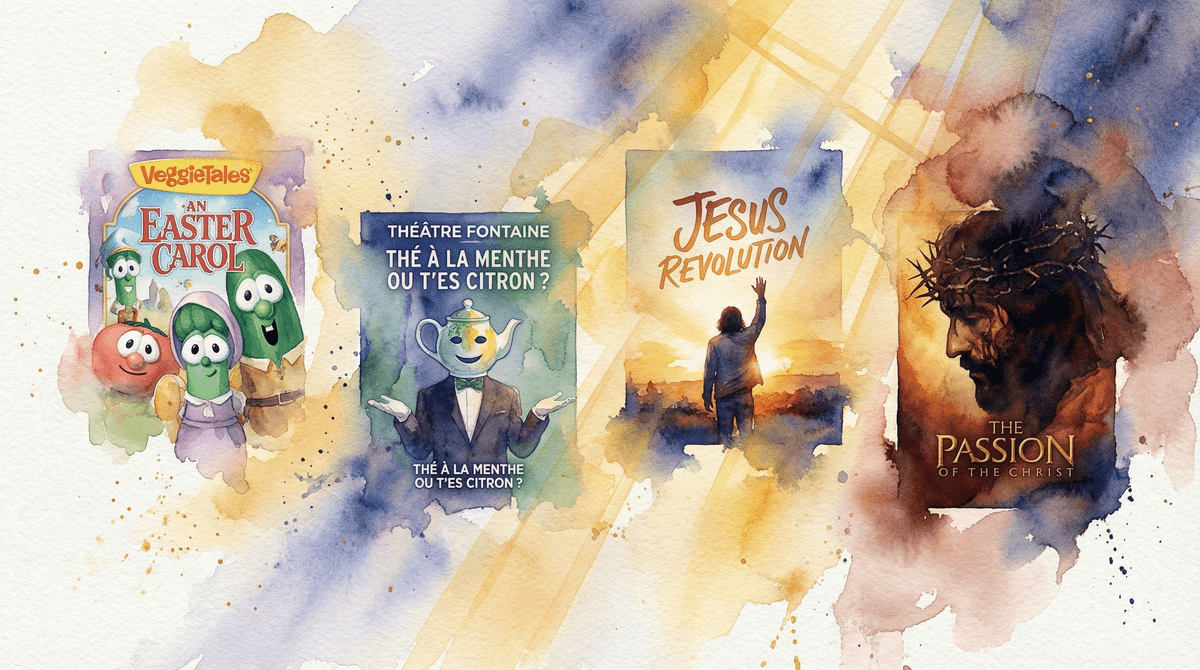
If you want something explicitly about Jesus's resurrection for younger kids, VeggieTales does it through allegory and humor. It's not a direct Jesus movie, but it communicates the Easter story's themes in a way that works for the 5-8 crowd without nightmares about crucifixion.
This multi-season series is the gold standard for Jesus content right now. It's well-acted, well-written, and treats the disciples as actual humans with personalities, doubts, and backstories. The production quality rivals mainstream TV, and it's free to stream.
Why it works for this age: Middle schoolers are starting to think more critically about faith. The Chosen shows Jesus interacting with real people in real situations, which makes the stories feel less like ancient history and more like something that happened to actual humans.
Binge warning: Each season is 8 episodes, roughly 45-60 minutes each. Plan accordingly.
This film imagines Jesus as a 7-year-old discovering his identity and powers. It's speculative (the Bible doesn't cover Jesus's childhood much), but it's thoughtfully done and can spark great conversations about what it might have been like for Jesus to be both human and divine.
Best for: Kids who like to ask "but what about..." questions. Ages 10+.
Mel Gibson's film is brutal, graphic, and not for younger viewers. But for high schoolers who can handle intense content, it's a powerful depiction of the crucifixion that doesn't sanitize the violence. Whether you show this to your teen depends entirely on your family's approach to graphic content and your teen's maturity level.
Real talk: This is rated R for a reason. The scourging scene alone is nearly unwatchable. If your teen can handle war movies or intense historical dramas, they can probably handle this. If they're sensitive to violence, skip it.
This is basically a condensed version of the miniseries "The Bible" that aired on History Channel. It covers Jesus's life from birth to resurrection in two hours. The production value is decent, and it's less intense than Passion while still being substantial enough for older teens.
Best for: Teens who want the full story without committing to a series. Ages 13+.
This 2023 film about the 1970s Jesus Movement in California is surprisingly good. It's less about Jesus's life and more about how a movement centered on Jesus transformed a generation. Great for teens interested in history, culture, or how faith intersects with social change.
Why it works: It acknowledges the messiness of faith, the complexity of church culture, and features characters who feel real rather than like cardboard cutouts.
God's Not Dead series: These films are less about Jesus and more about culture war talking points. If you want to watch Christians owning atheist professors, go ahead, but don't expect nuanced storytelling or compelling cinema.
Most pure-play Christian movies from 2000-2015: There was a rough decade where faith-based films had terrible production quality, wooden acting, and scripts that felt like they were written by people who'd never actually met a non-Christian. Some gems exist (Facing the Giants has its fans), but proceed with caution.
Left Behind: The Nicolas Cage version is unintentionally hilarious. The original Kirk Cameron version is just dated. If you want to discuss end-times theology, maybe just... have a conversation instead.
Ages 5-7: Stick with animated or allegorical content. Direct depictions of crucifixion are too intense. The Star and VeggieTales are your friends here.
Ages 8-10: You can introduce the full Jesus story, but choose versions that don't dwell on the violence. The Chosen works well because it focuses on relationships and miracles before getting to the crucifixion.
Ages 11-13: This is when kids can start handling more complexity—both in terms of content and theological questions. They can watch films that show suffering without being traumatized, and they're ready for stories that don't tie everything up neatly.
Ages 14+: Teens can handle adult content if it serves a purpose. The Passion of the Christ might be appropriate, or it might not be—you know your kid. What matters more is whether you're ready to process it together afterward.
Production quality matters: A poorly made film with a good message is still a poorly made film. Kids today are used to Marvel-level production values. If the acting is bad and the CGI looks like a video game from 2003, they'll check out mentally, and you've lost your chance for that meaningful conversation.
Theological differences exist: Some Jesus movies lean Catholic, some lean Protestant, some are more evangelical. The Chosen is pretty ecumenical, but films like The Passion of the Christ have distinctly Catholic elements. Know what you're showing and be ready to discuss differences if they come up.
Not all Jesus movies are about Jesus's life: Some, like Jesus Revolution, are about Jesus's impact on people and movements. These can be just as valuable for sparking conversations about faith in action.
Watch it first: Seriously. You don't want to discover mid-movie that it's way too intense, theologically problematic for your family, or just plain bad. Invest the time to preview, especially for younger kids.
Set it up: Don't just throw on a Jesus movie without context. Let your kids know what they're about to watch and why you chose it. "We're watching this because Easter is coming up and I thought it would be cool to see this part of the story" works better than surprise religious content.
Pause and discuss: You're not in a theater. If something confusing or intense happens, hit pause. "What do you think about that?" is a magic phrase.
Follow up the next day: The best conversations often happen after everyone's had time to process. Bring it up at breakfast or in the car: "I was thinking about that scene where..."
Connect to real life: "How would you react if someone asked you to give up something important for a friend?" beats "What did you learn about Jesus?" every time.
The best Jesus movie for your family isn't the most theologically accurate or the most expensive production—it's the one that matches where your kids are developmentally and opens up conversations you want to have.
For most families, The Chosen is the safest bet across age ranges because it's well-made, accessible, and gives you multiple entry points for discussion. But don't sleep on The Star for younger kids or Jesus Revolution for teens who think church is boring.
And if you pick one that turns out to be terrible? Laugh about it together and pick something else next time. The point isn't perfect movie selection—it's creating space for your family to engage with stories that matter to you.
Want more faith-based content recommendations? Check out Christian movies that don't make you cringe or explore faith-based books for different ages.